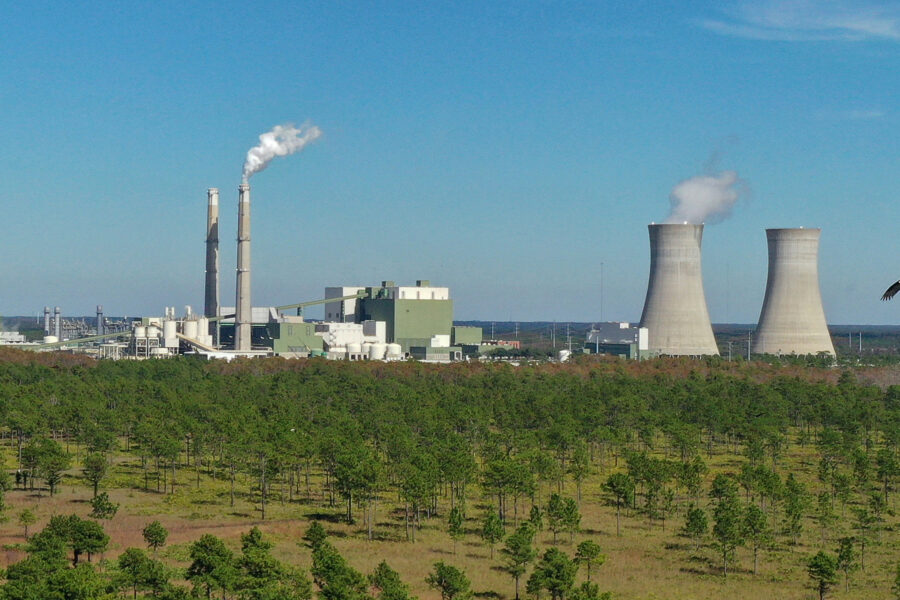
Three vetoes weren’t enough to make the Kansas Legislature rethink its push for building more coal-fired power plants.
Now lawmakers have a fourth veto to chew on – plus an imminent ruling from Washington that could make their legislative maneuvering moot, and signs that a key coal power player is losing interest.
In Washington, EPA Administrator Lisa Jackson is expected to issue a finding this week that greenhouse gases endanger the public health and welfare. The proposed finding passed its White House review yesterday, right on schedule, and it goes to the heart of the Kansas case.
Kansas Gov. Kathleen Sebelius, meanwhile, vetoed the state legislature’s fourth attempt to clear the way for Sunflower Electric to build two huge coal-fired power plants in the western part of the state.
Sunflower supporters in the legislature are still defiant and considering an override attempt, but it might not matter for two reasons: One is the EPA and the other is an important power customer.
Sunflower Electric’s plan hinges on selling the coal plants’ power to out-of-state utilities. The largest of those utilities, Colorado-based Tri-State Generation and Transmission, is having second thoughts.
At its annual meeting last week, Tri-State’s board of directors said it was re-evaluating its long-term strategy – including its support for new coal-fired power plants – because of the uncertainty surrounding future federal energy policies and the fragile state of the economy.
It listed areas where it planned to increase its investments instead: energy efficiency, renewable energy, natural gas and new technology put to use in the states it serves: Colorado, New Mexico, Wyoming and Nebraska.
“Part of our re-evaluation process will review how coal-based resources fit into our long-term resource plans,” said Ken Anderson, Tri-State’s executive vice president and general manager.
Anderson said the Sunflower plants could be a future option, but they are not a priority.
Sunflower Electric CEO Earl Watkins blamed the Kansas governor for Tri-State’s reaction and repeated his argument that without cheap coal power, electric prices will rise.
Under Sunflower’s plan, however, Kansas would end up with all the pollution and future CO2 liability from the two coal plants, but very little of the power. Only 200 of the 1,400 megawatts of power produced would actually be used in Kansas, the governor points out.
Sunflower’s own reports show that it doesn’t need the power, she wrote in her veto message. “We also know that President Obama is moving aggressively to regulate new carbon dioxide emissions." The two plants Sunflower want to build in Holcomb – plants that Watkins claims will be "the cleanest coal plants in the nation" – would pump out about 11 million tons of CO2 annually.
“What was a bad idea last year, is an even worse idea today,” Sebelius said.
The legislature got involved in the coal fight after Kansas Health and Environment Secretary Rod Bremby in 2007 became the first state official to refuse to issue an air permit for the two plants based on the potential danger posed by CO2.
To get around Bremby, the legislature has been trying to remove his office’s authority to regulate any power plant pollutants not regulated by the federal government. CO2 is not on the U.S. EPA’s list, at least not yet. The endangerment finding expected this week from Washington could turn that around.
The Kansas legislature returns in two weeks for its wrap-up session, and it will likely attempt to override the governor’s veto. After the past three coal plant vetoes, lawmakers have come as close as one vote from succeeding.
Sebelius is encouraging the legislature to look beyond the last century’s polluting power sources to a cleaner future and consider the state’s immense wind power potential and energy efficiency “as a way to stretch our power sources well into the future while creating thousands of sustainable Kansas jobs.”
Here is what the governor wrote in her veto message:
"Last year, I vetoed legislation that forced the Secretary of the Kansas Department of Health and Environment to issue air quality permits for two new coal fired plants which would produce 11 million tons of carbon dioxide each year. These new plants would generate 1400 megawatts of electricity, most of which would be exported to Colorado and Texas. In fact, Kansas would only get 200 megawatts of electricity, while we would get all of the new pollution.
"I vetoed that legislation because while the rest of the country was trying to reduce greenhouse emissions, Kansas would be creating massive new emissions for power we don’t need. Additionally, it appeared that federal legislation that would penalize new carbon dioxide emissions was on the horizon leaving Kansans vulnerable for years to come.
"The bill before me now attempts to take us down that failed path once again. What was a bad idea last year, is an even worse idea today. Now, we know that according to Sunflower Electric’s own reports, their customers will not need additional power until 2018. We also know that President Obama is moving aggressively to regulate new carbon dioxide emissions. These developments reaffirm that now is not the time for new coal plants in Kansas.
"Prior to the start of this legislative session, Lieutenant Governor Parkinson and I worked with utility stakeholders to develop a renewable portfolio standard that would have further developed the natural resource we have in wind energy. Our proposed energy legislation contained real net-metering so that Kansans would be fairly compensated for power they generated; we also included energy efficiency measures to reduce our future energy needs.
"We presented these proposals to the legislature, with the hope that the legislature would move towards a renewable energy economy creating thousands of jobs right here in Kansas. However, the legislature chose instead to sacrifice real comprehensive energy legislation in the pursuit of more coal-fired power plants.
"Despite what supporters of this legislation say, HB 2014 does little to advance clean, renewable energy. In fact, the renewable energy standards established in HB 2014 are less than the voluntary standards we already have today. The net metering provisions in the bill are weaker than any of the 42 states that currently offer net metering to utility consumers.
"Kansas needs legislation that will increase development of our renewable energy resources, increase energy efficiency measures and create good-paying jobs. Once again, as the rest of the country moves toward a renewable energy future, the legislature is intent on darkening Kansas’ energy future with new coal plants that will provide energy we don’t yet need.
"I encourage the legislature to abandon its efforts to saddle Kansas with massive new carbon dioxide emissions, and instead adopt a plan that will take advantage of our enormous wind assets and really look at energy efficiency as a way to stretch our power sources well into the future while creating thousands of sustainable Kansas jobs.
"Pursuant to Article 2, Section 14 of the Constitution of the State of Kansas, I veto House Bill 2014."
See also:
Kansas Lawmakers Ignoring Federal Signals in Latest Pro-Coal Push
Deja Vu: A Storm Brews in Kansas over Dirty Coal
Memo to Coal Power Industry: Regulations are Coming
About This Story
Perhaps you noticed: This story, like all the news we publish, is free to read. That’s because Inside Climate News is a 501c3 nonprofit organization. We do not charge a subscription fee, lock our news behind a paywall, or clutter our website with ads. We make our news on climate and the environment freely available to you and anyone who wants it.
That’s not all. We also share our news for free with scores of other media organizations around the country. Many of them can’t afford to do environmental journalism of their own. We’ve built bureaus from coast to coast to report local stories, collaborate with local newsrooms and co-publish articles so that this vital work is shared as widely as possible.
Two of us launched ICN in 2007. Six years later we earned a Pulitzer Prize for National Reporting, and now we run the oldest and largest dedicated climate newsroom in the nation. We tell the story in all its complexity. We hold polluters accountable. We expose environmental injustice. We debunk misinformation. We scrutinize solutions and inspire action.
Donations from readers like you fund every aspect of what we do. If you don’t already, will you support our ongoing work, our reporting on the biggest crisis facing our planet, and help us reach even more readers in more places?
Please take a moment to make a tax-deductible donation. Every one of them makes a difference.
Thank you,