To great media fanfare, Prime Minister Kevin Rudd has announced that Australia will build the "world’s largest" solar installation. To make it happen, he pledged a billion-dollar subsidy as part of the 2009-10 federal budget.
That investment is 10 times greater than Australia’s total funding commitment to solar to date.
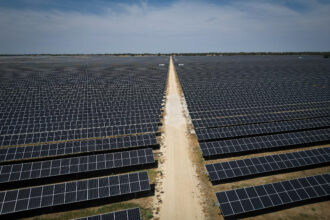
The facility will consist of four utility-scale solar plants. Two of them will be concentrated solar power (CSP) plants, or solar thermal, while two will use solar photovoltaics (PV). Together they will churn out a coal plant’s worth of electricity – up to 1,000 MW – or enough to power roughly 800,000 homes.
"Rather than to be solar followers worldwide we intend to be solar leaders worldwide," Rudd declared.
Truth time: If global leadership is the goal, then Australia has a long way to go.
Annually, the nation has the highest average amount of solar radiation per square meter of any continent on the planet, and nearly all of it is untapped.
A spattering of small PV plants exist and larger ones are planned, most notably a 154-MW facility by Solar Systems. The Australian-U.S. startup Ausra built a 1.5-MW pilot CSP site in New South Wales to pump solar-generated steam into a 2,000-MW coal plant.
But: There are no utility-scale CSP facilities up and running, or any on the near horizon. And they are what is needed.
CSP installations comprise fields of massive mirrors that concentrate the sun’s rays on a pipe or vessel, heating liquid that generates steam for conversion into power. The technology – decades old and a critical climate solution – could turn the world’s hottest deserts into a major source of electricity. Its greatest allure is that it can generate zero-carbon power, 24-7.
Lucky for Australia, its arid lands are one of the three best locations for CSP deployment on Earth – along with the Southwestern U.S. and the Sahara Desert in North Africa. Unlucky for its advocates down under, though, the U.S. and Spain lead the CSP market, while
Australia, which has solar resources equal to or stronger than either, isn’t even in the race yet.
That’s how DESERTEC-Australia, the Australian affiliate of the global DESERTEC network, explains it on their web site. The organization has published a set of proposals to tap the continent’s solar potential. In it, DESERTEC makes a stunning claim:
An Outback area 50 kilometers [or 21 miles] on a side covered with concentrating solar power mirrors could satisfy ALL of Australia’s electricity demand.
That’s not all. Take a look at the picture on the right, courtesy of DESERTEC. What it shows is that a field of mirrors spread over a chunk of Australia, 1,200 kilometers on each side (or 745 miles), could satisfy all of the world’s energy demand. Smaller desert pieces could power China, the U.S. and meet global electricity demand.
Of course, this is all hypothetical. What is actually possible now?
Worley-Parsons, Australia’s biggest engineering firm, claims that 34 250-MW CSP plants could be operating in Australia by 2020, according to its 2008 report, Advanced Solar-Thermal: Utility-Scale Renewable Power for Australia. The plants would meet half of the 20 percent renewable energy target that has been set by Rudd for 2020.
The ambitious program would need enormous private and government support, though – more than a billion-dollar budget line item. Don’t hold your breath for that to happen under Rudd, suggests Bill Parker, editor of Solar Progress, the online magazine of the Australian New Zealand Solar Energy Society. As he explained in an interview with SolveClimate:
Rudd came to power riding the crest of a wave of change. What he failed to do was clear out the old cadre of Howard advisors and therefore the connections with the coal industry. Coal rules on.
And while coal reigns supreme, clean energy continues to reel from unsteady government backing.
"Investors come here and see the climatic opportunity but not the solid government support," Parker said. "It’s on…off…on…off. It has been like that for as long as I have been writing on this (15 years)."
Coal currently accounts for 85 percent of Australia’s domestic electricity generation. The industry’s well-financed political influence is powerfully felt. It was certainly a factor in Rudd’s decision last month to delay his centerpiece cap-and-trade scheme for one year.
If you take a look at Rudd’s federal budget, then you’ll see it "cleaned up" there as well. Big Coal squeezed another $1.5 billion out of the public coffers for so-called clean coal technology – 50 percent more than is going into solar.
To understand why this is a problem, read this paragraph by DESERTEC:
Starting in 2010, much of the country’s clapped-out current coal-fired capacity will reach 40+ years of age. It will need replacement and carbon capture won’t be ready. Some other technology will have to be chosen. The only other choice is to allow old, dirty plants to continue to operate. But that could prove politically unpalatable.
CSP should be chosen. It has come of age, and it scales up well against the largest fossil fuel players, among a laundry list of other benefits that include solving global climate change and creating permanent green jobs.
Yes, Rudd’s solar boost announced yesterday was a step in the right direction. In fact,
"This is a huge step, not just in Australia but worldwide," said Bob Matthews, the Australian president of solar thermal company Ausra. "There are not any initiatives in the world this big and the government has put the money behind it."
But there is a question that needs answering: Is this solar pledge a billion-dollar beginning to something bigger from the Australian government, or is it just a one-shot deal?
Perhaps you noticed: This story, like all the news we publish, is free to read. That’s because Inside Climate News is a 501c3 nonprofit organization. We do not charge a subscription fee, lock our news behind a paywall, or clutter our website with ads. We make our news on climate and the environment freely available to you and anyone who wants it.
That’s not all. We also share our news for free with scores of other media organizations around the country. Many of them can’t afford to do environmental journalism of their own. We’ve built bureaus from coast to coast to report local stories, collaborate with local newsrooms and co-publish articles so that this vital work is shared as widely as possible.
Two of us launched ICN in 2007. Six years later we earned a Pulitzer Prize for National Reporting, and now we run the oldest and largest dedicated climate newsroom in the nation. We tell the story in all its complexity. We hold polluters accountable. We expose environmental injustice. We debunk misinformation. We scrutinize solutions and inspire action.
Donations from readers like you fund every aspect of what we do. If you don’t already, will you support our ongoing work, our reporting on the biggest crisis facing our planet, and help us reach even more readers in more places?
Please take a moment to make a tax-deductible donation. Every one of them makes a difference.