Rep. Rick Boucher (D-Va.) has been trying for the past year to get Congress to set up an independent corporation dedicated to clean coal development. He introduced the Carbon Capture and Storage Early Deployment Act (HR 6258), which provoked some hearings in 2008, but it went nowhere and died. So this spring he reintroduced the bill, virtually unchanged (HR 1689).
What happened next is further proof of the enormous leverage Boucher wields as a coal state Democrat in shaping national climate legislation.
His bill was incorporated wholesale as pages 52-75 into the American Clean Energy and Security Act of 2009 (ACES), the climate bill Reps. Henry Waxman and Ed Markey are shepherding through the House.
It fills section 114 of the Clean Energy Title of the Waxman-Markey bill, and it is a giant gift to the utility industry. It would create the Carbon Storage Research Corporation and funnel $10 billion to support the corporation over the next 10 years, with up to $500 million designated simply for “administrative expenses” to be spent at the discretion of its officers.
The most curious part is where all that money is going to come from. The answer: from every ratepayer who uses electricity, in the form of an almost invisible tax that would average 50-cents-a-month, conveniently referred to as an “assessment.”
Republican opponents of climate legislation have been telling the public that a cap-and-trade bill would impose a “light switch tax.” It was a witty and effective slogan used to scare voters during a recession.
The political irony is that Boucher, together with 20 co-sponsors including Republican climate-bashing Reps. Joe Barton and John Shimkus, have imposed a light switch tax of their own, with 100% of the proceeds earmarked as an enormous hunk of pork for coal-fired utilities.
“This is every industry’s dream – to have the proceeds of a monopoly tax dedicated entirely to your interests,” said Dan Greenwood, a professor of corporate finance and law at Hofstra University’s School of Law. “The money doesn’t need to be re-appropriated every year, all of it is dedicated to your industry, and your industry gets to decide on how the money is allocated.”
The purpose of the Carbon Storage Research Corporation is to “establish and administer a program to accelerate the commercial availability of carbon dioxide capture and storage technologies and methods” through “competitively awarded grants, contracts, and financial assistance.”
The corporation would be empowered to collect and spend $1 billion every year, and the bill says that “up to 5 percent of the funds collected in any fiscal year … may be used for the administrative expenses of operating the Corporation” (see page 62).
That’s $50 million a year in administrative expenses authorized for 10 years for the corporation, which for governance purposes is to become “a division or affiliate of the Electric Power Research Institute (EPRI).” EPRI is a non-profit that conducts research and development on electricity generation. Its members represent more than 90% of the electricity generated and delivered in the United States.
EPRI’s 2007 financial statements report total assets of $185 million, which would increase more than 25% with the addition of $50 million in administrative expenses. With the annual addition of the full billion dollar allocation over the next 10 years, the American Clean Energy and Security Act would increase the size of EPRI’s assets more than 50-fold.
There is no parallel provision in the Waxman-Markey bill to set up a federally created corporation within an existing non-profit or industry organization to support solar or wind energy development at such an astonishingly generous scale.
Less than a week after the Waxman-Markey bill was successfully voted out of the House Energy and Commerce Committee, EPRI announced the formation of a National Carbon Capture Center (NCCC).
PALO ALTO, Calif. – (May 27, 2009) – The Electric Power Research Institute (EPRI) announced today that it has joined with Southern Company, the U.S. Department of Energy (DOE) and four other companies in forming the National Carbon Capture Center (NCCC) for the development and testing of advanced technologies to capture carbon dioxide from coal-fired power plants.
The NCCC is located at the Power Systems Development Facility (PSDF), a research and development complex south of Birmingham, Ala., and will be managed and operated by Southern Company. Companies that will initially participate in the project also include American Electric Power, Luminant, Peabody Energy, and Arch Coal; others are expected to join the initiative as work progresses.
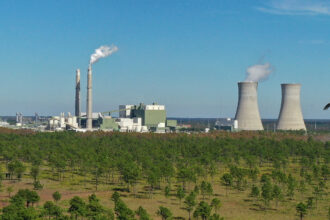
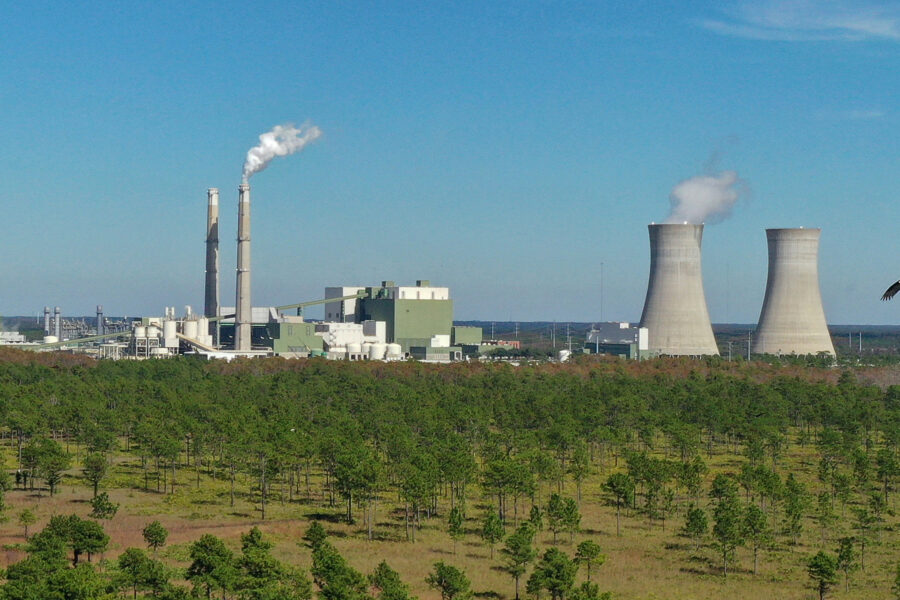
Adjacent to the PSDF is Southern Company’s subsidiary Alabama Power’s Plant Gaston, a coal-fired power plant that went into service in 1960. It will house new post-combustion testing and evaluation facilities of the center.
The Carbon Center would be a prime candidate to receive support from the Carbon Storage Research Corporation, which must distribute 50% of its billion dollar funds to early movers – “electric utilities that had, prior to the award of any grant under this section, committed resources to deploy a large scale electricity generation unit with integrated carbon capture and sequestration or conversion applied to a substantial portion of the unit’s carbon dioxide emissions.”
A call placed to Bryan Hannegan, EPRI’s VP quoted in the NCCC press release, was returned by Jeff Brehm of EPRI’s press office, who said that he didn’t know of “any expressed or implied connection” between section 114 of the Waxman-Markey bill and the new Carbon Center, and that he was “not aware of any discussion specific to that, either internally or externally.”
The Waxman-Markey bill sets minimum assessments per kilowatt-hour from various sources of fossil fuel that will provide the source of the annual billion-dollar Carbon Storage Research Corporation budget (see page 65).
Coal ………………………………………………………….. $0.00043
Natural Gas ……………………………………………….. $0.00022
Oil …………………………………………………………….. $0.00032
Since the average American uses 13,635 KWh of electricity a year (2005), the minimum assessment for coal-fired power would add less than $6 to an average person’s annual electric bill, less than 50 cents a month. A family of four would see a rise of less than $24 a year.
As the Waxman-Markey bill makes its way into the House Ways and Means Committee, which has jurisdiction over taxation and finance, section 114 is not expected to undergo any review, according to a Congressional staff member speaking on background.
The provision was structured for the Energy and Commerce Committee – where Boucher is a member – and no plans are in place to direct similar small assessments with huge cumulative impact to accelerate the development of solar, wind or other renewable sources of energy.
Technically, the assessments the Corporation would be authorized to collect are not a tax. That is because in order for the Carbon Storage Research Corporation to get set up, it must receive approval from two-thirds of the electricity generators in the country, who must agree to pay the assessments. Opposition is highly unlikely.
So in the eyes of the law, the collection of money looks like an industry self-assessment approved by a vote, but section 114 further stipulates (on page 72) that the utilities cannot be prohibited from recovering costs from ratepayers.
A distribution utility whose transmission, delivery, or sales of electric energy are subject to any form of rate regulation shall not be denied the opportunity to recover the full amount of the prudently incurred costs associated with complying with this section, consistent with applicable state or federal law.
If this program makes it through Congress and gets up and running without alteration, ratepayers will likely see a small new charge on their utility bills, called something like “federal clean energy assessment.”
See also:
Clean Energy Climate Bill Gives Coal a Competitive Future
Climate Bill Wins Enough Votes to Pass, But at What Cost?
Utilities, Coal-State Dems are Wrecking Our Last Chance on Climate Change
Coal Stocks’ Surge Mirrors Climate Bill Concessions
Greenpeace: We Cannot Support This Climate Bill
Official White House photo by Pete Souza
About This Story
Perhaps you noticed: This story, like all the news we publish, is free to read. That’s because Inside Climate News is a 501c3 nonprofit organization. We do not charge a subscription fee, lock our news behind a paywall, or clutter our website with ads. We make our news on climate and the environment freely available to you and anyone who wants it.
That’s not all. We also share our news for free with scores of other media organizations around the country. Many of them can’t afford to do environmental journalism of their own. We’ve built bureaus from coast to coast to report local stories, collaborate with local newsrooms and co-publish articles so that this vital work is shared as widely as possible.
Two of us launched ICN in 2007. Six years later we earned a Pulitzer Prize for National Reporting, and now we run the oldest and largest dedicated climate newsroom in the nation. We tell the story in all its complexity. We hold polluters accountable. We expose environmental injustice. We debunk misinformation. We scrutinize solutions and inspire action.
Donations from readers like you fund every aspect of what we do. If you don’t already, will you support our ongoing work, our reporting on the biggest crisis facing our planet, and help us reach even more readers in more places?
Please take a moment to make a tax-deductible donation. Every one of them makes a difference.
Thank you,