Renewable energy fueled by the sun, wind, plants and the Earth’s heat could contribute 10 percent of U.S. electricity by 2020 – all with the technology we have now – according to a new report by the U.S. National Academy of Sciences.
"For the time period from the present to 2020, there are no current technological constraints for wind, solar photovoltaics and concentrating solar power, conventional geothermal, and biopower technologies to accelerate deployment," the report states.
That point needs to be hammered over and over again: Clean energy technologies are ready for fast deployment today. And if plans are set in motion now, the result could be a 20 percent or more renewables share by 2035, the authors claim.
The chunky 316-page paper offers more proof that the problem of slow renewables deployment in America is not with technology, but with the political will to implement it.
Currently, the biggest barrier to widespread renewables adoption is cost – a result of short-sighted, industry-dominated national energy objectives. Simply put, in the absence of a price on carbon emissions and other stable policy incentives, clean energy remains far more costly to produce than fossil fuels.
This is not to say that major scientific advances won’t help to fast-track the country’s clean energy transition. They will. Have a look:
Currently, the U.S gets just 2.5 percent of its electricity from non-hydroelectric renewables. "Business as usual" would lead to 8 percent by 2030, according to U.S. Energy Information Agency projections.
Reaching the 10 percent mark in 10 years and 20 percent in 25 years won’t happen on its own. It will require increases in transmission capacity and other electric-grid improvements. But again, no technological breakthroughs are needed. The report explicitly states that advanced storage technologies are "not necessary" below 20 percent. But these government incentives are:
"Sustained, consistent, long-term policies that provide for production tax credits, market incentives, streamlined permitting, and/or renewable portfolio standards are essential …"
With such policies and economic enticements in place, the 20 percent target by 2035 is doable, the report maintains. Now, if the goal is to get a majority of the nation’s electricity from renewables post-2035, that’s a different story:
"Significant technological and scientific barriers must be surmounted if renewables are to provide upwards of 50 percent or more of domestic electricity generation in a reliable, controllable system that also has a low carbon emissions footprint."
The technologies that would be needed for that kind of massive clean energy ramp-up are largely unavailable or not yet developed. They include: large-scale and distributed cost-effective energy storage and new methods for cost-effective, long-distance electricity transmission.
On top of taking on technical prospects and impediments, the National Academy of Sciences delivered a careful scrutiny of America’s renewable resource potential. The findings will not surprise: It’s absolutely massive and untapped, especially for solar and wind energy.
According to the report, the nation’s solar resource provides a yearly average that exceeds the nation’s current annual energy demand by several thousand-fold. Which means that with even modest conversion efficiency,
solar energy is capable, in principle, of providing enormous amounts of electricity without stress to the resource base.
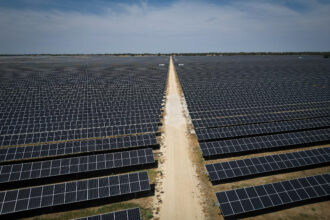
That’s especially true of the U.S. Southwest. And the authors affirm that in the region, concentrating solar power (CSP) systems are the way forward for low-cost, utility-scale clean electricity.
Using CSP, the Southwest could theoretically produce 15 million to 30 million GWh of electric energy per year. That’s substantially more than the 4.2 million GWh total U.S. electricity supply in 2007.
America’s land-based wind resource is capable of providing at least 10 percent to 20 percent of current electrical demand, the report finds. Although, in some areas that percentage is much higher.
A recent study by the U.S. Department of Energy (DOE) found that wind could contribute 20 percent of U.S. electricity by 2030. That would require 100,000 wind turbines, $100 billion of additional capital investments and transmission upgrades, and employees to fill 140,000 jobs.
The scale of such an effort would be huge. But it did not stop the panel from concluding that it is, in fact, feasible.
Same story with geothermal energy. According to an influential DOE-funded MIT report, the availability of the geothermal resource base is 130,000 times America’s current yearly consumption of energy.
The MIT researchers arrived at a way to tap it, using Enhanced Geothermal Systems (EGS). For $800 million to $1 billion in R&D funding, spread out over 15 years, EGS could be deployed on a scale that would produce more than 100,000 MW of additional new capacity in the U.S. by 2050.
The point is this: Renewable energy is there for our taking and is practically infinite. The notion that we cannot implement it on a utility scale without technological breakthroughs in the sector is dead wrong.
What will be? America’s future climate and energy law is working its way through the U.S. House of Representatives right now. What an opportunity to realize the clean energy vision laid out by the National Academy of Sciences, and countless other, even more ambitious, reports.
Unfortunately, the bill has been weakened to the point of being practically ineffective on renewable energy (see here, here and here). And it could die altogether, largely because good intentions on solving the climate problem were, again, not fortified by political will.
See also:
Breakthrough: Concentrated Solar Power All Over Southwest US
Solar Plan Would End Dependence on Foreign Oil for Cost of Iraq War
Wind Would Power 20% of America
Desert Solar Could Meet 25% of World’s Power Needs by 2050
About This Story
Perhaps you noticed: This story, like all the news we publish, is free to read. That’s because Inside Climate News is a 501c3 nonprofit organization. We do not charge a subscription fee, lock our news behind a paywall, or clutter our website with ads. We make our news on climate and the environment freely available to you and anyone who wants it.
That’s not all. We also share our news for free with scores of other media organizations around the country. Many of them can’t afford to do environmental journalism of their own. We’ve built bureaus from coast to coast to report local stories, collaborate with local newsrooms and co-publish articles so that this vital work is shared as widely as possible.
Two of us launched ICN in 2007. Six years later we earned a Pulitzer Prize for National Reporting, and now we run the oldest and largest dedicated climate newsroom in the nation. We tell the story in all its complexity. We hold polluters accountable. We expose environmental injustice. We debunk misinformation. We scrutinize solutions and inspire action.
Donations from readers like you fund every aspect of what we do. If you don’t already, will you support our ongoing work, our reporting on the biggest crisis facing our planet, and help us reach even more readers in more places?
Please take a moment to make a tax-deductible donation. Every one of them makes a difference.
Thank you,