By the middle of next year, the nine campuses that make up the nation’s largest community college system plan to be completely energy self-sufficient.
It’s a huge step, and it will begin saving money immediately.
The Los Angeles Community College District (LACCD) started down this path in 2001, the year voters approved the first part of $5.7 billion in bond funding to renovate the campuses.
The LACCD Board of Trustees was thinking about much-needed modernization work and its first new construction in 35 years, but it was also thinking ahead. It passed a sustainable building policy mandating that all new buildings that use 50% or more of bond funding be LEED certified. The board had previously developed a renewable energy plan that aimed for a minimum 10% renewable energy standard.
At the time, the trustees were afraid that anything beyond that would be too costly, says Larry Eisenberg, executive director of Facilities, Planning and Development for the LACCD.
The system’s chancellor and the implementation team saw greater potential, though.
They looked at the campuses’ energy costs – around $9 million a year, growing to $10 million by 2010 – and realized that ramping up renewable power would be a money-saving move. The chancellor at the time, Darroch “Rocky” Young, adopted the 100% renewable energy goal as a budgetary measure.
“What began as an environmental policy turned into a budget initiative,” Eisenberg says, “and that’s where it’s been ever since.”
Voters helped things along last fall when they passed Measure J by 70%, allowing for a further bond issue for renewables and other building and infrastructure needs to make the campuses sustainable.
“This policy action has been supported by the voters in three bond measures since 2001. It demonstrates that when the public knows what it is getting for passing bond funds … it will support such measures,” reflects the project’s energy director, Woodrow “Woody” Clark, a Nobel Prize co-recipient for his work with the United Nations Intergovernmental Panel on Climate Change (IPCC) from 1995-2000.
With each campus having a demand base load of 4 to 6 Megawatts, energy independence is no small commitment.
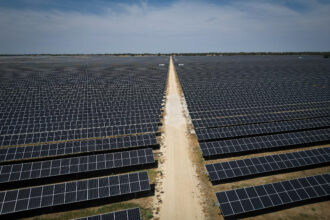
The campuses are using some wind and geothermal energy systems, but they will primarily be turning to solar photovoltaics due to lower costs.
All new buildings will be ‘zero energy’ so that they don’t add to the base load demand. And in preparation for the electrification of America’s fleet, the campuses are installing solar-powered electric re-charging stations for cars and trucks.
The colleges are not going completely off the grid, however, even though they plan to be in a position to do so by mid-2010. That’s because Southern California Edison buys their surplus electricity which brings in money for the District. It isn’t much, Eisenberg says, but it adds to the overall benefits of switching to renewable power.
The LACCD originally hoped to switch to 100% renewable energy by 2008, but the goal was pushed back, in part due to the complications of having campuses spread across two utility companies.
Two large campuses in the Southern California Edison (SCE) area are undergoing solar installations right now, including the East LA Campus (ELAC), which has been producing 1.2 MW in renewable energy since May of 2008, and a third is on track to begin. But the six campuses that receive their energy from the Department of Water and Power (DWP) have been waiting for final rebate program decisions before proceeding. Those decisions are expected within weeks.
Financing Model is Key to Success
LACCD’s financing model is an important piece of the puzzle: It will allow the colleges to make the conversion to renewable energy without investing any money up front.
Banks are investing the capital, and the LACCD has agreed to pay back the loan with every kilowatt-hour by buying electricity out of the campus system for the next 25 years. Their rate for electricity will still be less than what they were paying the utilities, even with the capital cost, maintenance cost and bank profit margin rolled in.
The banks have the additional bonus of monetizing the depreciation of the equipment through tax write-offs, along with taking advantage of federal, state, local and utility incentives.
Eisenberg says that any entity, public or private, can do the same thing.
The LACCD is using a similar financing model for its energy efficiency measures, from which it hopes will reduce energy use by 15% to 20%.
Each campus has an ESCO (Energy Saving Company) that won the job in a bidding process. Among the nine campuses, there are five different companies including Chevron, Siemens and Ameresco. The ESCOs come in and do an investment-grade audit, recommending retrofits and other efficiency measures. They cover the cost of the upgrades, and the LACCD pays them back out of the energy savings achieved. The ESCOs guarantee a minimum amount of energy savings, so there’s almost no risk.
Community Colleges Leading the Way
“It’s interesting because people never thought of community colleges as being terribly innovative or cutting edge,” says Eisenberg. “We’ve demonstrated that we are. No one else is where we are in terms of renewables and financing. It’s made people stand up and take notice.”
The community college system has received recognition, and even signed a partnership with the Clinton Climate Initiative. It was also one of the first educational institutions to join the Climate Registry and the first community college district in the nation to report their greenhouse gases in accordance with the protocol set by the Registry.
“It goes back to the board of trustees in 2002,” Eisenberg adds. “They knew that someone needed to be first and provide a model that others can follow and that’s what this project is doing. It’s a model showing the technology and financing mechanism that anyone can use. It will hopefully lead to a rapid expansion of this technology across California and the U.S.“
The project has other benefits, as well, that go to the heart of its mission, as Eisenberg explains:
“It’s attracting students that want to learn about the technology and how to implement it. At the end of the day, we’re a learning institution and the more students we can train, the more of them will go out across the United States and implement this technology.”
Clark sees similar micro and macro importance to the project.
“The LACCD sees sustainable campuses as a key in the community for demonstrating how this can be done for other building complexes like shopping malls, office buildings, housing units, etc. and thus educating students, faculty and staff on the installation, operation and maintenance of renewable energy systems.
"Some scholars call this ‘The Third Industrial Revolution’, or how we – people all over the world – must change dramatically from ‘The Second Industrial Revolution’ that was totally dependent on fossil fuels, into an era that stops violating our environment.”
See also:
Start-Ups Rise to Push Solar on College Campuses
Interview with Nobel Prize Winner Woodrow Clark
Universities Start Tailoring Degrees to Green Jobs
About This Story
Perhaps you noticed: This story, like all the news we publish, is free to read. That’s because Inside Climate News is a 501c3 nonprofit organization. We do not charge a subscription fee, lock our news behind a paywall, or clutter our website with ads. We make our news on climate and the environment freely available to you and anyone who wants it.
That’s not all. We also share our news for free with scores of other media organizations around the country. Many of them can’t afford to do environmental journalism of their own. We’ve built bureaus from coast to coast to report local stories, collaborate with local newsrooms and co-publish articles so that this vital work is shared as widely as possible.
Two of us launched ICN in 2007. Six years later we earned a Pulitzer Prize for National Reporting, and now we run the oldest and largest dedicated climate newsroom in the nation. We tell the story in all its complexity. We hold polluters accountable. We expose environmental injustice. We debunk misinformation. We scrutinize solutions and inspire action.
Donations from readers like you fund every aspect of what we do. If you don’t already, will you support our ongoing work, our reporting on the biggest crisis facing our planet, and help us reach even more readers in more places?
Please take a moment to make a tax-deductible donation. Every one of them makes a difference.
Thank you,