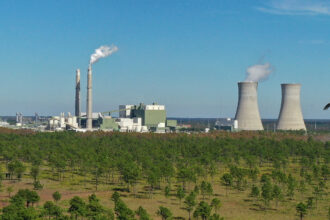
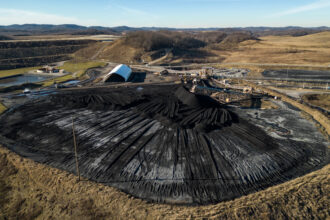
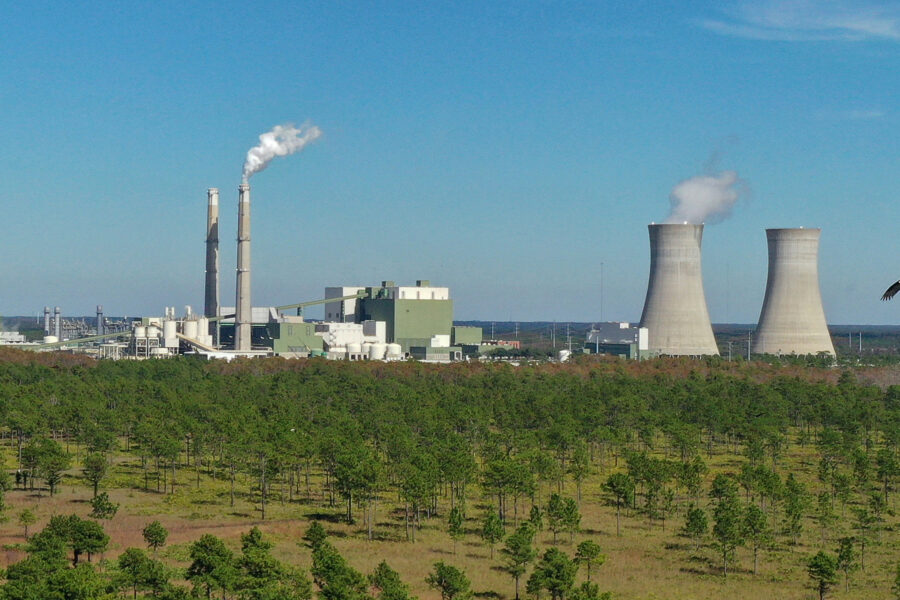
In Washington, it’s a popular climate conundrum everyone talks about: Even if the U.S. lowers its greenhouse gas emissions, China and India are on track to dwarf the entire western world’s as they build enormous coal-fired power plants. Politicians of all stripes regularly say we must get China and India to use less coal, the dirtiest of fossil fuels, to power their emerging economies.
But who do you think is financing all these new coal plants in the developing world?
Try the World Bank, the Asian Development Bank and other international public financial institutions supported by the world’s wealthiest nations.
That’s right. While the industrialized world is struggling to cut its emissions and gearing up to negotiate a new international climate treaty in Copenhagen this December, it is simultaneously bankrolling the construction of thousands upon thousands of megawatts of new coal-fired power in developing countries.
A study by Bruce Rich for the Environmental Defense Fund shows that international public financial institutions have provided $37 billion to finance the construction of at least 88 new coal plants in the developing world since 1994. What’s more, that $37 billion in direct financing secured another $60 billion or so from private and local sources, bringing total investment in new coal plants in developing nations to over $100 billion.
Even worse, the World Bank classifies these coal plants as "low carbon" financing projects if they are the so-called supercritical type with marginally better CO2 emissions rates.

Collectively, those 88 coal plants (see map) will pump out 792 million tons of CO2 a year — essentially negating pollution reductions the Waxman-Markey climate bill hopes to achieve over the next decade. The bill was approved last month in the House and is now up for debate in the Senate.
Bear in mind that 88 is a minimum number because most export credit agencies do not release detailed information on transactions and only plants for which the financing could be verified were included in EDF’s study.
If you’re wondering why 1994 is the baseline, it’s the year the United Nations Convention on Climate Change took effect, committing industrialized nations to provide funds and technology to mitigate climate change in poorer nations. But instead, the wealthier nations have been locking into place a carbon-intensive energy infrastructure, one that will endure for decades since coal plants typically operate for 40 to 50 years.
Sure, these public international lenders have committed $6 billion over the past 15 years to help the world’s most vulnerable citizens adapt to a warming planet — but it’s a fraction of the $100 billion spent on new coal plants.
Some would call that shooting yourself in the foot.

And it’s not as though the World Bank is unaware of the dangers of continued reliance on coal. It commissioned a three-year independent study on the future role of the World Bank Group in supporting coal, oil and gas. But when that study recommended decisive action away from fossil fuel lending, the World Bank refused to endorse its findings — even at the urging of six Nobel Peace Laureates and the European Parliament.
The World Bank also gets it that the poorest countries will suffer the worst effects of global warming. In 2003, it published Poverty and Climate Change: Reducing the Vulnerability of the Poor through Adaptation, which stated "climate change is a serious risk to poverty reduction and threatens to undo decades of development efforts."
Why then does it finance coal? Here’s what the World Bank’s chief economist has to say:
"Because coal is often cheap and abundant, and the need for electricity is so great, coal plants are going to be built with or without our support. Without our support, it is the cheaper, dirtier type of coal plants that will proliferate."
Not true, says the Center for Global Development. It says most new coal plants that are built without World Bank funds, at least in India, already are the "supercritical" type because the operating and fuel costs of supercritical coal plants are cheaper.
More to the point, supercritical coal plants are only slightly cleaner, producing about 15 percent less C02 than traditional coal plants, according to EDF. They are still not as clean as even a natural gas-fired plant.
Which leads me to alternatives. Clearly, bringing electricity to the world’s poor is a goal we can all get behind, but there’s a better way to do it: Renewables, energy efficiency and grid modernization. International financial institutions should be scaling up their support for these rather than financing coal.
Today, the Bank spends twice as much on fossil fuel projects as new renewable energy and energy efficiency projects combined and five times as much as new renewables alone.
That’s a missed opportunity when large-scale renewables are so feasible in the developing world.
Take Gujarat State in India, where a monstrous 4,000-megawatt coal-fired plant, the Tata Mundra, is being built with World Bank support. More than 7,000 megawatts of renewable energy are also in the works there — with no help from international development banks. AES, a U.S. based energy company, is constructing a $1.2 billion, 1,000 megawatt solar thermal array as part of that plan.
Think how many more renewable energy projects could be built if public international financial institutions changed their lending priorities.
International financial institutions must also tighten its definition of "low carbon." Supercritical coal plants now meet that feeble standard, which gives the World Bank’s claim that 40 percent of its energy lending is "low carbon" a hollow ring.
These reforms are imperative, for if we do not slow the rise of CO2 emissions from coal in the developing world, no amount of emissions cuts in industrialized nations will make a difference.
See also:
World Bank’s Massive Fossil Lending Undermines Its New Climate Funds
Public Financing or Offsets? How Best to Fund Clean Tech for Developing Nations
Insurance CEOs Call on Industry to Get Proactive About Climate Change
Federal Green Bank Could Jump-Start Clean Energy Revolution
(Photo: Karmor via Flickr)
About This Story
Perhaps you noticed: This story, like all the news we publish, is free to read. That’s because Inside Climate News is a 501c3 nonprofit organization. We do not charge a subscription fee, lock our news behind a paywall, or clutter our website with ads. We make our news on climate and the environment freely available to you and anyone who wants it.
That’s not all. We also share our news for free with scores of other media organizations around the country. Many of them can’t afford to do environmental journalism of their own. We’ve built bureaus from coast to coast to report local stories, collaborate with local newsrooms and co-publish articles so that this vital work is shared as widely as possible.
Two of us launched ICN in 2007. Six years later we earned a Pulitzer Prize for National Reporting, and now we run the oldest and largest dedicated climate newsroom in the nation. We tell the story in all its complexity. We hold polluters accountable. We expose environmental injustice. We debunk misinformation. We scrutinize solutions and inspire action.
Donations from readers like you fund every aspect of what we do. If you don’t already, will you support our ongoing work, our reporting on the biggest crisis facing our planet, and help us reach even more readers in more places?
Please take a moment to make a tax-deductible donation. Every one of them makes a difference.
Thank you,