Over the past week, federal regulators have begun to tighten environmental rules for mining operations. They’re taking steps in the right direction, environmental advocates say, but only baby steps – much more is needed.
One of the moves by regulators would strengthen the permitting process for mountaintop mining in Appalachia, but still allow the practice to continue. Another would require certain mining companies to have sufficient finances for cleaning up their sites, a rule intended to keep fly-by-night operations from dumping that burden on taxpayers.
First, the Army Corps of Engineers submitted the Obama administration’s plan to require a more stringent permitting process for coal companies that intend to bulldoze their mining debris into Appalachian streams.
The Corps’ notice, published yesterday in the Federal Register, deals with Nationwide Permit 21, a process that currently allows mining companies to apply for and receive permits to chop down forests, level mountain peaks and bury streams under rock and waste without notifying the public.
The new rule, expected to be finalized in early 2010, will require individual site permits, rather than NWP 21 permits, in the Appalachian states of Kentucky, Ohio, Pennsylvania, Tennessee, Virginia and West Virginia. Under those individual site permits, mining companies would be required to perform environmental analyses, issue public notices and provide opportunities for area residents to comment. (NWP 21 will still be allowed elsewhere.)
“It’s long overdue and is required both by the science and the law,” say Jim Hecker, environmental enforcement director at Public Justice. “I’m not saying that the ultimate decision is necessarily different. But usually when you have better information and analysis, you get better decisions.”
The current permitting practice goes against federal regulations, Hecker argues.
The EPA’s guidelines for allowing dredged materials to be dumped into streams, rivers and wetlands require agencies to evaluate the streams that are being filled. “They’re not doing that, so they don’t even know what is being lost before the stream is filled,” he says. If the agencies don’t know much harm will be done, they won’t how much mitigation is needed.
“No one has been able to recreate a natural stream on a virgin site out of nothing, but the Corps assumes you can re-create these new streams and offset all of the lost structure and function of the buried stream by creating new streams somewhere else. And we think that’s scientifically indefensible,” Hecker says.
The agencies also have not properly analyzed the cumulative impacts of the hundreds of issued mining permits, or the thousands of miles of streams that have been filled, Hecker says.
Appalachian advocates had high hopes for the Obama administration and were disappointed last month when the White House promised an important announcement but then only moved to tighten oversight rather than banning a practice that devastates the landscape and has been blamed for contaminating water supplies across the region.
“Ending the use of streamlined permits is another baby step in the right direction, but for the mountain that gets blown up, and the community whose drinking water gets destroyed, it doesn’t make a difference what type of permit was issued or how closely it was scrutinized,” says Tierra Curry, a biologist at the Center for Biological Diversity.
Environmentalists were similarly cautious in their applause for other proposed changes to regulations governing mining.
Spurred by a lawsuit decided in February, the EPA announced that it will create a rule requiring hard rock mining companies to have sufficient funds to cover their own environmental cleanup.
The decision is significant and long overdue, says Jan Hasselman, an Earthjustice attorney who worked on the case that catalyzed the EPA’s action. The 1980 Superfund law gave the EPA five years to create these “financial assurance standards,” mandating that mining companies pay for their cleanup.
Since then, Hasselman says, many mining companies have gone bankrupt, leaving the government to foot the cleanup bill.
“This regulation means two things. First, it will ensure that it is the polluting companies and not taxpayers who pay the bill for contaminated sites. Second, and more importantly, once these requirements are in place and effective, there is a strong incentive for the companies to make sure that the widespread problems we saw in the past don’t occur in the first place, because it’s their money on the line,” he says.
In its notice, the EPA estimated that the government has spent at least $2.6 billion in such costs from 1998 to 2007.
The agency estimates that hard rock mining, which extracts hard metals like gold, copper, zinc, nickel and lead, has polluted 3,400 miles of streams and 440,000 acres of land, and that the industry releases about 1.15 billion pounds of toxic chemicals, including carcinogens like benzene and poisonous metals like arsenic and mercury. According to the United States Forest Service, acid mine drainage from metal mining has contaminated 10,000 miles of rivers and streams.
The document details several instances of mining companies that have gone bankrupt. For instance, after the owner of a Colorado mine went bankrupt, the EPA remediated the “serious cyanide contamination and acid mine damage,” which, by October 2007, had cost almost $200 million.
The EPA also notes at the very end of its filing that it will be examining other industries that generate hazardous waste and considering whether to expand the new financial assurances rules. As Earthjustice points out, there’s a lot of room in that statement to look at coal-related waste and up the ante for the industries involved. One effect of the financial assurance requiement is to keep those companies most inclined to cut corners from getting into the game at all.
“Obviously they’re long overdue steps in the right direction,” Hasselman says. But he warns that it’s still uncertain whether the new regulations will be adequate.
See also:
The True Cost of Coal Revealed
Appalachia Says ‘Not Good Enough’ to Obama Mountaintop Mining Plan
Appalachia’s Best Hope for Ending Mountaintop Mining
EPA Releases Secret List of 44 High-Risk Coal Ash Ponds
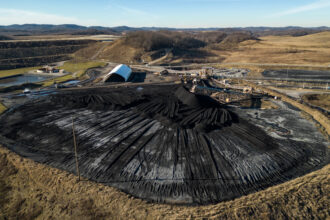
(Photo: Vivian Stockman/OHVEC)
About This Story
Perhaps you noticed: This story, like all the news we publish, is free to read. That’s because Inside Climate News is a 501c3 nonprofit organization. We do not charge a subscription fee, lock our news behind a paywall, or clutter our website with ads. We make our news on climate and the environment freely available to you and anyone who wants it.
That’s not all. We also share our news for free with scores of other media organizations around the country. Many of them can’t afford to do environmental journalism of their own. We’ve built bureaus from coast to coast to report local stories, collaborate with local newsrooms and co-publish articles so that this vital work is shared as widely as possible.
Two of us launched ICN in 2007. Six years later we earned a Pulitzer Prize for National Reporting, and now we run the oldest and largest dedicated climate newsroom in the nation. We tell the story in all its complexity. We hold polluters accountable. We expose environmental injustice. We debunk misinformation. We scrutinize solutions and inspire action.
Donations from readers like you fund every aspect of what we do. If you don’t already, will you support our ongoing work, our reporting on the biggest crisis facing our planet, and help us reach even more readers in more places?
Please take a moment to make a tax-deductible donation. Every one of them makes a difference.
Thank you,