Six months after EPA officials announced they had serious concerns about water contamination from mountaintop mining in Appalachia, the agency is starting to tighten the reins on mining permits.
The EPA outraged the coal industry last week when it asked the Army Corps of Engineers to suspend, revoke or at least modify a two-year-old permit covering the largest mountaintop mining project in West Virginia.
Today, EPA officials announced that they were also requesting closer reviews of 79 pending mountaintop mining permits on the grounds that “all of the projects would likely cause water quality impacts requiring additional review under the Clean Water Act.”
The agency’s moves follows a June agreement between the Army Corps of Engineers, which issues permits under the Clean Water Act for surface mining operations, and the EPA, which has the power to reject those permits, to work together to ensure more stringent reviews.
At the time that agreement was announced, activists had hoped President Obama would ban the practice entirely, and they were disappointed in what they heard. The EPA had promised in March to take a closer look at about 150 pending mining permits. Then, just before the June announcement, officials approved 42 of the first 48 of those pending permits.
Today’s request for a closer examination of 79 other pending permit requests heartened mountain residents who live every day with the sight of devastated mountains, altered landscapes that can change flooding patterns, and streams and well water contaminated with toxic metals.
“We who live with the nightmare of mountaintop removal are glad that the EPA is beginning to do its job to protect our communities,” said Vernon Haltom, co-director of Coal River Mountain Watch in Raleigh County, W.Va.
“Our life-giving water resources are priceless, and it’s refreshing to see the EPA finally prioritizing them over coal companies’ short-term profits.”
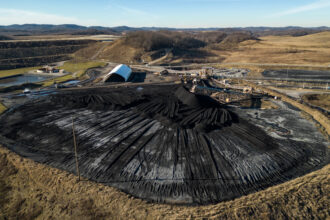
The practice of blowing the tops of mountains to scrape out the coal has devastated more than 1 million acres of Appalachia. In the process, mining companies push the debris into valleys. That “overburden,” as they call the former mountaintop, is laden with newly unearthed heavy metals, such as nickel, lead, cadmium, iron and selenium, that leach into streams, where they can poison fish and contaminate drinking water.
Last week, the EPA cited that kind of stream contamination when it asked the Corps of Engineers to suspend an Arch Coal subsidiary’s plan to dump mining debris into six West Virginia valleys from its Spruce No. 1 Mine in Logan County.
The 2,278-acre strip mine, the state’s largest mountaintop removal site, threatens more than 8 miles of stream channels in the Little Coal River watershed, the EPA said. It noted that the Little Coal River watershed already contains the largest number of impaired stream miles in the region, with high levels of iron, aluminum and selenium from mining.
The coal industry and its congressmen are already protesting.
Sen. Jay Rockefeller (D-W.Va.) wrote to EPA Administrator Lisa Jackson yesterday, saying it was “more than inappropriate to revoke a permit that was rigorously reviewed lawfully issued, and has been active for two years.”
Luke Popovich, a spokesman for the Washington-based National Mining Association, accused the EPA of “cherry picking” scientific data.
“They’ve been looking at these permits for a long time and suddenly the new cop comes to town and says the work they’ve done heretofore is questionable,” Popovich told Bloomberg news. “They seem to be moving the goalposts around so that you can’t score a touchdown.”
The Bush administration threw opened the doors for mountaintop mining in 2002 when it changed the definition of “fill material” allowed in streams under the Clean Water Act to include mining waste. Last December, it also repealed the stream buffer zone rule that had prohibited mining with 100 feet of streams.
The Obama administration attempted to reverse that 11th hour decision, but a federal judge rejected the effort last month.
The EPA can, however, take a fine-tooth comb to the mining permit requests, and it now appears to be doing exactly that.
“This represents the biggest step ever taken toward reining in the destruction of the Appalachian Mountains by mountaintop removal coal mining,” said Matt Wasson, program director for Appalachian Voices.
Wasson stressed, though, that “while we applaud the current decision by the EPA, these permits could still be approved.”
The EPA is giving its regional administrators 14 days to review the decision before sending its list of 79 permits back to the Corps of Engineers for closer review. Under the new “enhanced coordination” process, the EPA and Corps of Engineers will study each permit on a case-by-case basis, with a 60-day clock on each for reaching a decision. The EPA still holds the power to reject any permit.
During the Bush administration, the Corps of Engineers approved mining permits with little EPA involvement.
“The whole permitting process had become a bit toothless,” Jackson told the Tampa Bay Press in an interview last month. “I asked my staff what they did, and they said, ‘We made our concerns known to the Corps and we didn’t hear back.'”
Now, Jackson said, “The Corps of Engineers understands [that] when the EPA has concerns, it’s going to raise them. We’re going to do our jobs.”
Of the 79 permits the EPA is recommending for closer review, 49 are for mines in Kentucky, 23 in West Virginia, six in Ohio, and one in Tennessee.
The majority can be found in a swath across five counties, from Kentucky’s Knott County, through Floyd and Pike, and into West Virginia’s Mingo and Boone Counties.
Appalachian Voices has an interactive map of the planned mines at ilovemountains.org with links to the permits, further details about mining plans, and interviews with residents whose mountains are in the way.
Perhaps you noticed: This story, like all the news we publish, is free to read. That’s because Inside Climate News is a 501c3 nonprofit organization. We do not charge a subscription fee, lock our news behind a paywall, or clutter our website with ads. We make our news on climate and the environment freely available to you and anyone who wants it.
That’s not all. We also share our news for free with scores of other media organizations around the country. Many of them can’t afford to do environmental journalism of their own. We’ve built bureaus from coast to coast to report local stories, collaborate with local newsrooms and co-publish articles so that this vital work is shared as widely as possible.
Two of us launched ICN in 2007. Six years later we earned a Pulitzer Prize for National Reporting, and now we run the oldest and largest dedicated climate newsroom in the nation. We tell the story in all its complexity. We hold polluters accountable. We expose environmental injustice. We debunk misinformation. We scrutinize solutions and inspire action.
Donations from readers like you fund every aspect of what we do. If you don’t already, will you support our ongoing work, our reporting on the biggest crisis facing our planet, and help us reach even more readers in more places?
Please take a moment to make a tax-deductible donation. Every one of them makes a difference.