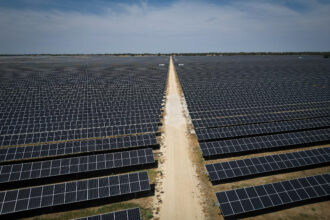
Investors, take heed: The market for desert solar farms is poised for breakaway growth.
That’s the main finding of a new report by Swiss bank UBS on the state of concentrating solar thermal power (CSP).
"The CSP market is on the point of taking off. After a long period of stagnation, the market is now evolving more dynamically. Interestingly, for regions in the sun belt, CSP offers similar opportunities as large offshore wind farms in Europe," the report says.
UBS says that growth rates of 35 percent over the next few years could add 20,000 MW of solar farms by 2020. Current installed capacity is just around 500 MW.
The report, "Solar Thermal – A New Power Giant is Awakening," does not chart any new territory, but it’s distinctly clear about the opportunities that lie ahead for potential investors.
Among the favorable circumstances: Major utilities are increasingly entering the market, possible IPOs are on the horizon, the politics of solar are becoming friendlier and most importantly, production costs are dropping.
Currently, a whopping 80 percent of CSP costs stem from construction. The remaining 20 percent comes from operating the systems once they’re built. These numbers are testament to the potential cheapness of electricity from sunlight.
For now, the reality is this: Of all the alternative energy options, the electricity production costs of CSP rank among the highest. Today’s utility-scale projects run around 15 to 40 cents per kWh. Compare that with wind power, which is currently at 4 to 15 cents per kWh. Coal with carbon capture and storage technology (CSS) is seen as even cheaper: It’s estimated at 3.5 to 6 cents per kWh.
This could change:
"Thanks to technological progress [of CSP], mass production of components, the scaling-up of plant size and growing market competition, we expect rapid cost reductions," UBS analysts write.
Spain and the U.S. currently lead the world in new CSP installations. But it’s America alone that is to pull ahead in the coming years, says UBS, courtesy of a large project pipeline, tax incentives, Renewable Portfolio Standards and an abundance of sun-drenched desert sites in California, Nevada, New Mexico, Arizona and Texas.

It helps that the technology is already here, and has been for decades.
CSP systems use hundreds of mirrors to concentrate light on a central, liquid-filled pipe that creates steam to drive a traditional turbine. Parabolic troughs (pictured to the right) are the technology du jour. They’re the most mature and proven, comprising 90 percent of installed and under-construction capacity. Expect their dominance to continue, says UBS.
But it’s CSP’s massive resource potential that remains its most alluring asset. The U.S. Department of Energy estimates that installations covering some 9 percent of Nevada’s land area could supply enough electricity to power the whole of America. And that’s not all: If the world were to build a supergrid of CSP plants on 3 percent of the Sahara Desert, they could theoretically power the entire planet.
Which bring us to the Desertec initiative, the most ambitious solar thermal plan ever conceived. The project envisions harvesting hot North African sun on 6,500 square miles to meet 15 percent of Europe’s electricity demand by 2050, for an initial cost of $555 billion. What do UBS analysts think of Desertec’s prospects? They’re cautiously optimistic:
"Obviously the initiative has a very long-term perspective and we expect no immediate market effects. Nonetheless, it shows the potential of CSP and could represent and interesting long-term opportunity for companies involved in CSP," the analysis finds.
Long-term investment success in the Sahara will likely depend on the short-term success of today’s more modest installations. And two things may spoil the show: the dwindling of Spain’s CSP feed-in tariff and environmental resistance, similar to the kind that just killed the proposed BrightSource plant in California’s Mojave desert.
In California’s case, a 5,130-acre solar power farm was to be built on land once earmarked for conservation. BrightSource met powerful eco-opposition with its plans to canvas the idle acreage with solar mirrors. The company is now searching for an alternative site.
The problem is that CSP plans require giant land requests on unspoiled deserts, making them an environmental liability in certain parts. UBS calls this "a minor issue" in its analysis. Time will tell just how minor an obstacle it is.
In Spain, there are now 232 MW of installed CSP capacity, with an additional 4,300 MW said to be in various stages of construction. A generous feed-in-tariff made it all possible, and it might be vastly diminished. The Spanish government is pondering slapping a cap on the number of CSP facilities eligible for a government-financed premium.
But UBS isn’t too concerned about the market effects of this either:
"It is likely that in autumn 2009 the feed-in tariffs for CSP will be lowered. However, the reduction might not turn out to be as the industry lobby for CSP … is quite strong and the feed-in tariffs for CSP are at relatively reasonable levels."
Investors face a slew of other unknown risks: potential regulatory changes, withdrawal of global political support, emergence of competing and disruptive renewable technologies and technology component shortages, among other things.
But overall, CSP may be one the safest investment bets of the renewable energy bunch.
Most analysts agree that it is the solar alternative to utility-scale fossil-fuels. CSP installations can churn out far more megawatts than rooftop solar photovoltaics. That’s in part because they have the coveted advantage of solar storage, meaning CSP systems can provide power at peak hours, even when the sun isn’t shining.
It’s no wonder public money is flowing into the sector in major markets. Will investors follow?
See also:
Desert Solar Could Meet 25% of World’s Power Needs by 2050
Solar Power From Africa: The Best Investment the EU Can Make
Holy Solar Funding: Project Desertec to Get $500 Billion Cash Infusion?
Another Perk for Desertec Solar Project: 240,000 New German Jobs
About This Story
Perhaps you noticed: This story, like all the news we publish, is free to read. That’s because Inside Climate News is a 501c3 nonprofit organization. We do not charge a subscription fee, lock our news behind a paywall, or clutter our website with ads. We make our news on climate and the environment freely available to you and anyone who wants it.
That’s not all. We also share our news for free with scores of other media organizations around the country. Many of them can’t afford to do environmental journalism of their own. We’ve built bureaus from coast to coast to report local stories, collaborate with local newsrooms and co-publish articles so that this vital work is shared as widely as possible.
Two of us launched ICN in 2007. Six years later we earned a Pulitzer Prize for National Reporting, and now we run the oldest and largest dedicated climate newsroom in the nation. We tell the story in all its complexity. We hold polluters accountable. We expose environmental injustice. We debunk misinformation. We scrutinize solutions and inspire action.
Donations from readers like you fund every aspect of what we do. If you don’t already, will you support our ongoing work, our reporting on the biggest crisis facing our planet, and help us reach even more readers in more places?
Please take a moment to make a tax-deductible donation. Every one of them makes a difference.
Thank you,