The Obama administration announced the winners of the first phase of "clean coal" dollars from the economic stimulus package, with the largest sums going to oil firms.
Only $21.6 million of the $1.4 billion for carbon capture and storage (CCS) technologies was made available in phase one. The money was awarded to 12 companies that will test ways to catch and compress CO2 from polluting plants, transport it by pipeline and pump it underground.
The biggest winners were C6 Resources, a Shell Oil affiliate; ConocoPhillips; and Shell Chemicals, another division of Shell Oil. Each nabbed $3 million to demonstrate their technologies for seven months.
In the announcement, U.S. Energy Secretary Steven Chu recycled the ‘clean coal’ boilerplate of past releases: "These new technologies will not only help fight climate change, they will create jobs now," although there was no estimate of how many jobs will be generated.
He also repeated this claim:
"The investments will help position the United States to lead the world in carbon dioxide capture technologies."
America still has a long way to go, though. A few subsidy-funded R&D tests are now being carried out, but none is considered economically feasible on a large scale, or even that clean.
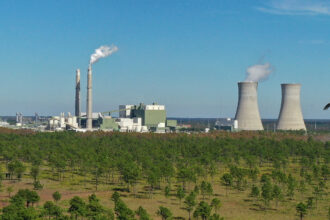
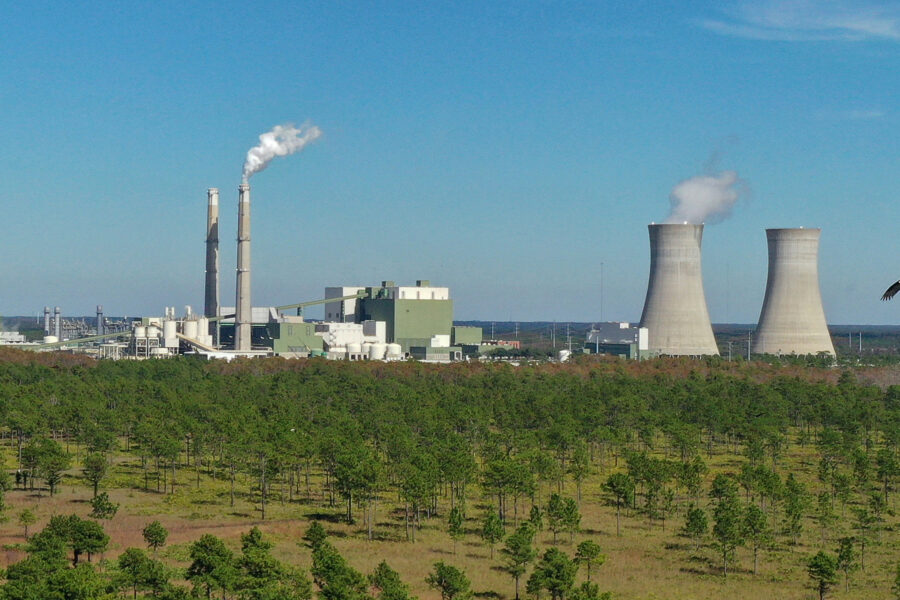
A massive, 1,300-MW West Virginia coal plant just became the nation’s first facility to pipe a small portion of its global-warming emissions back in the Earth. For an investment of more than $100 million, about 1.5 percent of the plant’s CO2 will be sequestered.
Despite his critics, Chu has stood firm on CCS, becoming one of its staunchest proponents. In a September op-ed in Science Magazine he explained why:
"… the United States, Russia, China, and India account for two-thirds of the [world’s coal] reserves. Coal accounts for roughly 25% of the world energy supply and 40% of the carbon emissions. It is highly unlikely that any of these countries will turn their back on coal any time soon, and for this reason, the capture and storage of CO2 emissions from fossil fuel power plants must be aggressively pursued."
Some form of CO2 reduction technology is necessary. And while CCS has become the solution of choice for politicians, its actual implementation worldwide is all close to absent – and it’s certain to be devilishly complex if and when it begins.
Research shows that returning a fraction of global emissions back into the Earth would require pumping as much compressed gas underground as all the oil being taken out. The infrastructure needed for that exceeds what is possible to build in a generation – or maybe ever.
The UN Intergovernmental Panel on Climate Change (IPCC) maintains its claim that the sector could account for up to 55 percent of the world’s carbon mitigation effort between now and the year 2100.
What about costs? A recent Harvard study shows they’d be sky high. Electricity from first-generation CCS plants in the U.S. would be double the costs of electricity from a conventional plant, up from the national average of 9 cents per kWh to 20 cents per kWh. Every ton of CO2 captured and stored would carry a price tag of $120 to $180.
Planned CCS plants in Europe have gone to the chopping block in large part because of their capital costs. Currently, there is no commercial-scale CCS operation up and running, anywhere.
Swedish energy giant Vattenfall was supposed to have one – a 30-MW CCS demo in Germany. But local "not in my backyard," or NIMBY, activism has gotten in the way of actual CO2 storage.
The lack of progress has detractors calling CCS a pipe dream.
The latest high-profile criticism comes from journalist Graham Thomson of the Edmonton Journal. In a report commissioned by the Munk Centre for International Studies at the University of Toronto, he posed the question: Is CCS political folly or a climate change fix?
The answer? The technology is too raw to tell, but there’s a good chance that the risks associated with large-scale CCS are a lot bigger than politicians are letting on. Thomson sums up his findings in the Edmonton Journal:
"CCS…is a political fix being used by politicians eager for an easy answer to the complicated issue of climate change.
I never concluded it won’t work. It might.
However, the technology comes with more risks and costs than politicians are willing to admit. If too much time, effort and money are spent on CCS at the expense of other ways of reducing carbon dioxide emissions, that, I concluded, would be ‘sheer folly.’ "
Folly or fix, the experiments go on.
In the U.S., a total of $3.4 billion is expected to be doled out to clean up coal as part of The American Recovery and Reinvestment Act of 2009. About a billion of that is supposed to fund the 275-MW FutureGen CCS project in Illinois, which was shelved by the Bush administration and resurrected by the Department of Energy in June.
Chu has called FutureGen the "flagship facility to demonstrate carbon capture and storage at commercial scale." But significantly more money will be needed for CCS to become viable. FutureGen alone will cost at least $2.4 billion to get off the ground. As Chu himself conceded in his Science article,
"The scale of CCS needed to make a significant dent in worldwide carbon emissions is staggering."
See also:
Will West Virgina’s CCS Demo Make a Dent in ‘Clean Coal’s Problems?
Exuberance over Carbon Capture and Storage Ignores Time Frame for Deployment
Climate Bill Earmarks $500M for Clean Coal ‘Admin Expenses’
Who’s Responsible If a CO2 Storage Site Leaks?
100,000: The Number of New Wells Needed to Store America’s Carbon Underground
DOE Timelines Show "Clean" Coal Will Be a Long Time Comin’
In Best Case, "Clean" Coal Is Still Two Decades Away
About This Story
Perhaps you noticed: This story, like all the news we publish, is free to read. That’s because Inside Climate News is a 501c3 nonprofit organization. We do not charge a subscription fee, lock our news behind a paywall, or clutter our website with ads. We make our news on climate and the environment freely available to you and anyone who wants it.
That’s not all. We also share our news for free with scores of other media organizations around the country. Many of them can’t afford to do environmental journalism of their own. We’ve built bureaus from coast to coast to report local stories, collaborate with local newsrooms and co-publish articles so that this vital work is shared as widely as possible.
Two of us launched ICN in 2007. Six years later we earned a Pulitzer Prize for National Reporting, and now we run the oldest and largest dedicated climate newsroom in the nation. We tell the story in all its complexity. We hold polluters accountable. We expose environmental injustice. We debunk misinformation. We scrutinize solutions and inspire action.
Donations from readers like you fund every aspect of what we do. If you don’t already, will you support our ongoing work, our reporting on the biggest crisis facing our planet, and help us reach even more readers in more places?
Please take a moment to make a tax-deductible donation. Every one of them makes a difference.
Thank you,