Europe is considering key changes to its energy technology budget – proposals that could give new life to the continent’s lagging cleantech sector at a time when the U.S and Asia are leaping far ahead.
The recommended changes come from the European Commission (EC) in its Strategic Energy Technology (SET) Plan. The blueprint urges a tripling of the EU energy research budget over the next ten years, from a yearly investment of $4.4 billion to $11.8 billion. In total, an extra $74 billion in public and private energy investment would be needed by 2020.
"Increasing smart investments in research today is an opportunity to develop new sources of growth, to green our economy and to ensure the EU’s competitiveness when we come out of the crisis," EU Commissioner for Science and Research Janez Potocnik said.
The proposal represents a test of the EU’s stated willingness to cut its global-warming emissions by at least 20 percent below 1990 levels by 2020. Member states will have to examine the plan before handing it to the European Parliament for approval.
The proposal identifies six priority low carbon technologies and funding recommendations: wind ($8.8 billion), solar ($24 billion), smart electric grids ($2.9 billion), next-generation biofuels ($13.3 billion), carbon capture and storage ($19 billion) and nuclear power ($10.3 billion).
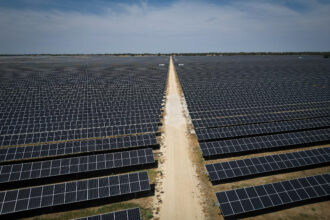
Solar would get the biggest chunk of the investment pie. The commission suggests pouring about a third of the total allotment into developing photovoltaic (PV) technologies and utility-scale concentrating solar power (CSP) installations. The goal: 15 percent of EU electricity in 10 years from sunlight.
While an improvement, it’s not ambitious enough, the European Photovoltaic Industry Association (EPIA) said in a statement.
"The EC is putting too much emphasis on long-term research and should better recognize the need for accelerating the development of existing commercial and pre-commercial PV technologies. Of course, long-term research should be carried out in parallel through other instruments," the group wrote.
EPIA claims that the EC targets simply don’t match the sector’s huge and largely untapped potential.
"PV represented 19% of new installed power capacity in Europe. Already next year, PV will be competitive with retail electricity prices in some regions of Europe."
The organization has found that PV alone can supply 12 percent of Europe’s electricity needs in 10 years and create 1.4 million jobs in the process.

If the SET plan is approved, carbon capture and storage would secure the second-largest slice of the funds, getting a quarter of the total increase, while wind would see only half that amount. The discrepancy was not lost on the European Wind Energy Association.
In a statement, the organization said that wind offers "such a big return in electricity generation and greenhouse gas reduction for such a small investment." And yet,
"Less than 12% of the proposed new energy research budget allocated to specific generation technologies will go to wind and 25% to coal."
The most common critique of the SET Plan involves funding. The plan doesn’t specify where the money will come from. The commission is expected to rely on member nations to foot some unknown portion of the bill, but most will need to come from private sources.
The EC’s plan was unveiled at a time of increased investment in clean energy from competitor nations. The U.S. government currently spends just $2.5 billion on clean-energy R&D a year, but the American Recovery and Reinvestment Act will supposedly invest a substantial $112 billion in green priorities during the next 18 months. That’s only about half as much as much as what China is expected to invest.
The U.S. Department of Energy has already given out more than $16 billion in stimulus funding this year and is slated to distribute a total of $30 billion by the end of the year. These sums were vital in getting venture firms to return to U.S. cleantech investing in the third quarter of 2009.
The EU, meanwhile, has diverted $23 billion of its stimulus into renewable energy. And in recent years, private cleantech investment there has begun to fall off a cliff. An August report by New Energy Finance found that Europe and America had almost identical cleantech investment in 2003, including private and government dollars. But by 2008, North America had outstripped Europe to invest nearly three times as much in clean energy.
Still, the EU has a leg up on the U.S.: low-carbon federal policies.
The EU boasts a renewable energy commitment, a price on carbon and a cap on emissions – all of which will help guarantee future investment momentum in European cleantech.
See also:
America Beats Europe on Clean Energy Funding for 6 Straight Years, and Counting
Cleantech Investment: 3rd Quarter Sizzles, Courtesy of Washington and Solar
Five Big Surprises on the Global Cleantech 100 List
About This Story
Perhaps you noticed: This story, like all the news we publish, is free to read. That’s because Inside Climate News is a 501c3 nonprofit organization. We do not charge a subscription fee, lock our news behind a paywall, or clutter our website with ads. We make our news on climate and the environment freely available to you and anyone who wants it.
That’s not all. We also share our news for free with scores of other media organizations around the country. Many of them can’t afford to do environmental journalism of their own. We’ve built bureaus from coast to coast to report local stories, collaborate with local newsrooms and co-publish articles so that this vital work is shared as widely as possible.
Two of us launched ICN in 2007. Six years later we earned a Pulitzer Prize for National Reporting, and now we run the oldest and largest dedicated climate newsroom in the nation. We tell the story in all its complexity. We hold polluters accountable. We expose environmental injustice. We debunk misinformation. We scrutinize solutions and inspire action.
Donations from readers like you fund every aspect of what we do. If you don’t already, will you support our ongoing work, our reporting on the biggest crisis facing our planet, and help us reach even more readers in more places?
Please take a moment to make a tax-deductible donation. Every one of them makes a difference.
Thank you,