The U.S. got its first glimpse of the future Senate climate bill today as Democrat John Kerry and Republican Lindsey Graham outlined a compromise plan that fully embraces nuclear power, off-shore drilling, “clean coal” and cap-and-trade.
The framework echoes the House’s 17 percent mid-term emissions cut, rather than the tougher 20 percent cut approved by the Senate Environment and Public Works Committee. It also seeks to shield agriculture from the impact of a price on emissions.
Right now, the framework is still just that, a sparse framework. The details will come later as various Senate committees combine their bills with those already passed by the Environment and Public Works and Energy and Natural Resources committees.
What the framework does, Kerry said, is lead the way toward “comprehensive climate change and energy legislation that will pass the Senate early next year.”
Sen. Joe Lieberman (I-Conn.), who joined Kerry (D-Mass.) and Graham (R-S.C.) in creating the bipartisan plan, described the framework as a series of commitments on the way to 60 Senate votes. Some senators who have been leery of nuclear power are now committing to a very robust nuclear power title with loan guarantees, tax credits and expedited permits because they see other benefits, he said. On the other side, colleagues reluctant to support a near-term cap on carbon are committing because they gain elsewhere.
“There are well over 60 votes in the U.S. Senate that are in play," Lieberman told reporters. "We don’t have over 60 votes, but there are well over 60 members of the U.S. Senate who I think would like to get to a point where they can say yes to climate change/energy independence legislation.”
Emissions Targets
The framework’s midterm emissions reduction target of 17 percent below 2005 levels sounds similar to the goal passed by the House earlier this year. However, the written framework, and Kerry in his announcement today, both avoided tying that number to a specific date.
Lieberman was only a bit more definitive: “Generally speaking, I think most of us feel that’s 2020,” he said.
The Clean Energy Jobs and American Power Act bill, pushed through the Senate Environment and Public Works Committee amid a Republican boycott earlier this fall, set a more ambitious goal of cutting emissions 20 percent below 2005 levels by 2020. The House-passed American Clean Energy and Security Act (ACES) set a goal of 17 percent below 2005 levels by 2020 (equivalent to about 4 percent below 1990 levels).
Any of the three would fall well short of what climate experts say is necessary to keep global warming in check.
“If a Senate bill is to have any chance of heading off the climate disaster threatening millions of people, it must guarantee that the planet’s carbon dioxide level is reduced to 350 parts per million by reducing U.S. greenhouse gas emissions 45 percent below 1990 levels by 2020,” said Kierán Suckling, executive director of the Center for Biological Diversity.
Polluter Pays
To start cutting emissions, the proposed Senate framework commits to a market-based cap-and-trade system — and rejects the possibility of a straight carbon tax.
"There’s a reason that a Republican named George Herbert Walker Bush first embraced that [market-based system], because it was the least intrusive, most effective way, least-cost way of achieving an environmental pollution reduction goal,” Kerry told reporters.
He vowed that the final bill would have strong market oversight “to avoid any kind of manipulation,” a serious concern for several senators on both sides of the aisle in recent hearings.
The framework also includes a promise of transitional help for families and businesses to buffer increases in energy prices as the nation shifts to a low-carbon economy. One option listed is a price collar to control the price of carbon and prevent volatility.
Agriculture would get a pass on emissions caps, and farmers would have access to offset projects and incentives to promote environmentally friendly practices — a concession to the Senate’s influential farm-state members.
Energy Sources: All of the Above
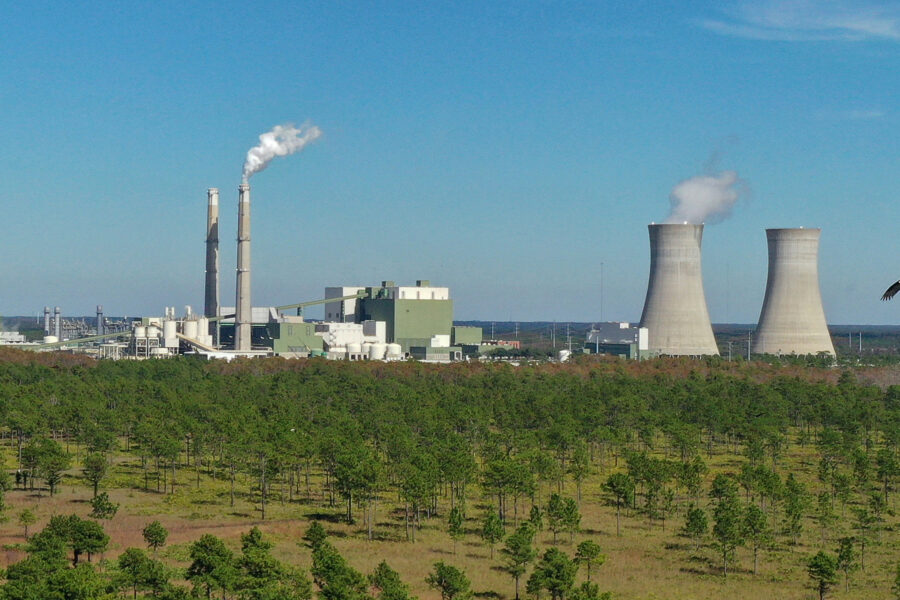
More concessions are obvious in the energy resources listed in the framework. With nuclear, more oil and gas drilling, and a secure future for coal celebrated alongside renewable energy, the framework follows the Republican energy matra: all of the above.
“Nuclear power is going to be embraced in a way through this collaboration that it’s never been embraced before,” Graham said.
It might not be Tennessee Sen. Lamar Alexander’s constant call for scrapping cap-and-trade and just building 100 new nuclear plants, but the U.S. can start with six or eight nuclear facilites and grow from there, Graham said.
“Our framework embraces and encourages the use of all energy sources, including renewables, clean coal, natural gas and nuclear power,” Kerry said. “We also embrace significant energy efficiency initiatives as a critical short-term opportunity to reduce out nation’s energy dependence and as well as household energy bills.”
For coal, the framework liberally quotes West Virginia Sen. Robert Byrd’s recent editorial and calls for committing “significant resources to the rapid development and deployment of clean coal technology and dedicated support for early development of carbon capture and sequestration.”
All three senators talked about the importance of greater energy independence for national security. To that end, they described a bill that would open the door to more oil and gas drilling, both on land and off shore. The plan would send money back to the states that choose to allow drilling and provide new federal revenue to mitigate the impacts of climate change, Lieberman said.
Jobs, Jobs, Jobs
They also stressed jobs — solid American jobs that could not be moved overseas. A new national poll out this week from McClatchy and Ipsos backs up the importance of that emphasis: The majority of Americans — 69 percent — said they were willing to support climate legislation that cost them as much as $10 more a month if it created a ‘significant’ number of American jobs. That dropped to 50 percent without the promise of significant jobs.
Not surprising then, job-creation takes center stage in the framework.
The senators talked about businesses — Honeywell, Duke Energy, GE, Shell — supporting a price on carbon to drive clean tech innovation, create certainty that will ease the concerns of investors, and create demand for new technologies that will fuel business growth.
Echoing President Obama’s jobs speeches in Allentown, Pa., and Washington earlier this week, their framework also emphasizes the need to revive American manufacturing.
“Manufacturing is the backbone of our nation’s economy, and we refuse to believe that the days of American leadership are behind us,” the framework states. The framework promises “significant assistance to manufactures to avoid carbon leakage and ensure competitiveness of American-made goods.”
Money for financial incentives to help manufacturers improve their energy efficiency would come from polluters paying until they clean up their act, Lieberman said. What that promise might mean for the number of free pollution permits vs. auctioned permits remains to be seen.
Getting to 60
Making the bill enticing enough for 60 senators to vote yes was Senate Majority Leader Harry Reid’s goal when he asked Kerry to come up with a new plan. Graham, who has been censured and vilified by his own party for working with Democrats on a bipartisan bill, was the key.
Getting the GOP on board will mean putting climate change in business terms, Graham said. If the bill can’t be made a winner for business, it won’t pass, he said. But Graham believes it can.
Every day, we send about $1 billion to foreign countries to buy oil, and some of that money works its way into terrorist organizations, Graham explained at the news conference this afternoon:
“What if you could cut it in half? What if you could save a couple hundred billion a year and invest it here and not send it overseas?"
Graham also talked about the environmental changes and damage he had seen in Alaska and the polar regions.
“I’ve come to conclude this: Why can’t America have the cleanest air and the purest water?” he said. “Why would any Republican or Democrat not want that to be so?
“That is something I think every citizen should embrace, and let’s embrace it in a way that makes us more energy independent and creates jobs. It can be win-win-win.
"All the cars and all the trucks and all the power plants that spew out millions of tons of carbon a day in my view are not helping things. An unlimited, perpetual carbon pollution is not going to create a better environment for the next generation of Americans. The good news is you can solve that problem, become more energy independent and create jobs that pay well and will never leave this country. So let’s do it.”
The next big public appearance for the framework will likely come in January, when Sen. Blanche Lincoln’s Senate Agriculture Committee holds hearings on its elements of the bill. The Arkansas Democrat hasn’t held back about her concerns about the impact of the legislation on her home state.
Two coal-state senators, Montana’s Max Baucus, chairman of the Finance Committee, and West Virginia’s Jay Rockefeller, head of the Commerce, Science and Transportation Committee, are also expected to hold hearings on their parts of the bill early next year, Kerry said.
See also:
Oil Industry Applauds Senate’s ‘Clean Energy’ Bill
Offshore Oil Drilling Debate Renewed in Senate Hearing
Senate Urged to Protect Clean Air Act from Climate Bill
300-Plus Groups Write to Senate Calling for Stronger Climate Bill
Key Senate Democrat Raises Questions about Climate Bill Emissions Cuts, Costs
(Photo: Electablog)
About This Story
Perhaps you noticed: This story, like all the news we publish, is free to read. That’s because Inside Climate News is a 501c3 nonprofit organization. We do not charge a subscription fee, lock our news behind a paywall, or clutter our website with ads. We make our news on climate and the environment freely available to you and anyone who wants it.
That’s not all. We also share our news for free with scores of other media organizations around the country. Many of them can’t afford to do environmental journalism of their own. We’ve built bureaus from coast to coast to report local stories, collaborate with local newsrooms and co-publish articles so that this vital work is shared as widely as possible.
Two of us launched ICN in 2007. Six years later we earned a Pulitzer Prize for National Reporting, and now we run the oldest and largest dedicated climate newsroom in the nation. We tell the story in all its complexity. We hold polluters accountable. We expose environmental injustice. We debunk misinformation. We scrutinize solutions and inspire action.
Donations from readers like you fund every aspect of what we do. If you don’t already, will you support our ongoing work, our reporting on the biggest crisis facing our planet, and help us reach even more readers in more places?
Please take a moment to make a tax-deductible donation. Every one of them makes a difference.
Thank you,