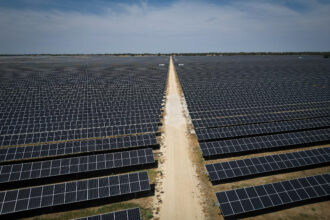
Solar power technologies could generate 15 percent of America’s power in 10 years, but only if Washington levels the playing field on subsidies, a report by the Solar Energy Industries Association (SEIA) says.
That means either rolling back fossil fuel subsidies, as President Obama proposed earlier this year, or increasing subsidies for clean energy, the association says.
Fossil fuels received $72 billion in total federal subsidies from 2002 to 2008, keeping prices artificially low, according to figures from the Environmental Law Institute (ELI). About 98 percent of that went to conventional energy sources, namely coal and oil, leading to more emissions. The rest, $2.3 billion, was pumped into a new technology to trap and store carbon dioxide spewed by coal plants.
During that same period, solar got less than $1 billion, according to the SEIA, a trade group representing 1,100 solar companies across the nation.
To compete and gain market share — and stop global warming — this inconsistency “must reverse itself immediately,” said Rhone Resch, SEIA president and CEO.
There had been hints of this happening.
In September, the G20 group of the largest 20 economies agreed to phase out the $300 billion spent worldwide in fossil fuel subsidies “over the medium term” to combat climate change.
But neither the Obama administration nor Congress has yet to take steps to comply with the G20 commitment.
For solar to have a shot, the world cannot wait, Resch told reporters at the Copenhagen climate talks this month.
“We either remove subsidies with oil and gas or create parity with solar,” he said.
Almost a million jobs could hang in the balance.
Currently, solar contributes less than 1 percent of energy used in the U.S. and employs some 60,000 people. Increasing that amount to 15 percent would result in a total of 882,000 new jobs, the association said.
That’s compared with a dwindling coal mining industry that employs 85,000 people, said Resch.
The solar ramp-up would also fight climate change. A 15 percent scenario would slash America’s energy-related emissions by an estimated 10 percent, curbing national carbon dioxide output by 1.4 gigatons (1 gigaton equals 1 billion tons).
To get there, however, rooftop solar photovoltaic systems would need to grow massively — from today’s 1,500 MW to 350,000 MW by 2020. Concentrating solar power, which generates electricity by focusing sunlight on giant mirrors on desert land, would have to leap to 50,000 MW, up from just 424 MW today.
It “won’t happen naturally,” Resch said.
Domestic policy provisions that favor renewable energy sources are needed now, the solar industry argues. Many of these would not cost the government “a penny,” said Resch. In fact, getting to 15 percent solar would require a relatively small government investment of between $2 billion and $3 billion in total, he said. But, he added,
“The government will have to change the way things have been done.”
The policies proposed by SEIA are contained in the association’s “Solar Bill of Rights.” They include: the right to connect to a grid with uniform standards; the right to new transmission lines to connect solar resources in the Southwest to population centers; and the right to equal access to public land.
The last one is vital for utility-scale solar power. The oil industry currently leases over 45 million acres of federal land, much of it on sun-blessed stretches of Southwestern earth. The solar industry has access to “zero” of that, said Resch.
Also vital is global warming legislation that creates a long-term price on carbon and a federal “renewable portfolio standard” that would ensure a chunk of the nation’s electricity gets produced by green power.
The industry hopes momentum from the utilities and the states will trickle up to the federal government. In 2009, solar accounted for 13 percent of all new utility announcements and filings, according to figures from the Electric Edison Institute. “There are orders right now for solar in excess of 10 GW from utilities,” Resch said.
Assuming the solar industry returns to its pre-recession growth rate of 50 percent each year, electricity from the sun will be the lowest cost option in almost every state by 2018, the association said.
Copenhagen Plea
When SEIA presented the 15 percent accelerated deployment scenario at the Copenhagen talks this month, the U.S. trade group wasn’t alone. Over 40 solar associations from around the world banned together to release a report summarizing surveys of the leading solar nations.
The main point was this: If the EU industry makes good on its pledge to get 12 percent of its electricity from solar by 2020, and if the U.S. can hit 15 percent in the same time frame, 6.3 million new jobs would flow. On top of that, China and India have each pledged promising near-term solar booms.
“Our message was clear,” said Resch, “We are ready now to help solve the climate crisis.”
Before the talks, solar representatives sent the UN secretary-general a letter, urging him to keep in mind that solar energy “offers a concrete way forward” in negotiations on how to curb and adapt to global warming. In the end, it didn’t help. The Copenhagen Accord that emerged produced no binding commitments to slow climate change, and no hard signals to stimulate clean-tech investment.
But it appears the summit was not for naught for Big Solar.
“This is the first time in the history of climate negotiations that the global solar industry has gathered together with one voice,” said Resch. It’s also the first UN climate convention where the renewable energy industries outweighed the fossil fuel industries in “both in numbers and in influence,” he added.
The key in the short term, Resch said, is not legally binding and verifiable carbon reductions but action in the biggest economies.
“If agreement has to wait until Mexico City or South Africa, fine, but we can no longer wait to star building the solar industry and making sure we have uniform policies around the world,” Resch said.
See also:
In a League of Its Own: First Solar Breaks the $1-a-Watt Barrier
World’s Largest Sky-Scraping Solar Plant Goes Live in Spain
California Building Power Lines to a Renewable Future
New York Offers 50% Solar Subsidy, as East Coast Pulls Ahead in PV Growth
Subsidies Worth Billions at Stake in Battle Over Biofuel Rules
Climate Financing Vital to G20 Meeting Success, But Increasingly Pushed Aside
About This Story
Perhaps you noticed: This story, like all the news we publish, is free to read. That’s because Inside Climate News is a 501c3 nonprofit organization. We do not charge a subscription fee, lock our news behind a paywall, or clutter our website with ads. We make our news on climate and the environment freely available to you and anyone who wants it.
That’s not all. We also share our news for free with scores of other media organizations around the country. Many of them can’t afford to do environmental journalism of their own. We’ve built bureaus from coast to coast to report local stories, collaborate with local newsrooms and co-publish articles so that this vital work is shared as widely as possible.
Two of us launched ICN in 2007. Six years later we earned a Pulitzer Prize for National Reporting, and now we run the oldest and largest dedicated climate newsroom in the nation. We tell the story in all its complexity. We hold polluters accountable. We expose environmental injustice. We debunk misinformation. We scrutinize solutions and inspire action.
Donations from readers like you fund every aspect of what we do. If you don’t already, will you support our ongoing work, our reporting on the biggest crisis facing our planet, and help us reach even more readers in more places?
Please take a moment to make a tax-deductible donation. Every one of them makes a difference.
Thank you,