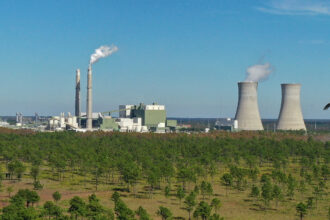
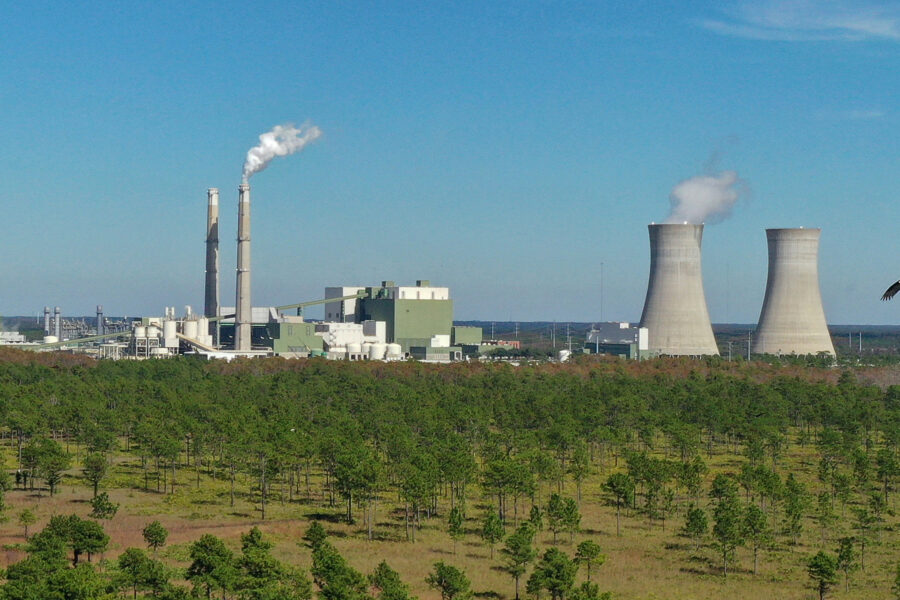
Sunflower Electric Corp. today submitted a revised permit application to build a new coal plant in Holcomb, Kan., reviving a long-running effort to break ground on a locally polluting facility that would send most of its electricity to customers out of state.
The saga first drew national attention in 2007, when the head of the Kansas Department of Health and Environment rejected Sunflower’s air permit request, making history as the first state official to base the rejection in part on the potential dangers greenhouse gas emissions pose to human health and the environment. The legislature tried four times to get around the department, and four times it ran into vetoes from former Gov. Kathleen Sebelius, now U.S. secretary of Health and Human Services. Her replacement brokered a deal a week after taking office.
Sunflower’s plans are smaller now, but the plant is sure to become the focus of national attention yet again.
The review of the permit is likely to be affected by federal regulations triggered by a 2007 Supreme Court decision. The EPA last month finalized its own endangerment finding, expected to lead to federal emissions regulations. New national tailpipe standards will also trigger Clean Air Act provisions (PSD and Title V) that would bring coal plants like Sunflower’s under new regulatory standards aimed at climate protection.
"There are some people who question that," said Cindy Hertle, a spokesperson for Sunflower. By "some people" she was referring to efforts by the GOP, with Sen. Lisa Murkowski (R-Alaska) leading the charge in Congress, to overturn EPA authority to regulate CO2 from industrial facilities.
"Right now, there are no regulations mandated, so we’re going forward, and we’ll continue to do so as long as it’s prudent," Hertle said.
The Kansas Department of Health and Environment said in a brief press release that the review of Sunflower’s application for the 895 MW coal-fired plant would take from three to six months, contingent upon the completeness of the application. Once KDHE completes its review, the permitting process requires public hearings and a comment period before final action is taken.
"There’s a long process ahead of us," KDHE Secretary Rod Bremby told SolveClimate. "Though it is being submitted as a revised permit application, EPA has made its position clear that the review process would have to go through a full public process as if it were a new application."
The permit application for the Kansas coal plant was filed today following a year that saw energy companies shelve plans for more than two dozen new U.S. coal plants, frequently citing the uncertain regulatory environment. Opponents of coal plant expansion are now gearing up for another battle with Sunflower.
"We’ll be participating fully in the public process, letting the people of Kansas know about the serious health risks of yet another dirty coal plant, and the serious financial risks as well," said Amanda Goodin, an attorney for Earthjustice. "With increasing construction costs and declining demand for electricity, Sunflower is in no position to be taking on more debt at taxpayer expense."
Hertle defended Sunflower’s decision to seek to build another coal plant in Kansas in difficult economic times.
"It is about economies of scale. Our purchase power agreement expires in 2019," she said, explaining that the new plant and the export of much of its power across state lines is what will help secure an adequate electricity supply for ratepayers in Kansas.
The local battle, however, is likely to be dwarfed by national forces. EPA is already involved in the permitting process and has the responsibility to step in to block the permit if it runs afoul of federal regulations, including those that could be finalized in the coming months.
"The regulatory framework is continuing to form around the Supreme Court decision, so it could have an impact," Bremby said, referring to the decision in Massachusetts v. EPA that triggered the federal endangerment finding.
For now, Sunflower is moving ahead. Asked if she thinks Sen. Murkowski will succeed in limiting the scope of the Supreme Court decision with new legislation, Hertle said "As long as there …" and then stopped herself.
"I can’t speculate," she said.
See also:
Clean Air Act Trips Up Sunflower’s Coal Plant Deal in Kansas
Vetoed Again, Sunflower Electric’s Kansas Coal Plant Plans Lose Support
Deja Vu: A Storm Brews in Kansas over Dirty Coal
GOP Protest Builds Against EPA Regulating Greenhouse Gases
Rocky Year for Coal Industry: 26 Power Plant Plans Shelved in 2009
About This Story
Perhaps you noticed: This story, like all the news we publish, is free to read. That’s because Inside Climate News is a 501c3 nonprofit organization. We do not charge a subscription fee, lock our news behind a paywall, or clutter our website with ads. We make our news on climate and the environment freely available to you and anyone who wants it.
That’s not all. We also share our news for free with scores of other media organizations around the country. Many of them can’t afford to do environmental journalism of their own. We’ve built bureaus from coast to coast to report local stories, collaborate with local newsrooms and co-publish articles so that this vital work is shared as widely as possible.
Two of us launched ICN in 2007. Six years later we earned a Pulitzer Prize for National Reporting, and now we run the oldest and largest dedicated climate newsroom in the nation. We tell the story in all its complexity. We hold polluters accountable. We expose environmental injustice. We debunk misinformation. We scrutinize solutions and inspire action.
Donations from readers like you fund every aspect of what we do. If you don’t already, will you support our ongoing work, our reporting on the biggest crisis facing our planet, and help us reach even more readers in more places?
Please take a moment to make a tax-deductible donation. Every one of them makes a difference.
Thank you,