A new poll on Thursday found overwhelming support for building giant solar farms on America’s pristine public lands.
The poll was conducted by Gotham Research Group, a national pollster, and was commissioned by the Solar Energy Industries Association (SEIA), a 1,100-member trade group. It was done mainly to gauge support for plans by the U.S. Department of Interior to fast-track environmental reviews of 14 solar plant proposals in the American West.
The poll found that 75 percent of Americans across all demographics, regions and political parties approve of a utility-scale solar boom. But it also revealed a partisan divide when solar power was pitted against wind farms, nuclear plants, oil wells, natural gas facilities and coal plants.
"Solar energy is the top priority across the board—except among Republicans," Jeff Levine, president of Gotham Research Group, told reporters.
When asked which energy source should be the top priority for the U.S. government, Democrats and Independents selected solar as their No. 1 choice, followed by wind and nuclear power. For Republicans, however, solar farms came in fourth.
The poll comes at a time when belief in climate change from Republicans is dropping. According to a new Gallup poll, Republican doubters grew from 59 percent to 66 percent in a single year, while Democrats stayed steady at 20 percent.
But the gap in perceptions of solar does not appear to be driven by skepticism in climate science. Republicans, for instance, ranked wind energy as their top priority, followed by nuclear and then oil wells.
And new coal facilities fared the worst of all—among all parties, including Republicans.
The results imply that the debate over America’s energy future is more complex than it is often portrayed, said Monique Hanis, a spokeperson for SEIA. A lack of familiarity with solar farms may be one explanation for Republican preference for other sources, Hanis told SolveClimate.
"We suspect some are less educated about utility-scale solar and think about traditional sources first," she said.
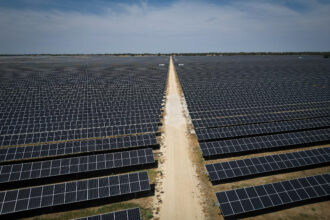
Utility-scale solar refers to ground-based installations that harvest large amounts of electricity for the grid. These projects can take the form of PV farms, which use panels to convert sunlight to electricity, or concentrating solar power (CSP) facilities, which use mirrors to capture the sun’s rays to create steam and turn a traditional turbine.
The U.S. has 525 megawatts of utility-scale solar currently in the ground, according to SEIA data. But new plants have been slow to get government approval in recent years, said Rhone Resch, the CEO and president of SEIA—even though the U.S. Southwest boasts one of "best solar resources of any country in the developed world."
Much of that potential is on public lands. So far, the Bureau of Lands Management (BLM) has identified 23 million acres with solar energy potential in six southwestern states. Around 160 applications for large-scale solar projects have been stalled at the agency for years now. If all of these projects were built, they would generate 97,000 MW of electricity, or enough to power 29 million homes, according to BLM figures.
Still, not a single permit has been issued for solar development on Interior-managed lands, said Resch. Meanwhile, during the last two decades, the oil and gas industries have received over 75,000 drilling permits.
One main hurdle to building solar plants has been environmental opposition. Installations on Western desert lands have drawn fire from some advocates, who say they would damage pristine natural resources.
While left-leaning land preservationists and Democratic lawmakers often take the heat for this type of "green-on-green" opposition, this week’s polling data reveals a more complicated picture.
One unexpected result: Republicans were far more likely than Democrats or Independents to say the biggest energy challenge facing the nation is developing energy sources while at the same time protecting the environment.
"We were surprised frankly that Republicans were so much higher" on this issue, said Hanis.
Perhaps less surprisingly, Democrats were the political party most worried about developing clean energy resources. Addressing climate change, meanwhile, ranked last among the five issues of concern to all respondents.
‘Incredible Bipartisan Support’ as Solar Set to Explode
Overall, "solar has incredible bipartisan support on Capitol Hill, and with state and local legislators," said Hanis. "We are seeing Republican leadership today with Sen. Graham’s (R-South Carolina) cooperation with Sens. Kerry (D-Massachusetts) and Lieberman (I-Connecticut) on crafting a climate and energy bill."
The real proof, SEIA says, is in the project numbers. Resch predicts "a record year" for utlity-scale solar, with 200 megawatts expected to come online in 2010 compared with 58 megawatts in 2009.
"The outlook for utility-scale solar power is more promising today than it ever has been," Resch said.
In total, 100 announced solar projects, representing 17,000 megawatts of capacity, are under development in America — enough electricity to power 3.4 million households.
"This will create a little over 100,000 domestic jobs between now and 2016, while powering us toward our clean energy future," Resch said.
If the Department of Interior can pull off its plans to fast-track 14 solar projects in 2010, the installations would power around a million homes in the next couple of years, according to the agency.
In total, the 17,000 megawatts of new solar in the pipeline could come online by 2015, said Resch. "To put that in perspective, we’re not going to see a new coal plant or a new nuke plant for upwards of a decade."
See also:
Anxious Geothermal, Solar Industries Looking to U.S. Interior for a Hand
Salazar Tells Congress of Hundreds of Thousands of Domestic Jobs in Solar Energy
US Confirms Plans to ‘Fast-Track’ Solar on Federal Lands in 3 Western States
Solar Could Generate 15% of Power by 2020, If US Ends Fossil Fuel Subsidies
Desert Solar Could Meet 25% of World’s Power Needs by 2050
California Building Power Lines to a Renewable Future
About This Story
Perhaps you noticed: This story, like all the news we publish, is free to read. That’s because Inside Climate News is a 501c3 nonprofit organization. We do not charge a subscription fee, lock our news behind a paywall, or clutter our website with ads. We make our news on climate and the environment freely available to you and anyone who wants it.
That’s not all. We also share our news for free with scores of other media organizations around the country. Many of them can’t afford to do environmental journalism of their own. We’ve built bureaus from coast to coast to report local stories, collaborate with local newsrooms and co-publish articles so that this vital work is shared as widely as possible.
Two of us launched ICN in 2007. Six years later we earned a Pulitzer Prize for National Reporting, and now we run the oldest and largest dedicated climate newsroom in the nation. We tell the story in all its complexity. We hold polluters accountable. We expose environmental injustice. We debunk misinformation. We scrutinize solutions and inspire action.
Donations from readers like you fund every aspect of what we do. If you don’t already, will you support our ongoing work, our reporting on the biggest crisis facing our planet, and help us reach even more readers in more places?
Please take a moment to make a tax-deductible donation. Every one of them makes a difference.
Thank you,