The coal industry is headed down the same path as U.S. automakers, and its future will become just as troubled and expensive for the American people if it continues pouring money into fighting the science rather than investing in cleaner technology, Congressman Ed Markey warned industry leaders Wednesday.
In a tense hearing held in the wake of last week’s deadly coal mine explosion in West Virginia, Markey questioned the business sense of the coal industry’s opposition to climate legislation — legislation that he says goes out of its way to help coal users adjust to what he considers inevitable carbon emissions reductions and to help coal itself remain a central part of the U.S. economy.
“The American auto industry claimed the technology wasn’t available, affordable or preferable,” Markey said. “Eventually, their folly became clear — customers abandoned their products.” The next stop was a multibillion-dollar taxpayer bailout.
The Massachusetts Democrat compared that to changes taking place today in electricity production, where countries, aware that carbon regulations are likely coming, are competing to become the global leader in clean energy technology and secure the jobs and economic advantages that come with it.
The response from the panel of coal executives at the hearing: The U.S. government should provide more money for U.S. companies to develop and deploy “clean coal” technology such as carbon capture and storage, and it should hold off on any regulations until that technology is up and running at scale — likely 15 to 20 years.
The hearing in Markey’s House Energy Independence and Global Warming Select Committee included the heads of the United States’ three largest coal producers — Peabody Energy, Arch Coal and Rio Tinto — and ranged across the topics, from climate change to technology to mine safety.
CCS First, Regulations Later
Markey, like President Obama and Energy Secretary Steven Chu, clearly supports carbon capture and storage technology.
The Waxman-Markey American Clean Energy and Security (ACES) bill that passed the House last year includes $10 billion for CCS research and development plus $50 billion in bonus allowances for CCS installed before 2025. The bill also would provide deep concessions for coal-using industries, such as utilities, in the form of free carbon emission allowances and a ban on the EPA regulating carbon emissions under the Clean Air Act. The Senate’s version, which could finally be unveiled by Sens. John Kerry (D-Mass.) and Lindsey Graham (R-S.C.) next week, is expected to support fossil fuels even more strongly than the House’s.

The industry wants the money being proposed for CCS and it wants the ban on EPA regulations, but without any federal requirements that limit its greenhouse gas emissions until the technology is fully deployable.
“Peabody will support the right kinds of legislation,” Peabody CEO Greg Boyce told the committee.
Boyce and Arch Coal CEO Steven Leer both pitched greater government-supported deployment of CCS as a way to reinvigorate the U.S. economy. Leer noted a National Coal Council finding that CCS through 2050 could create 800,000 permanent jobs. But, Boyce said, “More funding is needed to bring this technology to commercial scale.”
While the coal industry talks about CCS, its financial commitment to actual projects has been thin.
Between 2003 and 2008, the industry’s investment came out to 2 cents for every $1 of profit the companies made, according to a 2009 American Center for Progress report. Members of the industry’s American Coalition for Clean Coal Electricity (ACCCE) — which stoked controversy with its campaign questioning climate action and a series of forged letters to Congress falsely claiming certain groups opposed the climate bill — as of last year had committed to spend $3.6 billion on CCS projects in the U.S. through 2017, with taxpayers expected to kick in an additioanl $2.8 billion.
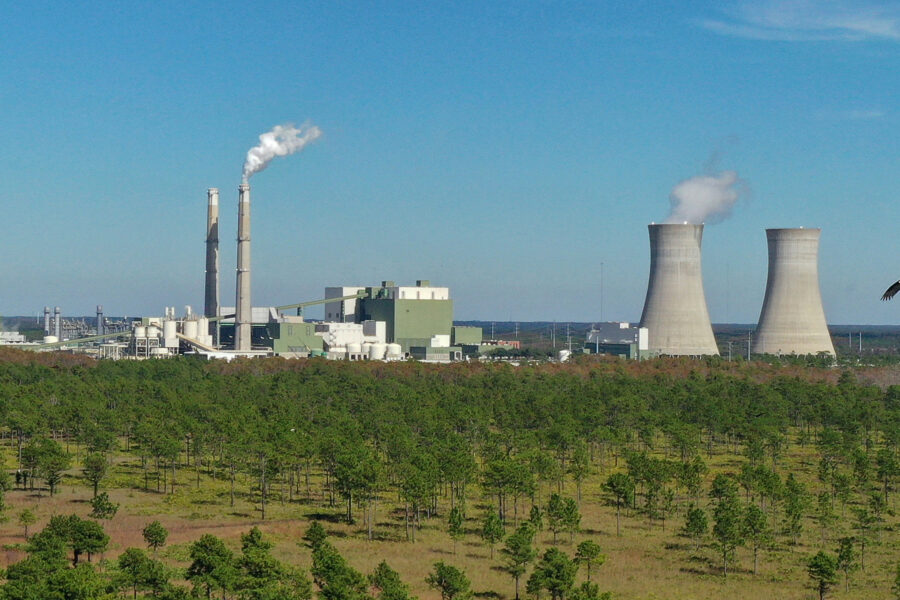
The first U.S. CCS coal plant demonstration project launched in West Virginia last year with a plan to captured just 1.5 percent of the AEP Mountaineer Plant‘s annual CO2 output and bury it 8,000 feet in a layer of dolomite rock.
In Leer’s view, the nation needs to sharply expand the number of CCS demonstration projects to the 15 to 20 recommended by the National Research Council, and Congress still needs to address the legal framework, such as long-term liability if a site leaks and ownership of the underground pore space, before it considers capping greenhouse gas emissions.
Leer and Rep. Shelly Moore Capito (R-W.Va.), whose district includes Massey Energy’s Upper Big Branch mine where 29 miners died last week, also suggested changing renewable energy standards so “renewable energy” would include carbon capture and storage and efficiencies at existing fossil fuel power plants.
“Coal’s issue is CO2. The solution is carbon capture and storage technology,” Leer said. “It can be done. It must be done if we’re going to stabilize global CO2 emissions.
“Without CCS, I don’t think we can achieve the goals outlined for 2050.”
Mine Safety
The hearing had its points of drama. As Boyce was testifying, three protesters wearing surgical masks and carrying lumps of coal interrupted by chanting “coal is dirty.” Rep. Jay Inslee (D-Wash.) also chastised the head of the Ohio Coal Association for repeatedly saying that the federal government was waging “a war on coal”: “We don’t give $60 billion to people we’re at war with. We don’t give $60 billion to Al Qaeda,” Inslee said. “We give $60 billion to industries we hope there’s a chance to save.”
On a more critical level, the executives talked about mine safety.
Massey Energy’s Upper Big Branch mine had been cited 123 times this year before the deadly explosion, including three straight weeks right before the explosion in which MSHA inspectors raised concerns about the mine’s ventilation plan, which is required to be designed to control methane and breathable dust. In January, the same mine received its highest single fines assessed for the year — $66,142 and $70,000 — both related again to the ventilation plan requirements.
“If I saw that level of violations at one of my mines, I would be quite concerned,” said Rio Tinto Chief Executive for Energy and Minerals Preston Chairo.
Boyce said all of Peabody’s board meetings start with safety discussions.
At Arch Coal, Leer said he looks at the violations report every week. He described some of those violations as “like a traffic ticket,” but said,
“If there is a violations that has endangerment and a major concern about safety, we’d better be on it before the inspector gets there.”
Massey CEO Don Blankenship, who did not attend Wednesday’s hearing, has come under fire for his handling of safety at Massey mines, with some major investors calling for his resignation.
CtW Investment Group Executive Director William Patterson wrote to Massey’s board of directors this week saying that under Blankenship’s “domineering leadership,” the company “placed short-term production and profit goals ahead of prudent risk management, with devastating consequences for the corporation, its shareholders and employees.”
New York State Comptroller Thomas DiNapoli, whose $129.4 billion New York State Common Retirement Fund controls about $14.1 million of shares of Massey stock, was less reserved in his call for Blankenship’s removal:
“Massey’s cavalier attitude toward risk and callous disregard for the safety of its employees has exacted a horrible cost on dozens of hard-working miners and their loved ones,” DiNapoli wrote. “This tragedy was a failure both of risk management and effective board oversight. Blankenship must step down and make room for more responsible leadership at Massey.”
DiNapoli filed a shareholder resolution to be considered this spring that calls for Massey to declassify its board so shareholders can more effectively weigh in its performance.
Blankenship, who outwardly questions climate science, has fought unions and pulled in $11 million in salary and benefits in 2008, stands behind his actions. His company issued a release about the violations saying: “Safety of our members has been and will continue to be our top priority every day.”
See also:
Obama: The Making of a Clean Coal President
Will West Virgina’s CCS Demo Make a Dent in ‘Clean Coal’s Problems?
Coal Mine Where 25 Died Had Been Fined Repeatedly for Safety Violations
(Capitol Photo: Greenpeace)
About This Story
Perhaps you noticed: This story, like all the news we publish, is free to read. That’s because Inside Climate News is a 501c3 nonprofit organization. We do not charge a subscription fee, lock our news behind a paywall, or clutter our website with ads. We make our news on climate and the environment freely available to you and anyone who wants it.
That’s not all. We also share our news for free with scores of other media organizations around the country. Many of them can’t afford to do environmental journalism of their own. We’ve built bureaus from coast to coast to report local stories, collaborate with local newsrooms and co-publish articles so that this vital work is shared as widely as possible.
Two of us launched ICN in 2007. Six years later we earned a Pulitzer Prize for National Reporting, and now we run the oldest and largest dedicated climate newsroom in the nation. We tell the story in all its complexity. We hold polluters accountable. We expose environmental injustice. We debunk misinformation. We scrutinize solutions and inspire action.
Donations from readers like you fund every aspect of what we do. If you don’t already, will you support our ongoing work, our reporting on the biggest crisis facing our planet, and help us reach even more readers in more places?
Please take a moment to make a tax-deductible donation. Every one of them makes a difference.
Thank you,