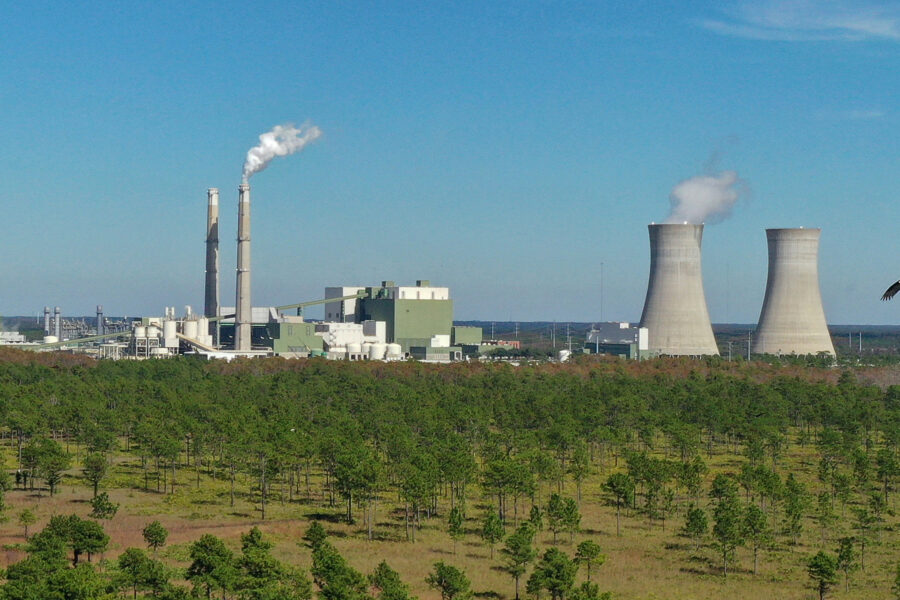
The biomass industry is demanding that U.S. EPA revamp newly proposed standards that would impose strict emissions limits on the boilers at its wood-burning plants, saying the billions in equipment upgrades would “endanger” the “entire renewable energy industry.”
The Biomass Power Association (BPA), a trade group with members in 20 states, said on Wednesday it is appealing to EPA for special protections under a series of maximum achievable control technology (MACT) standards for industrial boilers.
Two rules – the boiler MACT and the area source MACT – are at the heart of BPA’s concerns.
The association said they would impose unnecessary regulatory burden on a $1 billion industry that it says causes no environmental harm or public health threats.
“The problem is that EPA is trying to create this one-size-fits-all-approach — not distinguishing among fuels, and not distinguishing among boilers,” Bob Cleaves, BPA president and CEO, told reporters. “A one size fits all will not move the [biomass] industry forward.”
Cleaves said the rules would impact all of the nation’s current 100 biomass facilities. For potential new projects, he said, just the prospect of having to install state-of-the-art pollution controls is having a “chilling effect.”
“Because of that we are asking EPA [to move] on an expedited basis,” Cleaves said.
BPA submitted comments to the EPA on August 23, just as the 45-day comment period came to a close. Final regulations are expected at the end of the year.
Enesta Jones, an EPA spokesperson, told SolveClimate News that the agency intends to take BPA’s complaints into account.
“We will take comments from the association into consideration — along with all public comments — as we prepare our final regulations,” she said in email.
The biomass industry burns organic waste material — mainly wood — to make electric power, generating pollution, including particulate matter. Advocates say it is a proven carbon-neutral alternative to fossil fuels. But for opponents, an increase in biomass facilities would cause more air pollution and could lead to the destruction of vital carbon-absorbing forests.
Today’s controversy over the EPA rules highlights the uphill battle the industry faces in gaining recognition as a clean-burning fuel source.
In June, a study in Massachusetts set off a firestorm by claiming that burning woody biomass would be more polluting than coal for at least the next several decades. The study prompted a change in the way that state provides renewable energy incentives to biomass projects.
Boiler Standards Impossible to Meet
EPA’s MACT standards set limits on hazardous air emissions across 28 large industry sectors. Under the Clean Air Act, the agency must review them every eight years.
The boiler rules have been several years in the making.
Proposed on June 4, the standards would reclassify the boiler units at biomass plants as “incinerators.” The designation would subject them to stricter emissions limits for several toxic pollutants, including mercury, hydrogen chloride, manganese, carbon monoxide and dioxin.
The limits are impossible to meet, according to Cleaves. They would require installation of a non-existent “huber boiler” unit, he expained, with an emissions-reduction capacity “greater than what technology can possibly deliver in today’s world.”
“No such boiler can achieve all of the emissions standards that EPA is proposing in their rules,” he said.
Even if the standards could be achieved, Cleaves said they would cost “billions of dollars” and would force many plants to close, putting the nation’s effort to combat global warming in jeopardy.
“Virtually every major renewable energy policy at the federal and state level would come to an abrupt halt,” BPA wrote in its comments to the EPA.
According to BPA, biomass already provides over 50 percent of the nation’s renewable energy. DOE projects it could supply 14 percent of the nation’s total power needs by 2030.
Over 40 states and territories have adopted renewable portfolio standards that include biomass, the trade group says. California would be particularly hard hit by the new rules.
“If the result of this rule shuts down biomass boilers in the state of California, then [it] is going to have to revert to … open burning of solid fuels, which, from an air emissions standpoint, makes no sense,” Cleaves said.
BPA Wants ‘Flexibility’
Cleaves said it wants EPA to provide the biomass industry with “some type of flexibility” in meeting the boiler MACT restrictions; it is not seeking an exemption.
It also wants facilities to have the opportunity to meet the standards at “reasonable costs” and to demonstrate that emissions of certain pollutants do not pose a public health threat.
Cleaves suggested that two of the pollutants in particular — hydrogen chloride and manganese – pose no major public health threat. “There’s no basis for EPA to be proposing [regulations] at the level EPA is proposing.”
100 Members of Congress Echo Concerns
Beyond biomass, the EPA standards would affect a large number of powerful industries involved in the combustion of forest products and agricultural waste. Many in Congress are pushing the agency to proceed with caution.
That point was lost on EPA, accused Cleaves.
“We think that the right hand really doesn’t know what the left hand is doing,” he said.
“EPA is proposing a set of rules that by every indication we’re receiving could be devastating to our industry. This is the same industry that probably ten different agencies of the federal government, as well as the White House … have all been extremely supportive of…”
On August 2, 100 members of Congress — 69 Republicans and 31 Democrats – sent a letter to EPA Administrator Lisa Jackson, expressing their concern with the proposed boiler MACT rule.
“EPA should use a method to set emissions standards that is based on what real world best performing units actually can achieve,” the lawmakers wrote, adding that the regulations should “be crafted in a balanced way that sustains both the environment and jobs.”
Perhaps you noticed: This story, like all the news we publish, is free to read. That’s because Inside Climate News is a 501c3 nonprofit organization. We do not charge a subscription fee, lock our news behind a paywall, or clutter our website with ads. We make our news on climate and the environment freely available to you and anyone who wants it.
That’s not all. We also share our news for free with scores of other media organizations around the country. Many of them can’t afford to do environmental journalism of their own. We’ve built bureaus from coast to coast to report local stories, collaborate with local newsrooms and co-publish articles so that this vital work is shared as widely as possible.
Two of us launched ICN in 2007. Six years later we earned a Pulitzer Prize for National Reporting, and now we run the oldest and largest dedicated climate newsroom in the nation. We tell the story in all its complexity. We hold polluters accountable. We expose environmental injustice. We debunk misinformation. We scrutinize solutions and inspire action.
Donations from readers like you fund every aspect of what we do. If you don’t already, will you support our ongoing work, our reporting on the biggest crisis facing our planet, and help us reach even more readers in more places?
Please take a moment to make a tax-deductible donation. Every one of them makes a difference.