

Editor’s Note: This is the last in a three-part series on the development of seawater desalination plants in California and other drought-prone regions, looking at the environmental and economic challenges involved.
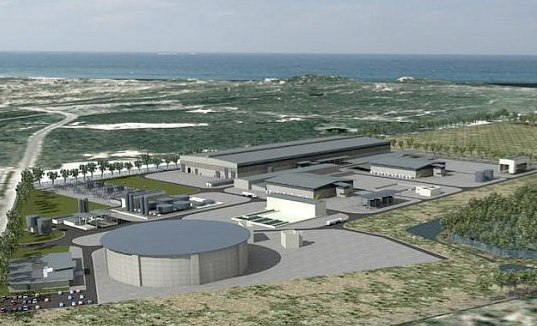
When California regulators this month approved a facility on the state’s central coast that would turn salty ocean water into drinking water, it was in the face of environmental concerns and warnings that the project’s hefty price tag could drastically hike customers’ water bills.
The $400 million public-private facility is expected to deliver 10 million gallons of water per day to residents of the Monterey Peninsula by the end of 2015. Project detractors say the plant is too energy hungry, and that it could increase water prices by up to four times their current rates.
But in the face of state-mandated cutbacks in water withdrawals from the nearby Carmel River, the utility and water agencies behind the project say they have nowhere else to turn.
In that sense, the Monterey project, one of more than a dozen proposed desalination plants on the U.S. West Coast, mirrors a situation on the other side of the world.
Australia ‘Ran Out of Water’
In Australia, desalination plants developed in response to severe and protracted drought. They could supply about one-third of the country’s water in the next two years, according to estimates.
“The main difference for Australia is that they truly ran out of water,” said Paul Choules, vice president for desalination and reuse for Veolia Water Solutions and Technologies, one of the world’s biggest desalination companies. “They had to move and they had to move quickly.”
Since the 1970s, southwest Australia has seen declines of up to 20 percent in its annual rainfall. In the past decade, a drought said to be the worst in more than 100 years parched much of the country and forced state and local agencies to look to alternate water sources.
Through analysis of increased snowfall in Antarctica, scientists have pegged climate change as a cause of the extreme weather, and predict that water shortages will only intensify in the future for what is already the driest inhabited continent.
“Certainly the need has been identified there with climate change,” said Lisa Henthorne, director of the International Desalination Association, a Topsfield, Mass.-based nonprofit group. “Demand and lack of alternatives is pushing [desalination].”
In southeast Australia, for example, droughts are projected to increase up to 40 percent by 2070.
“The effect of climate change on the hydrological cycle, and the consequences for water resources, is one of the most important aspects of climate change for societies around the world, and particularly for Australia,” according to a 2009 report from the Australian Government’s Department of Climate Change.
Global ‘Water Bankruptcy’
Australia’s water pains may presage what’s to come in other regions as the world teeters on the verge of what the World Economic Forum has called “water bankruptcy.”
By 2025, 1.8 billion people around the world will be living in water-scarce regions, while two-thirds of the world’s population could be under stressed water conditions, according to the UN figures.
Australia isn’t the only country to tap into the ocean to augment water supplies. Worldwide, more than 15,000 desalination plants in about 150 countries produce about 65 million cubic meters of fresh water each day, according to the International Desalination Association, which defines desalination as any process that involves removing dissolved solids from water.
In the U.S., a handful of cities already rely on desalination. In Tampa, Fla., the largest operating seawater desalination plant in North America provides the region with about 25 million gallons of drinking water daily, enough to meet about 10 percent of the region’s needs.
In 2010, the coastal town of Sand City, Calif., fired up a small desalination facility near the proposed Monterey plant, making it the first city in the state to draw drinking water from the Pacific Ocean.
Algeria is building what is slated to be the world’s biggest reverse osmosis seawater desalination plant. It is expected to produced 500,000 cubic meters of water per day. Plans are in the works in Israel for a slightly larger one.
In Australia, a plant expected to be the country’s largest is forecast to be completed in 2011 near Melbourne, which in recent years has seen both record high temperatures and record low water stores. The Wonthaggi plant is expected to generate 440,000 cubic meters of water per day — enough to supply about one-third of Melbourne’s household and industrial needs.
The economics of desalination, and whether the technology is worth the high price — desalinated water can cost more than $1 per cubic meter — depends in part on geography. In the Middle East, for instance, fossil fuels are cheaper while water supplies are scarce, which makes desalination pencil out.
In Australia, the cost of desalination is more than about $3 billion per plant. But experiencing the impacts of water shortages firsthand has made Australia more willing to foot the bill for costly projects, said Heather Cooley, a senior research associate at the Pacific Institute, an Oakland, Calif.-based research group that focuses on water issues.
“In Australia they’re very concerned about climate change,” Cooley said. “They understand that what they’re experiencing now, there will be more of it in the future.”
About This Story
Perhaps you noticed: This story, like all the news we publish, is free to read. That’s because Inside Climate News is a 501c3 nonprofit organization. We do not charge a subscription fee, lock our news behind a paywall, or clutter our website with ads. We make our news on climate and the environment freely available to you and anyone who wants it.
That’s not all. We also share our news for free with scores of other media organizations around the country. Many of them can’t afford to do environmental journalism of their own. We’ve built bureaus from coast to coast to report local stories, collaborate with local newsrooms and co-publish articles so that this vital work is shared as widely as possible.
Two of us launched ICN in 2007. Six years later we earned a Pulitzer Prize for National Reporting, and now we run the oldest and largest dedicated climate newsroom in the nation. We tell the story in all its complexity. We hold polluters accountable. We expose environmental injustice. We debunk misinformation. We scrutinize solutions and inspire action.
Donations from readers like you fund every aspect of what we do. If you don’t already, will you support our ongoing work, our reporting on the biggest crisis facing our planet, and help us reach even more readers in more places?
Please take a moment to make a tax-deductible donation. Every one of them makes a difference.
Thank you,