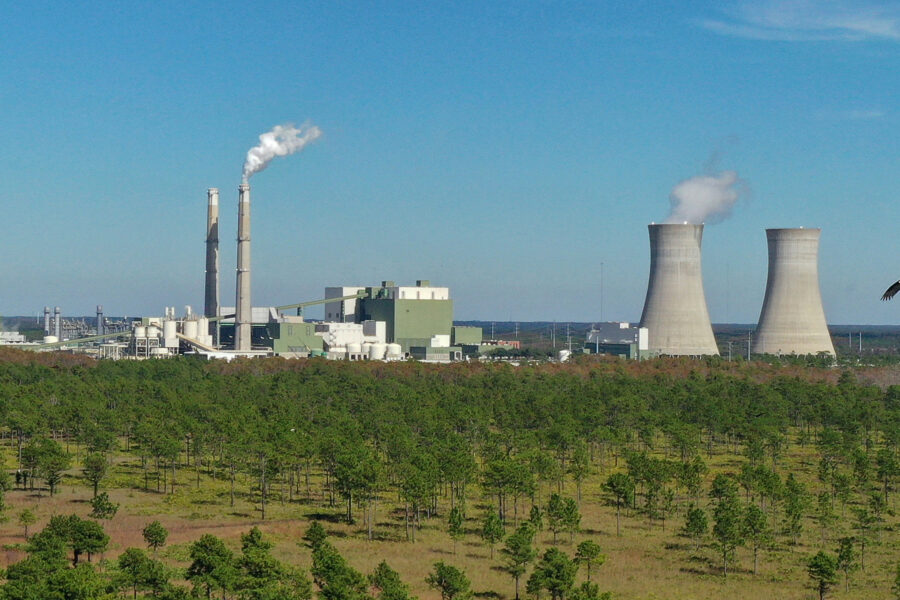
Editor’s Note: In this three-part series, SolveClimate News examines the feasibility of closing the Indian Point nuclear facility in Buchanan, N.Y. The plant, now up for relicensing, faces demands for a shutdown by Gov. Andrew Cuomo and many environmental groups. This is part two. (Read part one.)
Renewed backlash against New York’s Indian Point nuclear plant in the wake of Japan’s disaster has forced politicians and energy experts in the state to again confront tough questions about how to permanently replace the facility’s electricity.
Now, with the plant up for relicensing, some observers warn that time may have run out for a well-managed and gradual shutdown of the complex, located just 24 miles from America’s most populous city.
The 40-year licenses for Indian Point’s working reactors, units 2 and 3, are set to expire in 2013 and 2015. The plant’s owner, Entergy Corp., is awaiting final word from the Nuclear Regulatory Commission on its applications for 20-year renewals.
The complex fills a significant portion of the downstate area’s energy needs, generating about 2,160 megawatts of clean-burning electricity — enough to power 3.2 million households or 25 percent of New York City and Westchester County’s combined electrical needs.
Three options to replace Indian Point stand out. One, local fossil fuel sources such as natural gas could generate more electricity. Two, excess hydroelectric power or wind power generated upstate or in Canada could be transported downstate. And three, consumers could drastically cut their electricity use.
All appear relatively simple and, together, offer promise. But closer inspection shows there is a great deal of complexity involved.
Switching to replacement power generation in New York City, for instance, would be costlier and dirtier than nuclear power at a time of economic distress for the nation, and when top climate experts agree that carbon emissions must be reduced.
And, while New York’s excess energy flow would be enough to generate two Indian Point’s worth of electricity, current transmission wires are insufficient to carry the megawatts downstate.
“There are no easy answers,” said Lindsay Audin, president of Energywiz, a Croton on Hudson, N.Y.-based energy consulting firm, at a recent meeting convened near Indian Point to brainstorm ways to shutter the plant.
Is it Too Late to Prevent a Power Disruption?
For at least one month a year, New York City gets no power from one of the two Indian Point reactors when they are taken offline for routine maintenance.
Some say this is evidence that the city already has substitute power for Indian Point for the long term — although many experts dispute this. Further, various studies commissioned to examine how to replace Indian Point’s power permanently suggest that preparations should have begun years ago.
Most significant among these was the 104–page report commissioned by the Department of Energy at the request of Congress in the wake of the 9/11 attacks, and published by the National Academies in 2006.
The study, “Alternatives to the Indian Point Energy Center for Meeting New York Electric Power Needs,” cost over $1 million and took more than a year to complete. It included input from dozens of scientists, politicians and environmentalists, along with professionals from Indian Point, Con Edison and General Electric.
The report’s main conclusion was that if “sufficient resources were added,” then “Indian Point units could be retired at the end of their current operating licenses [2013 and 2015] without causing a major disruption of power capacity.”
To achieve this, the authors said the downstate region, which includes New York City, Long Island and nearby suburbs, would need 5,000 to 5,500 megawatts in new resources by 2015 — half of that from natural gas plants — on top of new transmission and other actions. They based this figure on estimates that 3,300 additional megawatts of power would be needed “even if Indian Point continues to operate.”
“The report does not propose a ‘single solution’ to the replacement of Indian Point,” the authors wrote. A replacement strategy “would most likely consist of a portfolio of approaches … including investments in energy efficiency, transmission and new generation.”
Despite the time, money and expertise put into completing the study, advocates say its recommendations have been ignored, leaving New York City nearly as dependent on Indian Point as it was in 2006.
Testifying before the State Senate Standing Committee on Energy in May, Stephen Whitley, president of the New York Independent System Operator (NYISO), which oversees the state’s power markets and distribution, said New York is not yet prepared for a shutdown.
“The immediate shutdown of Indian Point without replacement resources could have serious electric reliability consequences … including rolling blackouts,” he told them. “The economic costs … can total billions of dollars a day.”
Fossil Fuel Capacity Available
For more than half of the last century, New York City relied on power generated outside the city to meet most of its electrical needs.
But after the Northeast Blackout of 1965, the city has required that generating stations within its five boroughs be able to provide 80 percent of the city’s power at any given time — although it is not mandated to purchase or use that much.
New York City relies almost entirely on fossil fuels to meet this capacity requirement. According to a 2008 NYISO analysis, 95 percent of the city’s generation comes from natural gas- and oil-generating plants compared with 15 percent in the rest of the state.
The 2006 National Academies assessment recommends that five new natural gas- or oil-fired plants, providing approximately 500 megawatts each, be built to replace Indian Point.
If these plants were built “you could take Indian Point out, and the lights won’t go out,” said James M. Van Nostrand, executive director of Pace Energy and Climate Center in White Plains, N.Y.
“But, you would be replacing a very cheap form of electricity with a very expensive resource,” he said. “It’s all a matter of price.” The new Astoria Energy II gas-fueled plant in Queens, for example, cost more than $1 billion to build.
‘Very Limited Options,’ and the Clock Is Ticking
Already, New York’s electricity prices are about 70 percent higher than the U.S. average, according to U.S. Energy Information Administration statistics. Replacing nuclear power — which becomes relatively cheap after paying off construction costs — with more expensive gas-fired plants would increase electricity prices by an additional 5 to 8 percent, Van Nostrand said.
Cost, he said, is not the only hurdle.
While Indian Point opponents suggest a litany of possible replacements — from gas to wind and solar power — the reality, said Rick Gonzales, senior vice president of NYISO, is that “there are very limited options” for new sources of generation before Indian Point 2’s operating license expires in 2013.
For now, they come down to the Astoria Energy II natural gas plant, which began providing another 576 megawatts of power to New York City on July 1, and the Bayonne Energy Center, a 500-megawatt gas plant expected to come online by next year.
Together, these projects could provide New York City with 1,076 additional megawatts of power — not enough to cover projected increases in the city’s electricity demand. According to NYISO estimates, the city will need an additional 1,150 megawatts by the next decade, even after factoring in reduced energy use from the current recession.
5,000-MW Excess in Upstate NY
New York State alone produces more than 38,000 megawatts of power from a combination of hydroelectric, nuclear, coal, wind, natural gas and oil, according to NYISO assessments.
In fact, the region produces so much power that it has a 5,070-megawatt “cushion” of excess reserve margin. If this could reach New York City it would make up for the electricity generated by Indian Point, two times over.
The problem is getting it downstate.
Already, 11,000 circuit miles of old and clogged transmission lines snake across the state. NYISO reports that 85 percent of high-voltage transmission lines are more than 30 years old, while some are more than 100 years old.
While private transmission cables have been added to connect New York to neighboring power systems, 20 years have passed since the state government added a new link, Gonzales of NYISO said.
During peak periods of electrical use, transmission lines often reach capacity. To improve this — and possibly compensate for an Indian Point shutdown — the state is currently undergoing a statewide assessment to learn what transmission upgrades could give the biggest bang for the buck.
Cautious Optimism Over Transmission Lines
Proposed transmission projects could potentially go online by 2015, when unit 3’s license is set to expire, Gonzales said — or even earlier.
The Hudson Transmission Project project, for instance, could come into service as early as 2013. The line would transport up to 660 megawatts of electricity, including renewables, from Ridgefield, New Jersey, to midtown Manhattan. PowerBridge of Fairfield, Conn., plans to invest approximately $850 million into the private project, according to company documents.
Recently endorsed by Gov. Andrew Cuomo, the developers received approval from the New York Power Authority to bring 320 megawatts of the line’s total capacity via an eight-mile buried transmission cable, four miles of which would be installed beneath the Hudson River. Construction began in May.
Another proposed transmission project called the Champlain Hudson Power Express would carry 1,000 megawatts of Hydro Quebec’s hydropower resources 355 miles from Canada to New York City. The project won key New York State approval last month when the New York Department of State certified that its plan is consistent with New York’s Coastal Zone Management Program. It now faces its final hurdles: approval from the federal Department of Energy and Army Corps of Engineers.
But New York State has a long history of similar projects that ultimately go nowhere, Gonzales cautioned. “It is unclear at this time whether these projects will actually be built.”
The core problem is funding.
Companies in the business of selling electricity such as PowerBridge typically pay the cost of building transmission lines. And over the years, many investors have been tempted by the income potential of meeting downstate demand with relatively cheap upstate excess electricity.
But plans to fund new transmission lines often become bogged down by political and even environmental opposition that delay work and cause funding shortfalls. Albany-based Conjunction LLC, for instance, announced plans in 2003 to invest approximately $700 million to bring 2,300 megawatts of surplus electricity from Canada to downstate New York.
This would have been enough to replace Indian Point’s 2,160 megawatts of electricity.
But environmental groups, including opponents to Indian Point, criticized the company’s initial plan to string a power line on towers lined along the Hudson River. They dropped their opposition when Conjunction LLC modified its plans to instead run a 135-mile transmission line underground along the New York Thruway.
But by then major investors had pulled out of the project and killed its prospects.
Energy Efficiency is Especially Difficult
Cutting electricity demand as a way to reduce dependence on Indian Point is a particularly difficult challenge, said Audin of Energywiz.
“As a general rule, we are happy if we can keep a facility’s peak demand and usage stable or reduce it slightly through energy efficiency upgrades,” he said.
Just countering the approximately 1 percent per year load growth in the New York City area would require cutting demand by more than 100 megawatts per year, he said.
“Even with hefty rebates, that has only rarely occurred.”
In the meantime, New York State is experimenting with a variety of energy efficiency programs to lower energy consumption. This summer it plans to reduce over 2,000 megawatts during peak periods through financial incentives and other consumer-oriented programs, a reduction that NYISO has already factored into its calculations of current electrical needs.
The recession helped bring energy use below pre-recession levels, according to NYISO calculations. But usage in New York City completely recovered in 2010, and is expected to increase as economic growth returns.
Boosting electricity prices, a highly unpopular measure, could also cut demand. According to Audin’s figures, cutting usage by 1 percent requires a 10 percent price hike, while reducing usage by 10 percent would require a near doubling of price.
When this occurred during Gov. Gray Davis’s administration in California he was recalled and replaced by Arnold Schwarzenegger.
For his part, Gov. Andrew Cuomo, a staunch opponent of Indian Point, who has recently heightened his opposition to the facility, admitted at a recent news conference that the state has no viable substitutes “at this time.”
However, “could you have replacement power for Indian Point?” he asked. “Yes.”
Monday: Part 3, What would be the economic costs of an Indian Point shutdown to Westchester County and New York City?
About This Story
Perhaps you noticed: This story, like all the news we publish, is free to read. That’s because Inside Climate News is a 501c3 nonprofit organization. We do not charge a subscription fee, lock our news behind a paywall, or clutter our website with ads. We make our news on climate and the environment freely available to you and anyone who wants it.
That’s not all. We also share our news for free with scores of other media organizations around the country. Many of them can’t afford to do environmental journalism of their own. We’ve built bureaus from coast to coast to report local stories, collaborate with local newsrooms and co-publish articles so that this vital work is shared as widely as possible.
Two of us launched ICN in 2007. Six years later we earned a Pulitzer Prize for National Reporting, and now we run the oldest and largest dedicated climate newsroom in the nation. We tell the story in all its complexity. We hold polluters accountable. We expose environmental injustice. We debunk misinformation. We scrutinize solutions and inspire action.
Donations from readers like you fund every aspect of what we do. If you don’t already, will you support our ongoing work, our reporting on the biggest crisis facing our planet, and help us reach even more readers in more places?
Please take a moment to make a tax-deductible donation. Every one of them makes a difference.
Thank you,