The momentum building behind carbon capture and sequestration as the future for coal-rich Montana deflated a little yesterday with the death of a carbon sequestration bill in the state legislature. That led immediately to partisan finger-pointing, because with both the White House and Congress getting behind the technology, the stakes are higher than ever.
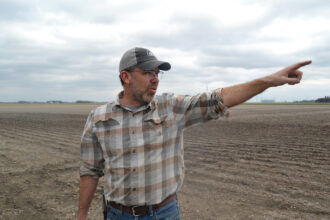
Republicans in Montana tried to push an overly industry-friendly bill that Democrats – even Gov. Brian Schweitzer (above), a strong supporter of the technology – could not stomach. The Billings Gazette covered the news from the statehouse:
"The problem was that the sponsor of the bill, he doesn’t know CO2 from Coca-Cola," Schweitzer said. "He couldn’t even explain his own bill. I have to question his motives. The committee did exactly the right thing [in killing it]. It was a terrible bill."
Supporters argue that Carbon Capture and Sequestration, or CCS – a collection of expensive and complex technologies under development to capture, liquefy and permanently store CO2 underground – would cut climate-changing greenhouse gas emissions while also keeping coal near the top of the energy food chain.
The draft federal climate bill released last week by Reps. Henry Waxman and Ed Markey includes a robust package of provisions to encourage CCS development, and at the annual EIA conference this week, Joe Aldy, special assistant to the president for energy and the environment, called CSS "a priority" for the Obama administration.
“We believe it’s an important part of energy policy moving forward,” Aldy said.
It’s also a big and expensive gamble.
Nobody knows what will happen when millions of tons of CO2 are pumped underground. Demonstration projects exist, but they are small. There is concern that the CO2 can combine with groundwater to form carbonic acid and pollute drinking water supplies, and that it can migrate great distances across property lines, and perhaps even escape into the atmosphere. Without clarity on who will be responsible for the behavior of the gas, investors will not support industrial-scale development of CCS.
Montana sees where the government is going on climate. It wants to be first to attract large pools of federal funding to develop CCS, so lawmakers are trying to quickly craft the legal and regulatory framework to make Montana a leader in the field. Perhaps too quickly.
Democrats objected to SB498 as being completely favorable to industry. The bill defined underground CO2 as nontoxic and allowed transfer of ownership of the vast underground deposits of CO2 to the state after only 20 years. Democrats didn’t want the state to assume ownership of the CO2 for 75 years – after there was far more certainty of its long-term safety.
The bill stipulated that if anything went wrong after 20 years, taxpayers would have to foot the bill for liability, with industry getting a free pass. The bill, sponsored by Republican Sen. Keith Bales, would have helped generate great private rewards for industry at great public risk.
There was also contention over the question of who owns the pore space in underground rocks. Do property owners also own the microscopic gaps inside the rocks under their own land – where the CO2 would lodge? The governor thinks not, and argues that it belongs to the state.
“Just because you live along a river, doesn’t mean you own it. Just because you live above an aquifer, doesn’t mean you own it,” he said.
That puts Schweitzer up against landowners who don’t want to cede rights beneath their land. They figure that the mini-storage space for CO2 is worth some rental payments from energy companies.
"Landowners want control of pore space," said Gwen Lachelt, director of EarthWork’s Oil and Gas Accountability Project based in Durango, Colo. She’s worked for more than two decades on landowner protection issues, and she’s seen their rights trampled on repeatedly.
"There’s a lot of nervousness about CCS. It’s an out-of-control truck coming down the highway, and you have to decide how to deal with it. Can you do this and protect potable water? There are huge questions marks out there," Lachelt said.
In the neighboring Canadian provinces of Alberta and Saskatchewan, landowners do not have ownership of pore space beneath their property. The laws there are providing a model for Schweitzer, who is already looking northwards for partners on CCS development.
Last month, the governor invited Saskatchewan Premier Brad Wall to attend a meeting of the Democratic Governors Association in Big Sky that he was hosting. In a meeting closed to the public, Wall touted a $60 million CCS pilot project that would transport Canadian CO2 across the border for storage in a test site in Montana.
Schweitzer wants to add $100 million from federal coffers to the project, which eventually would end up costing $250 million.
The project calls for storing 1,000 tons of CO2 in a geological formation called the Bowdoin Dome in northeastern Montana, and monitoring its behavior, but it’s unclear what the project would accomplish. A thousand tons of CO2 is a miniscule amount, not enough to bring scientific certainty to resolve a host of questions about long-term sequestration which need answering.
Until a bill gets through the legislature to the governor’s desk and answers the question about ownership of pore space and other unfamiliar issues in this brand new territory of environmental law, CCS is going to be stalled. And, so far, that seems like good news, with the safety of drinking water supplies, landowner rights and the Montana taxpayers’ liability all on the line.
See also:
Exuberance over Carbon Capture and Storage Ignores Time Frame for Deployment
About This Story
Perhaps you noticed: This story, like all the news we publish, is free to read. That’s because Inside Climate News is a 501c3 nonprofit organization. We do not charge a subscription fee, lock our news behind a paywall, or clutter our website with ads. We make our news on climate and the environment freely available to you and anyone who wants it.
That’s not all. We also share our news for free with scores of other media organizations around the country. Many of them can’t afford to do environmental journalism of their own. We’ve built bureaus from coast to coast to report local stories, collaborate with local newsrooms and co-publish articles so that this vital work is shared as widely as possible.
Two of us launched ICN in 2007. Six years later we earned a Pulitzer Prize for National Reporting, and now we run the oldest and largest dedicated climate newsroom in the nation. We tell the story in all its complexity. We hold polluters accountable. We expose environmental injustice. We debunk misinformation. We scrutinize solutions and inspire action.
Donations from readers like you fund every aspect of what we do. If you don’t already, will you support our ongoing work, our reporting on the biggest crisis facing our planet, and help us reach even more readers in more places?
Please take a moment to make a tax-deductible donation. Every one of them makes a difference.
Thank you,