A new report claims the world can scale up eight clean technologies so massively and rapidly they could meet 60 percent of new energy demand and abate more CO2 than is necessary for climate stabilization in just 10 years.
Naturally, this scale-up won’t come cheap. The report estimates that annual private investment worldwide would need to triple between now and 2020 to reach $500 billion to $800 billion per year:
At this scale, clean energy investments would be in line with fossil-fuel investments.
This is not as far-fetched as it seems. Current global investment plans for maintaining and expanding energy infrastructure are on the order of $13 trillion over the next 10 years. The United States alone has a planned investment of close to $1 trillion.
Shift a sizable chuck of that money into ready cleantech solutions, the authors argue, and the results would be world changing: climate mitigation, energy security and 5 million new jobs planetwide.
"The Gigaton Throwdown" report is the brain child of Sunil Paul, the cleantech venture capitalist and founder of Silicon Valley’s Spring Ventures.
In 150 pages, Paul and a team of investors, CEOs and researchers seek to redefine what’s possible for clean energy by 2020. And they do it through an uncommon metric: the gigascale.
To attain gigaton scale, a single technology must reduce annual emissions of carbon dioxide and equivalent greenhouse gases (CO2e) by at least 1 billion metric tons — a gigaton — by 2020. For an electricity generation technology, this is equivalent to an installed capacity of 205 gigawatts (GW) of carbon-free energy (at 100 percent capacity factor) in 2020.
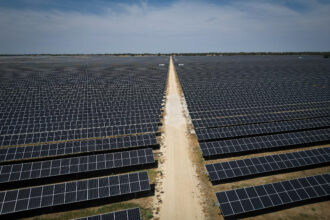
Specifically, the researchers analyzed nine clean energy technologies "currently attractive to investors" for their potential as gigascale solutions. Eight met the criteria, seven of which are ready for aggressive deployment today.
They are: building efficiency, concentrating solar power, construction materials, nuclear, biofuels, solar photovoltaics and wind.
Each of the eight solutions could feasibly deliver a giagaton of global energy, and each could avoid one gigaton of emissions from being discharged into the atmosphere by 2020.
Notably, just one of the technologies, geothermal, requires an intense period of R&D and pilot plants for new enhanced geothermal systems (EGS) before it can be "gigascale ready." Wind power, for its part, is already growing fast enough to achieve that mark, the report says:
The wind industry has been growing at an annual rate of 28 percent over the past decade and will soon reach 150 gigawatts of installed capacity globally. At currently projected growth rates, it will exceed half a terawatt (TW) of installed capacity by 2020 and deliver close to 1.5 gigatons of CO2e emissions reductions.
Plug-in hybrid electric vehicles were the sole technology among the nine considered not to make the cut. The reason? The industry would need an estimated 300 million of them on the road in 2020. That’s equivalent to the total number of new cars to be added to the fleet worldwide in the next 10 years.
Having a gigaton of new nuclear capacity on the list (with a price tag of $1.27 trilllion) may raise eyebrows, although the authors do deliver a disclaimer: "Concerns surrounding weapons proliferation, waste disposal, and safety make nuclear uniquely challenging."
Same with biofuels as a replacement for gasoline. The report clearly states that corn-based ethanol "cannot deliver 1 gigaton of Co2e reductions because of massive land use requirements." The answer they say is in next generation fuels like cellulosic ethanol.
If it’s tough to wrap your brain around the magnitude of a gigaton, the Department of Energy has a guide. There they list the monster actions that add up to one gigaton of CO2 mitigation, including:
- replacing 1,000 conventional 500 MW power plants with "zero-emission" power plants;
- deploying 1 billion cars running at 40 mpg instead of 20 mpg;
- installing 150 times the current U.S. wind generation;
- or installing 10,000 times the current U.S. solar PV generation.
Gigascale growth is clearly dramatic. But there is precedent for it, the study authors say, namely in the IT sector in the United States.
In 20 years, IT has gone from a tiny Internet and mobile phone sector to a trillion-dollar sector that now employs more than 1 million people directly in the U.S. The key? Stable and supportive government policy.
With favorable cleantech policies and heavy investment, America has the opportunity to repeat the boom, the authors say:
With more than 140 funded solar start-ups and numerous start-ups in all of the other clean energy categories, these technologies could flourish in the U.S., given the right policy support.
Rather than importing energy sources, the U.S. could be in a position to export to other countries with burgeoning energy markets.
John Holdren, President Obama’s top science advior, put his stamp of approval on the "Gigaton Throwdown:"
"Investments in clean energy technologies — and policies that encourage those investments — can pay off handsomely with jobs and economic growth while reducing our dependence on foreign and tempering the impacts of climate change," he said in a statement on the report.
The policies required for success are financial incentives, regulatory structure and infrastructure development, the report says. The authors call for a meaningful price on carbon immediately:
It’s the single most important action that will encourage investment across the clean energy sector and ensure that capital flows to the most cost-effective technologies.
The signatories on the study include some heavy hitters in the cleantech sector: Raj Atluru, managing director of Draper Fisher Jurvetson; Andrew Beebe, managing director of Suntech Energy Solutions; Dan O’Shei, CEO of AltaRock; and Bill Gross, CEO of eSolar and founder of Idealab, among others.
In a shared statement, they agree that the U.S. — and the world — needs a price signal on global warming pollution as the central step to a quantum jump in clean energy:
The central reform must be a comprehensive carbon policy that puts a price on carbon for the long term. Without such a policy, cleantech energy pathways will grow slowly and in most cases fail to affect climate change. With such a policy, we can achieve gigaton scale by 2020, stabilize the climate, and create a new industry.
About This Story
Perhaps you noticed: This story, like all the news we publish, is free to read. That’s because Inside Climate News is a 501c3 nonprofit organization. We do not charge a subscription fee, lock our news behind a paywall, or clutter our website with ads. We make our news on climate and the environment freely available to you and anyone who wants it.
That’s not all. We also share our news for free with scores of other media organizations around the country. Many of them can’t afford to do environmental journalism of their own. We’ve built bureaus from coast to coast to report local stories, collaborate with local newsrooms and co-publish articles so that this vital work is shared as widely as possible.
Two of us launched ICN in 2007. Six years later we earned a Pulitzer Prize for National Reporting, and now we run the oldest and largest dedicated climate newsroom in the nation. We tell the story in all its complexity. We hold polluters accountable. We expose environmental injustice. We debunk misinformation. We scrutinize solutions and inspire action.
Donations from readers like you fund every aspect of what we do. If you don’t already, will you support our ongoing work, our reporting on the biggest crisis facing our planet, and help us reach even more readers in more places?
Please take a moment to make a tax-deductible donation. Every one of them makes a difference.
Thank you,