While the world’s governments struggle to agree on emissions cuts that would keep atmospheric CO2 from exceeding 450 ppm, a growing number of climate experts are warning that even that target is too high.

British economist Nicholas Stern is the latest to recommend 350 ppm instead. Stern, whose 2006 Stern Review spelled out for the world the economic crises that would accompany climate change, told a reporter in Germany that 350 ppm — rather than 450 ppm — would be “a very sensible long-term target.”
“It is most important to stop the increase of flows of emissions short term and then start the decline of flows of annual emissions and get them down to levels which will move concentrations of CO2 back down towards 350 ppm," Stern said.
The world has already exceeded 350 ppm, with atmospheric CO2 nearing 390 ppm right now and rising.
The 450 ppm target was agreed upon two years ago by the hundreds of scientific participants on the Intergovernmental Panel on Climate Change as the upper limit to avoid dangerous climate change. If atmospheric CO2 levels surpass that mark, the IPCC said, the global temperature will rise more than 2 degrees Celsius above pre-industrial levels.
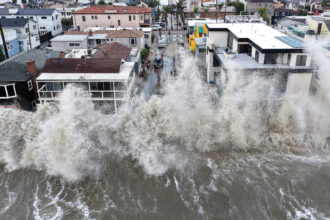
Beyond 2 degrees, scientists say, the ability of ecosystems to adapt rapidly declines, leading to rising oceans, water and food shortages, and the spread of diseases. Even now, rising sea levels are already turning residents of Carteret Island and parts of Fiji into climate refugees. In Alaska, melting permafrost and sea ice are forcing coastal residents to move. And droughts and disappearing glaciers are creating water problems for farmers and residents from India to Kenya to California.

At the time the IPCC issued its 2007 assessment, it recommended that to keep the temperature rise under 2 degrees and atmospheric greenhouse gases below 450 ppm, developed countries would have to cut their emissions by at least 25% below 1990 levels by 2020.
Few countries have set goals anywhere close to that. The climate bill passed by the U.S. House would take emissions down to about 1990 levels in 2020. If every country followed the U.S. 2020 target, the IPCC predicts greenhouse gas levels would be on track to reach levels closer to 650 ppm, well into the danger zone.
More people are now embracing 350 ppm as the safer target because the science is so obvious, said author Bill McKibben, whose group 350.org plans a Global Day of Climate Action on Oct. 24.
"If 390 ppm melts the Arctic, 450 is clearly a very bad idea," McKibben said from Mexico City, where he is organizing support for stronger climate action.
To get the world to 350 ppm, "it would take a great deal more political will to make such a tough agreement possible — and there’s only one way to generate political will, which is why we’re working so hard to build a movement. And that movement is really really growing fast!"
IPCC Chairman Rajendra Pachauri personally endorsed 350 ppm last month, though the IPCC’s official position has not changed.

"As chairman of the Intergovernmental Panel on Climate Change, I cannot take a position because we do not make recommendations," Pachauri told AFP. "But as a human being I am fully supportive of that goal. What is happening, and what is likely to happen, convinces me that the world must be really ambitious and very determined at moving toward a 350 target."
Along with Stern and Pachauri, Canadian environmentalist David Suzuki, Nobel Prize winners Desmond Tutu and Al Gore, and NASA climate scientist James Hansen have all endorsed the 350 ppm target.
To get there, Hansen recommends phasing out coal for starters.
“If humanity wishes to preserve a planet similar to that on which civilization developed and to which life on Earth is adapted, paleoclimate evidence and ongoing climate change suggest that CO2 will need to be reduced from its current 385 ppm to at most 350 ppm," Hansen wrote in a 2008 scientific paper.
“An initial 350 ppm CO2 target may be achievable by phasing out coal use except where CO2 is captured and adopting agricultural and forestry practices that sequester carbon. If the present overshoot of this target CO2 is not brief, there is a possibility of seeding irreversible catastrophic effects.”
See also:
Thawing Permafrost Could Emit Massive Amounts of Greenhouse Gases
Melting Ice Could Lead to Massive Waves of Climate Refugees
Government Report Brings Climate Change to America’s Backyard
Report: At 385 PPM, Current CO2 Level Already in “Dangerous Zone”
James Hansen on Climate Tipping Points and Political Leadership
Bad and Getting Worse: Surge in CO2 Emissions Damaging World’s Oceans
About This Story
Perhaps you noticed: This story, like all the news we publish, is free to read. That’s because Inside Climate News is a 501c3 nonprofit organization. We do not charge a subscription fee, lock our news behind a paywall, or clutter our website with ads. We make our news on climate and the environment freely available to you and anyone who wants it.
That’s not all. We also share our news for free with scores of other media organizations around the country. Many of them can’t afford to do environmental journalism of their own. We’ve built bureaus from coast to coast to report local stories, collaborate with local newsrooms and co-publish articles so that this vital work is shared as widely as possible.
Two of us launched ICN in 2007. Six years later we earned a Pulitzer Prize for National Reporting, and now we run the oldest and largest dedicated climate newsroom in the nation. We tell the story in all its complexity. We hold polluters accountable. We expose environmental injustice. We debunk misinformation. We scrutinize solutions and inspire action.
Donations from readers like you fund every aspect of what we do. If you don’t already, will you support our ongoing work, our reporting on the biggest crisis facing our planet, and help us reach even more readers in more places?
Please take a moment to make a tax-deductible donation. Every one of them makes a difference.
Thank you,