When the House passed its version of a federal climate bill in June, lawmakers included a provision to handcuff the Environmental Protection Agency when it came to greenhouse gas emissions from the nation’s biggest polluters.
Bowing to demands of coal state Democrats, lawmakers effectively agreed that the agency shall not regulate “stationary sources” for CO2 — in other words, hands off the greenhouse gases from coal plants and large industries.
Today in the Senate, those handcuffs came off. The Senate climate bill introduced by Sens. Barbara Boxer and John Kerry made no mention of restricting EPA authority the way the House version did, and the agency wasted no time in raising both free hands in a move that put it emphatically center stage in the climate game.
Just hours after the roll-out of the Boxer-Kerry bill, EPA issued a press release explaining how it plans to control emissions from big polluters, including new power plants, by establishing common sense regulatory rules. EPA Administrator Lisa Jackson announced the details during a keynote address at the Governors’ Global Climate Summit in California.
“We will not continue with business as usual while waiting for Congress to act,” Jackson said from the podium.
It was the same Global Climate Summit where last November a newly-elected Barack Obama delivered a videotaped message, vowing U.S. leadership on climate change, and made instant global news.
While today’s EPA announcement is not likely to be appreciated worldwide, it does provide evidence of the Obama administration’s commitment to climate action ahead of international talks in Copenhagen. It is also an important regulatory development that will help determine whether the U.S. will really be able to reduce domestic industrial emissions of greenhouse gases or not.
Absent EPA authority, large loopholes and handouts in both the Senate and House versions of the climate bill will make it difficult, if not impossible, for the nation to depart from the trajectory of business as usual for decades. That’s why one of the fiercest upcoming battles in the partisan war over federal climate law will be over the reach and authority of the EPA in reducing greenhouse gas emissions.
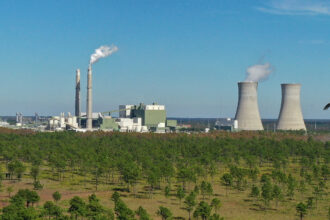
The 416-page proposal EPA introduced today will require large industrial facilities that emit at least 25,000 tons of greenhouse gases a year to obtain construction and operating permits for the release of the emissions. Smaller facilities would be exempt. The proposal is known as the “tailoring rule,” needed to allow the Clean Air Act to be effectively applied to CO2.
It could face legal challenges. Opponents say the proposed tailoring rule overturns a specific Congressional mandate written into law that sets the emissions threshold at 250 tons. EPA has no authority to override the will of Congress, they argue. The lower threshold makes sense for other pollutants regulated by the Clean Air Act, but if applied to CO2, it would require regulation of absurdly small sources of emissions.
Jackson told reporters she still expects to hear about doomsday scenarios — everything from regulating cows to regulating Dunkin’ Donuts. “That’s not going to happen,” she said. As for legality,
“EPA would not propose a rule that we did not believe made good sense,” Jackson said. “In implementing the Clean Air Act, we have looked with our attorneys and certainly believe that it is more than defensible.”
On the first page of its proposal, now subject to a 60-day public comment period, EPA argues that the rule would be justified “on the basis of the legal doctrines of ‘absurd results’ and ‘administrative necessity.'” If the permitting threshold remained at 250 tons for CO2, state permitting authorities, for example, would be paralyzed by tens of thousands of permit applications — far beyond what their current administrative resources could accommodate.
By setting the threshold at 25,000 tons, the EPA proposal would limit the number of facilities facing regulation. EPA explained the impact of the rule this way:
With the proposed emissions thresholds, EPA estimates that 400 new sources and modifications to existing sources would be subject to review each year for GHG emissions.
In total, approximately 14,000 large sources would need to obtain operating permits that include GHG emissions. Most of these sources are already subject to clean air permitting requirements because they emit other pollutants.
To obtain these permits, owners of facilities must demonstrate that they are using the best available control technologies and energy efficiency measures to minimize greenhouse gas emissions. If they don’t, EPA won’t issue the permits needed for construction or for significant modifications.
It would be just the latest major regulatory advance by the Obama EPA, as Jackson pointed out in her remarks. The first was the proposed endangerment finding, which she expects to be finalized “soon”. The agency also issued a national greenhouse gas reporting rule and set new vehicle efficiency standards.
Now, the tailoring rule is aimed at regulating the emissions of the largest polluters in the U.S., facilities responsible for about 70% of the nation’s greenhouse gas emissions. EPA doesn’t have a cost analysis, Jackson said, but added, “We will not have a solution that doesn’t work for the economy.”
“The results won’t just be emissions cuts, this will also promote emerging innovation. It allows us to do what the Clean Air Act has always done best: Reduce emissions for better health, drive technology innovation for a better economy and protect the environment for a better future, all without putting an undue burden on businesses.”
“Our chief responsibility in all of this is to leave this planet a better place. The journey toward real carbon reduction, cleaner air and a better future is underway.”
Under the proposal, EPA will re-evaluate the final greenhouse gas emissions thresholds after five years, to determine whether it might be administratively feasible to regulate facilities at greenhouse gas thresholds lower than 25,000 tons.
See also:
Senators Argue Over Murkowski Bid to Block EPA Action on Climate Change
EPA Investigating Aging Coal Plants, Like N.H.’s Merrimack
EPA Begins Untangling Bush Policies, Starts California’s Waiver Review
Lawyers Advising Clients to Prepare for Economy-Wide GHG Regulation
About This Story
Perhaps you noticed: This story, like all the news we publish, is free to read. That’s because Inside Climate News is a 501c3 nonprofit organization. We do not charge a subscription fee, lock our news behind a paywall, or clutter our website with ads. We make our news on climate and the environment freely available to you and anyone who wants it.
That’s not all. We also share our news for free with scores of other media organizations around the country. Many of them can’t afford to do environmental journalism of their own. We’ve built bureaus from coast to coast to report local stories, collaborate with local newsrooms and co-publish articles so that this vital work is shared as widely as possible.
Two of us launched ICN in 2007. Six years later we earned a Pulitzer Prize for National Reporting, and now we run the oldest and largest dedicated climate newsroom in the nation. We tell the story in all its complexity. We hold polluters accountable. We expose environmental injustice. We debunk misinformation. We scrutinize solutions and inspire action.
Donations from readers like you fund every aspect of what we do. If you don’t already, will you support our ongoing work, our reporting on the biggest crisis facing our planet, and help us reach even more readers in more places?
Please take a moment to make a tax-deductible donation. Every one of them makes a difference.
Thank you,