The Obama administration’s federal stimulus package propelled the geothermal and solar energy industries to record growth in 2009 while most of the economy struggled.
But industry anxiety is rising over the lack of a long-term policy signal from Washington. This week, trade groups again warned lawmakers that relying solely on short-term support to boost clean energy could eventually sink their industries.
As part of the push, the groups called on U.S. Department of Interior Secretary Ken Salazar to keep his word to unleash the torrent of solar and geothermal projects proposed for America’s public lands.
In a formal order last March, Salazar pledged to break the bureaucratic gridlock that he said was holding up reviews of utility-scale renewable energy plans.
"It is absolutely critical that Secretary Salazar is successful," said Rhone Resch, president of the Solar Energy Industries Association, a trade group representing 1,100 solar-related firms.
Karl Gawell, executive director of the 80-member U.S. Geothermal Association, commended the secretary for setting "some very ambitious goals for meeting the leasing and permitting time frames for solar and geothermal projects."
"We hope that he’ll not only succeed, but that he’ll exceed these goals," Gawell added.
The Interior manages one-fifth of the United States’ landmass, some of which boasts the richest geothermal and solar resources in the country. So far, the department’s Bureau of Land Management (BLM) has identified 23 million acres with solar power potential.
In terms of geothermal, an energy source that involves tapping underground heat, 190 million acres of lands managed by the BLM and the U.S. Forest Service are considered rich in the resource. In the waning hours of the Bush administration, the Interior Department under then-Secretary Dirk Kempthorne announced plans to open up all of these acres for development.
Last July, the BLM held lease sales for developing geothermal on a small chunk of that land — 255,355 acres in Nevada, California and Utah. According to Gawell, by the end of 2009, the BLM had over 1.2 million acres under lease for geothermal growth.
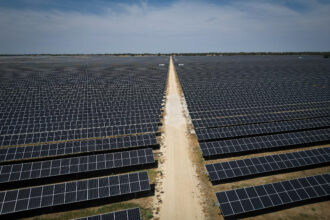
On solar, Salazar has confirmed that the Interior Department is processing 128 applications for commercial-scale systems, with plans to "fast-track" 13 of them for U.S. approval by December 2010. These projects are expected to produce 4,500 MW of power, equivalent to about a half-dozen coal-fired power plants.
Some 20,000 thousand jobs could begin to flow from these projects by the end of this year, said Resch, the same number of solar jobs that were created in 2009.
2010 Looks Bright, ‘Roller Coaster’ Could Follow
Last year, the solar industry installed a record 470 megawatts in the U.S., up from 340 MW in 2008. The jump was largely thanks to 19 separate provisions in the American Recovery and Reinvestment Act of 2009, said Resch.
It was a similar story with geothermal.
"We saw real growth at the highest level yet in 2009," said Gawell. The number of new projects, he said, was "exploding." There are now geothermal projects in 14 states, with 132 under development. The industry added 7,000 to 10,000 jobs last year, he said.
Money from the green portion of the federal stimulus will keeping flowing through 2010, securing growth in these sectors for the next several months.
The financial package was "not a one-year shot in the the arm," said Resch. "Most analysts expect the solar energy industry to grow by over 100 percent this year."
And that means the long-coveted one-gigawatt milestone is within reach for solar in 2010. For the geothermal industry, 10 gigawatts could be online "in the near future." According to Gawell, that’s something that would have been "unheard of just a few years ago."
But concerns post 2010 are significant.
"We’re on a roller coaster every year," Denise Bode, CEO of the American Wind Energy Association said this week.
In response, the solar, geothermal, wind, hydropower and biomass industries have joined forces to call on Congress to enact a federal Renewable Energy Standard (RES) that would require utilities in every state to get 25 percent of their power from renewable sources by 2025.
The U.S. wind industry is pushing the measure especially hard. One reason is competition from China. For the first time last year, China led the world in building wind turbines.
"Chinese activity really lends an urgency to having Congress and the administration act this year on a Renewable Electricity Standard," said Bode.
Under the cap-and-trade bill that narrowly passed the U.S. House in June, utilities would be required to meet a goal of 20 percent clean energy by 2020, with states permitted to fulfill up to eight percent of the requirement through energy efficiency measures. That legislation, and carbon trading more generally, is under threat in the Senate, though.
The Senate Energy and Natural Resources Committee passed its own energy bill last summer that contains an RES of 15 percent by 2021, with energy efficiency allowed to make up 4 percent of the target.
While the geothermal industry is actively pushing for an RES, Gawell made it clear that no RES is better than a weak one. A "federal renewable energy standard must exceed what the states have already written into law," he said.
Currently, about 30 U.S. states have such policies in place, many of them exceeding 15 percent.
Resch, speaking on behalf of the solar industry, said the RES must be coupled with an economy-wide cap and trade program, which would mandate a cap and global-warming emissions.
We can’t "turn our back on carbon legislation," he said. "These two goes hand in hand."
See also:
Study: National Renewables Mandate Could Help Make U.S. Competitive with China
Salazar Tells Congress of Hundreds of Thousands of Domestic Jobs in Solar Energy
Obama Budget Erases Fossil Fuel Subsidies, Ramps Up Nuclear Spending
US Confirms Plans to ‘Fast-Track’ Solar on Federal Lands in 3 Western States
About This Story
Perhaps you noticed: This story, like all the news we publish, is free to read. That’s because Inside Climate News is a 501c3 nonprofit organization. We do not charge a subscription fee, lock our news behind a paywall, or clutter our website with ads. We make our news on climate and the environment freely available to you and anyone who wants it.
That’s not all. We also share our news for free with scores of other media organizations around the country. Many of them can’t afford to do environmental journalism of their own. We’ve built bureaus from coast to coast to report local stories, collaborate with local newsrooms and co-publish articles so that this vital work is shared as widely as possible.
Two of us launched ICN in 2007. Six years later we earned a Pulitzer Prize for National Reporting, and now we run the oldest and largest dedicated climate newsroom in the nation. We tell the story in all its complexity. We hold polluters accountable. We expose environmental injustice. We debunk misinformation. We scrutinize solutions and inspire action.
Donations from readers like you fund every aspect of what we do. If you don’t already, will you support our ongoing work, our reporting on the biggest crisis facing our planet, and help us reach even more readers in more places?
Please take a moment to make a tax-deductible donation. Every one of them makes a difference.
Thank you,