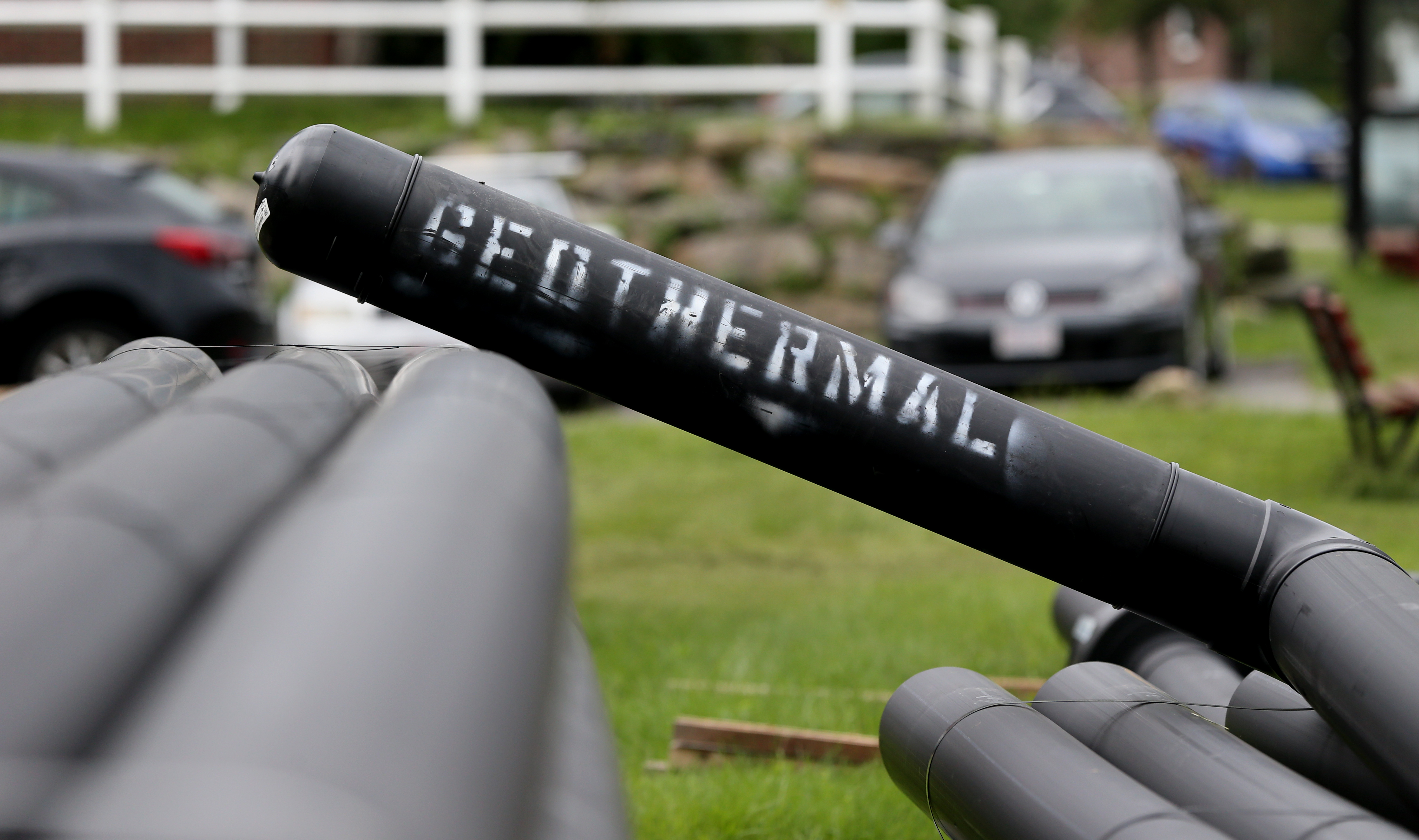


The U.S. Department of Energy has approved an $8.6 million grant that will allow the nation’s first utility-led geothermal heating and cooling network to double in size.
Gas and electric utility Eversource Energy completed the first phase of its geothermal network in Framingham, Massachusetts, in 2024. Eversource is a co-recipient of the award along with the city of Framingham and HEET, a Boston-based nonprofit that focuses on geothermal energy and is the lead recipient of the funding.
Geothermal networks are widely considered among the most energy-efficient ways to heat and cool buildings. The federal money will allow Eversource to add approximately 140 new customers to the Framingham network and fund research to monitor the system’s performance.
The federal funding was first announced in December 2024 under the Biden administration. However, the contract between HEET and the Department of Energy was not finalized until Sept. 30 and was just announced Wednesday. The agreement, which allows construction to move forward, comes as the Trump administration is clawing back billions of dollars in clean energy funding, including hundreds of millions of dollars in Massachusetts.
“This award is an opportunity and a responsibility to clearly demonstrate and quantify the growth potential of geothermal network technology,” Zeyneb Magavi, HEET’s executive director, said in a written statement.
The existing system provides heating and cooling to approximately 140 residential and commercial customers in the western suburb of Boston. The network taps low-temperature thermal energy from dozens of boreholes drilled several hundred feet below ground, where temperatures remain steady at 55 degrees Fahrenheit. A network of pipes circulates water through the boreholes to each building, enabling electric heat pumps to provide additional heating or cooling as needed.
“By harnessing the natural heat from the earth, we are taking a significant step towards increasing our energy independence and promoting abundant local energy sources,” Charlie Sisitsky, Framingham’s mayor, said in a written statement.
Progress on the project is a further indicator that, despite opposition to wind and solar, the Trump administration and Republicans in Congress appear to back geothermal energy.
President Donald Trump issued an executive order on his first day in office declaring an energy emergency that expressed support for a limited mix of energy resources, including fossil fuels, nuclear power, biofuels, hydropower, and geothermal energy.
The One Big Beautiful Bill Act, passed by Republicans and signed by Trump in July, quickly phases out tax credits for wind, solar, and electric vehicles. However, the bill left geothermal heating and cooling tax credits approved under the Inflation Reduction Act of 2022 largely intact.
A reorganization of the U.S. Department of Energy announced last month eliminated the Office of Energy Efficiency and Renewable Energy but kept the office for geothermal energy as part of the newly created Hydrocarbons and Geothermal Energy Office.
“The fact that geothermal is on this administration’s agenda is pretty impactful,” said Nikki Bruno, vice president for thermal solutions and operational services at Eversource Energy. “It means they believe in it. It’s a bipartisan technology.”
Plans for the expansion project call for roughly doubling Framingham’s geothermal network capacity at approximately half the cost of the initial buildout. Part of the estimated cost savings will come from using existing equipment rather than duplicating it.
“You’ve already got all the pumping and control infrastructure installed, so you don’t need to build a new pump house,” said Eric Bosworth, a geothermal expert who runs the consultancy Thermal Energy Insights. Bosworth oversaw the construction of the initial geothermal network in Framingham while working for Eversource.
The network’s efficiency is anticipated to increase as it grows, requiring fewer boreholes to expand. That improvement is due to the different heating and cooling needs of individual buildings, which increasingly balance each other out as the network grows, Magavi said.
The project still awaits approval from state regulators, with Eversource aiming to start construction by the end of 2026, Bruno said.
“What we’re witnessing is the birth of a new utility,” Magavi said. Geothermal networks “can help us address energy security, affordability and so many other challenges.”
About This Story
Perhaps you noticed: This story, like all the news we publish, is free to read. That’s because Inside Climate News is a 501c3 nonprofit organization. We do not charge a subscription fee, lock our news behind a paywall, or clutter our website with ads. We make our news on climate and the environment freely available to you and anyone who wants it.
That’s not all. We also share our news for free with scores of other media organizations around the country. Many of them can’t afford to do environmental journalism of their own. We’ve built bureaus from coast to coast to report local stories, collaborate with local newsrooms and co-publish articles so that this vital work is shared as widely as possible.
Two of us launched ICN in 2007. Six years later we earned a Pulitzer Prize for National Reporting, and now we run the oldest and largest dedicated climate newsroom in the nation. We tell the story in all its complexity. We hold polluters accountable. We expose environmental injustice. We debunk misinformation. We scrutinize solutions and inspire action.
Donations from readers like you fund every aspect of what we do. If you don’t already, will you support our ongoing work, our reporting on the biggest crisis facing our planet, and help us reach even more readers in more places?
Please take a moment to make a tax-deductible donation. Every one of them makes a difference.
Thank you,

Phil McKenna
Reporter, Boston
Phil McKenna is a Boston-based reporter for Inside Climate News. Before joining ICN in 2016, he was a freelance writer covering energy and the environment for publications including The New York Times, Smithsonian, Audubon and WIRED. Uprising, a story he wrote about gas leaks under U.S. cities, won the AAAS Kavli Science Journalism Award and the 2014 NASW Science in Society Award. Phil has a master’s degree in science writing from the Massachusetts Institute of Technology and was an Environmental Journalism Fellow at Middlebury College.