David Funk has spent decades working to restore the native forest ecosystems of southeast Ohio. Now, he’s finally getting paid for it—through a carbon credit program.
“The Nature Conservancy reached out and knew that I was very active in the preservation of woodlands in southeastern Ohio,” Funk said. “It was just a perfect fit for what we do.”
Funk runs Capstone Property Management, a nonprofit based in Athens County, Ohio. The organization is best known locally as a rental property manager, but woodland preservation is also part of its DNA. According to its website, Capstone owns and manages 3,600 acres of forest.
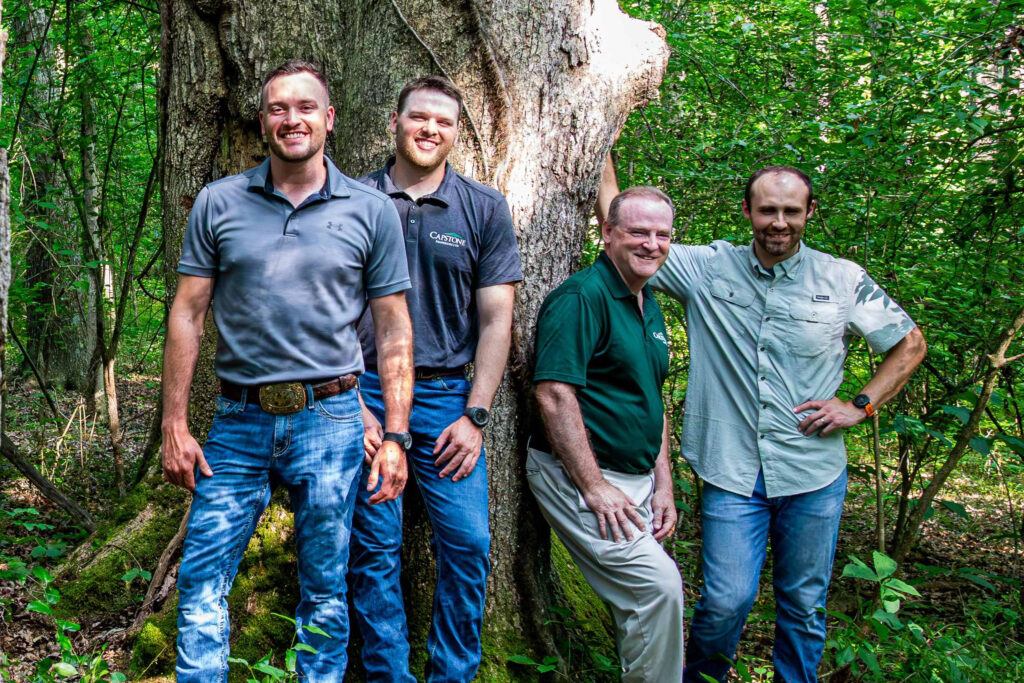
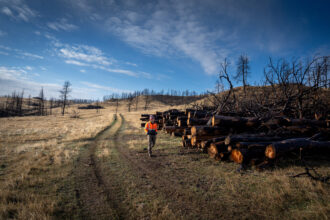
That’s why Funk was eager to become the first Ohio member of the Family Forest Carbon Program. An initiative of the American Forest Foundation and the Nature Conservancy, the FFCP pays private landowners not to timber the forests on their properties for 20 years. It also provides free consultations with forest managers to facilitate whatever goals landowners may have for their woods—hunting, hiking, even sustainable harvesting.
To pay for it all, the program sells carbon credits to companies looking to offset their greenhouse gas emissions. By preventing large-scale timber harvests, trees continue to absorb more carbon. When companies buy a credit, they are essentially paying a cohort of landowners not to clear cut.
The landowner gets money. The forest is healthier. Companies offset their emissions. On paper, everyone wins.
The reality is not so clear. Carbon credit programs in general have faced withering criticism from scientists who argue that many are fatally flawed. The American Forest Foundation has taken great pains to address those worries, but not everyone is convinced. In fact, the very presence in the program of someone like Funk—a man who is devoted to local forest ecosystems and deeply concerned about climate change—may play into their concerns.
At the same time, the program’s own monitoring suggests its approach is working: On average, its forests are growing more and better than those not enrolled.
How It Works
The FFCP operates in 19 states, from Minnesota to Maine to Alabama. To participate, landowners must own at least 30 acres of forest with at least 4,000 board feet per acre. They sign a contract promising not to remove more than 25 percent of their timber stocking over 20 years.
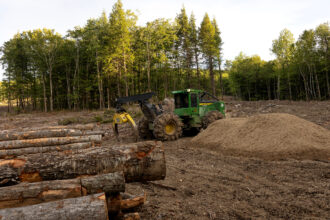
“It guides you away from a high grade approach or a clear cut approach and to the sort of tending approach,” said Richard Campbell, director of science and product refinement at the American Forest Foundation. “Tending,” he said, includes “things like a forest thinning, where you remove the less healthy, less valuable trees and promote growth on larger, more valuable trees that will live for longer.”
According to Campbell, landowners can remove 5 percent of their stock every 5 years and still end up with more trees than when they started.
“It’s not a theory. These are well-proven examples. You can see it in the rapid-growing forests in the Pacific Northwest. You can see it to some degree in the Northeast … A really good example is in Central Europe, in Germany, where they’ve been managing some timber stands for two [hundred] or three hundred years,” Campbell said.
Enrolled landowners get paid for each acre they own. In Central Appalachia, they earn a total of $230 per acre over the span of their 20-year enrollment.
“This is typically not life-changing money to these landowners, but it seems to correlate pretty closely with property tax, at least throughout most of the program,” said American Forest Foundation outreach forester Tristan Kinnison.
The FFCP also provides the landowner with an optional forest management plan. Funk, who has been trying to restore southeast Ohio’s native oak and hickory forests since the 1980s, said this has been invaluable.
“We need to be very careful that it’s not that passive activity,” Funk said. “If you let woods go, you may end up with an autumn olive plantation … invasive species that are terrible for the environment.”
Funk said he is committed to doing this work with or without the FFCP. Still, he said it’s no question the money and management expertise have helped him and his team at Capstone accomplish much more than they would have otherwise.
A Problem of Addition
A carbon credit is essentially a promise: Pay this money and keep a ton of carbon out of the atmosphere. It’s generally understood there should be some additional carbon removed from the atmosphere because of that credit, and only because of it. This is known as “additionality.”
Studies have shown that a vast number of carbon credit programs have failed to deliver on that promise. A 2024 meta-analysis published in Nature found only 25 percent of those based on avoiding deforestation yielded emissions reductions, while those based on improved forest management yielded no statistically significant reductions at all.
This story is funded by readers like you.
Our nonprofit newsroom provides award-winning climate coverage free of charge and advertising. We rely on donations from readers like you to keep going. Please donate now to support our work.
Donate NowBenedict Probst is a research leader at the Net Zero Lab at the Max Planck Institute for Innovation and Competition in Munich, and one of the authors of the 2024 study. He explained how a carbon credit program might fail on additionality
“A typical example is wind power in China. Under the Clean Development Mechanism [a carbon offset program of the Kyoto Protocol], a lot of project developers said, ‘You know, we can’t build this wind farm if we don’t get this additional funding through carbon credits,’” Probst said.
Credits were then sold based on how many fossil fuels the wind farms would replace. Buy a credit, be the reason a certain amount of oil, gas and coal doesn’t get burned.
The problem, Probst said, is that “studies later showed that there were a bunch of projects that didn’t get carbon credits, but were built in similar regions.” In other words, those credits probably weren’t decisive in making those wind projects happen. There was no additionality.
Low-quality credits effectively allow companies to continue emitting more than they should, and Probst said they have other knock-on effects, as well. He co-authored a recent essay in Nature arguing such credits are flooding the voluntary carbon market, depressing carbon prices and pushing the Paris climate goals farther out of reach.
The challenge is also significant for forestry-based credits.
“Let’s say you want to protect some forests. You need to understand what would have happened without that protection. But this … is unobservable,” Probst said.
To get around this, forestry-based programs often resort to complex, individualized models that simulate how their forests will grow in the future. They then award credits based on the projections. This “ex-ante” approach is often unreliable, according to a recently published essay in Global Change Biology which Probst co-authored.
The paper states that ex-post approaches—which award credits based on real observations, not simulations—can be more reliable, if the data is good enough. However, “there is currently no single ex-post method that should be regarded as the definitive solution,” the authors wrote.
The FFCP does use an ex-post approach. First, it groups properties like Funk’s into a cohort. Over the next 20 years, it compares growth in this cohort to a control group from the Forest Inventory and Analysis program of the U.S. Forest Service.
“We match for ownership type, we match for eco region, species mix, timber stocking, regeneration class—all of the different things to basically try to … control for every other variable,” Campbell explained. “We look at … the growing difference between those two sets of data—not the initial stocking, but only the change over time as it occurs. And since we’ve controlled for everything but membership in the program, we can attribute that change in stocking to the program, and then we can quantify that, and then we can turn that into carbon credits.”
In short: cohort’s carbon, minus the control group’s carbon, equals carbon credits.
Brent Sohngen, a professor of environmental and resource economics at the Ohio State University, said he believes the FFCP’s approach to calculating additionality is “state of the art.”
They’re “using really good data to try to sort of identify what and where landowners can achieve additional carbon,” Sohngen said. “It seems pretty solid.”
But not everyone shares his enthusiasm. John Sterman, a professor of system dynamics at the MIT Sloan School of Management, said he still has serious concerns.
Sterman has developed a framework called “AVID”—Additional, Verifiable, Immediate and Durable—to evaluate carbon credits. A good credit has all four qualities. Sterman is not confident the FFCP meets the bar.
“If I own the land and I see this program, and I say to myself … ‘Well, I wasn’t planning on logging it for 30 years because it isn’t going to be ready for market until then.’ … How are you going to know?” Sterman said. If people are getting paid to preserve forests they never planned on timbering, “that’s the very definition of non-additional.”
That’s where the participation of someone like Funk might raise a red flag. The program’s ex-post approach did not assuage Sterman’s concerns.
“How is the control group determined, and who assesses whether it is representative of the stands in the program? I’m not saying there is any unethical behavior here but there is an obvious appearance of conflict if the program itself is assessing additionality and undertaking verification,” he wrote in an email.
The FFCP’s credits are certified by Verra, which the AFF’s Kinnison described as a leader in the field. However, Probst has written that many Verra-certified credits still fail on additionality. For Sterman, that’s to be expected.
Currently, Sterman said, the people who sell credits on the voluntary carbon market are also the ones verifying additionality. If they overestimate, they make more money—and no one will punish them. He likened it to selling snake oil in the Wild West.
“There’s no standards, there’s no regulations, there’s no real sanctions,” he said.
Sterman said the system needs an entity similar to the Securities and Exchange Commission to provide oversight and enforcement.
“I don’t see any way to solve this problem with self-regulation, because the incentives and the opportunities for cutting corners and fraud are just too great,” he said.
By contrast, he said, regulation would help everyone except “the small number of bad actors” and increase the overall size of the market.
Campbell declined to offer an opinion on regulation, but he agreed that standardization would help.
“We need a credit to equal a credit. We need to know that … what it represents is a ton of CO2 that has been taken out of the atmosphere for an agreed upon amount of time,” he said.
Sohngen, the economist, said fraud would happen with or without regulators. He thinks the carbon market is already showing signs of improvement as bad actors are called out.
“What we’re seeing is a market maturing,” Sohngen said. “We’re seeing a lot more care being taken in those sort of additionality assessments. We’re seeing better data being applied to the problem.”
He dismissed the concern from Probst and others about low-quality credits depressing carbon prices, saying that’s the whole point of a credit in the first place. If regulators want carbon prices to rise, he said, the solution is to simply “squeeze the cap”—that is, further restrict emissions.
Sohngen even said it’s not so bad if credits miss on additionality. He’s more frustrated that not everyone who owns forests is getting paid for it yet. In his view, they’re performing an uncompensated public good.
“All of a sudden, you’re going to make this guy (a company) pay a little bit of money to this guy (a landowner),” Sohngen said. “To me, that’s not the worst place that we’re actually in.”
But that flies in the face of what many people understand carbon credits to do.
For his part, Sterman also raised concerns about the FFCP’s durability.
“At best, this is committing you to not harvest for 20 years … but 20 years is a very short amount of time relative to climate dynamics,” Sterman said. If all those trees get timbered in year 21, much of the carbon will go back into the atmosphere.
Campbell said that’s unlikely to be an issue because of how the FFCP groups landowners into cohorts.
“In order for us to lose that longevity, our landowners who have decided to make a long-term forest management commitment would have to all go completely upside down and cut their forest much harder than the landscape around it,” he said. That’s unlikely to happen over a meaningfully large part of the cohort.
Moreover, the FFCP is still obligated to keep the carbon on the ground for another 100 years. If it all gets chopped down, the program has to find a way to make the buyer whole again.
But such statistical maneuvering is not enough for Sterman.
“Once you’ve put CO2 in the atmosphere, it stays there for hundreds and hundreds of years, and the consequences of the warming are essentially irreversible,” Sterman said. He thinks the FFCP should claw back the credit when trees are lost. But it’s not clear that there’s a mechanism to do so, especially without regulatory oversight.
“What is so difficult and sometimes discouraging is seeing people—well-intentioned, smart people—putting so much time and effort and financial capital and emotional energy into climate solutions that seem like they’ve got to be helpful, but, because it’s such a complex dynamical system, actually, many of them turn out not to be,” he said.
But Campbell remains committed—and not, he said, for the money.
“The carbon credits are the fuel for the engine that we use,” Campbell said. “The machine itself, and the thing we want to have succeed, is more productive, more healthy forests. … That’s also going to result in climate mitigation and climate resilience, by the way.”
About This Story
Perhaps you noticed: This story, like all the news we publish, is free to read. That’s because Inside Climate News is a 501c3 nonprofit organization. We do not charge a subscription fee, lock our news behind a paywall, or clutter our website with ads. We make our news on climate and the environment freely available to you and anyone who wants it.
That’s not all. We also share our news for free with scores of other media organizations around the country. Many of them can’t afford to do environmental journalism of their own. We’ve built bureaus from coast to coast to report local stories, collaborate with local newsrooms and co-publish articles so that this vital work is shared as widely as possible.
Two of us launched ICN in 2007. Six years later we earned a Pulitzer Prize for National Reporting, and now we run the oldest and largest dedicated climate newsroom in the nation. We tell the story in all its complexity. We hold polluters accountable. We expose environmental injustice. We debunk misinformation. We scrutinize solutions and inspire action.
Donations from readers like you fund every aspect of what we do. If you don’t already, will you support our ongoing work, our reporting on the biggest crisis facing our planet, and help us reach even more readers in more places?
Please take a moment to make a tax-deductible donation. Every one of them makes a difference.
Thank you,