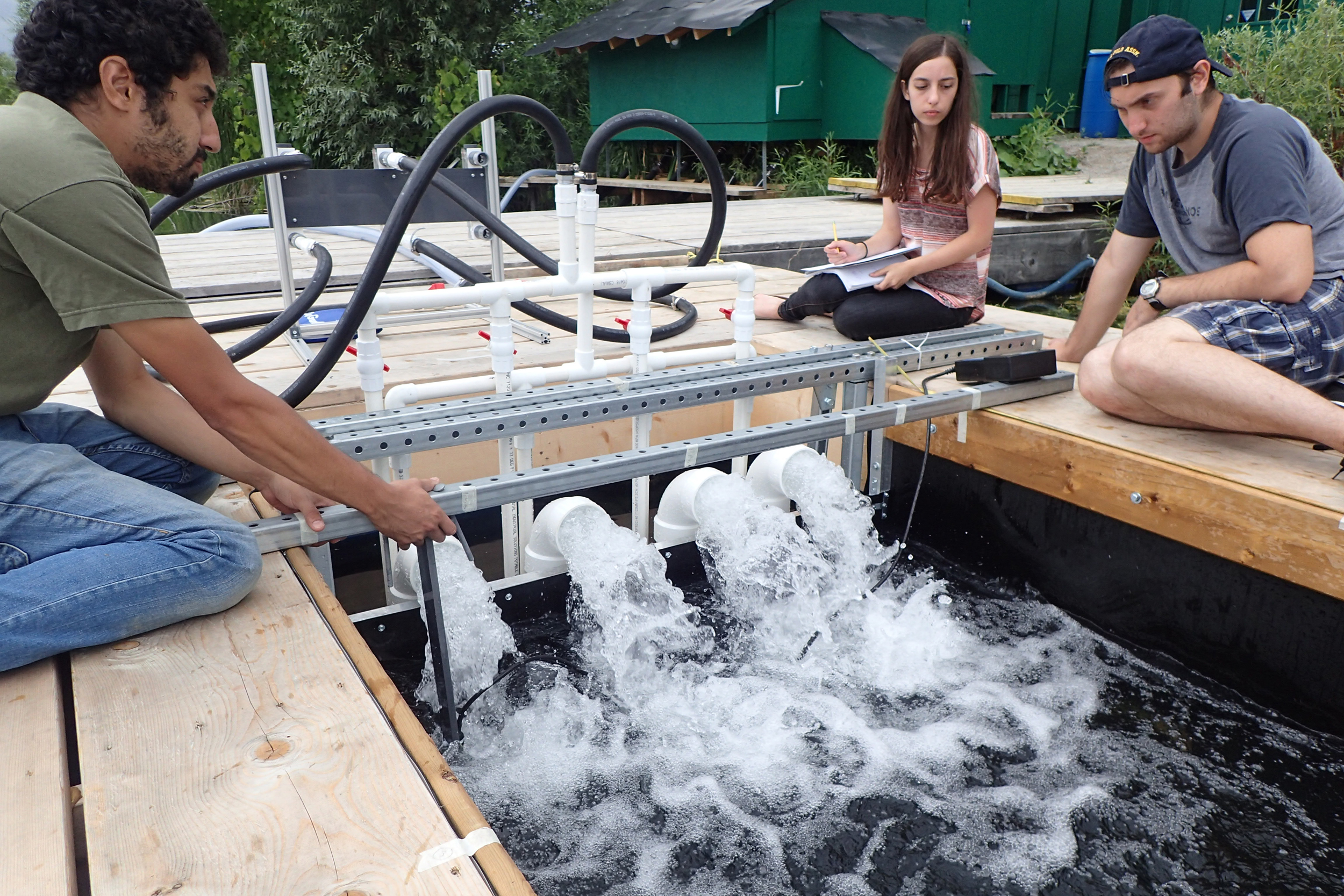


When it comes to cleaning up dirty water, tiny bubbles can pack a big punch.
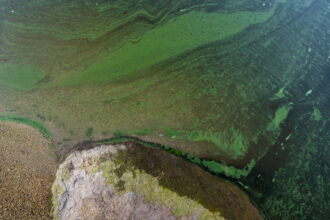
When Nano Gas Environmental was called to clean up ponds and lagoons in a community in West Texas, they found thick algae and bugs walking on top of sludge islands. Digging the muck out of the ponds would have cost millions, according to Nano Gas Environmental CEO Len Bland. So instead, the company deployed tiny bubbles armed with beneficial microbes into the water at a cost of less than $200,000.
“Within four days, the algae was gone. Within several months, the piles of sludge were way down,” Bland said. “We think 85 percent of the organic sludge was consumed. And the town loved it, they saved over 80 percent of what they were going to have to spend for dredging.”
Deerfield, Illinois-based Nano Gas is one of seven early-stage water technology startups selected earlier this fall for the Sustainable Water Tech Accelerator cohort, a joint project from Chicago manufacturing incubator mHUB and Current, a nonprofit focused on solving water challenges. The project aims to speed the startups’ path to market by connecting them to pilots and industry partners, as well as figuring out potential customers, said Current CEO Alaina Harkness. Each will receive $200,000 in capital investment from mHUB’s venture funds.
But federal upheaval this year is complicating the accelerator’s efforts.
The project is partially funded by the Great Lakes Water Innovation Engine, also known as Great Lakes RENEW Engine. In 2022, the multistate partnership received a $160 million grant for 10 years from the National Science Foundation (NSF). An executive order from President Donald Trump in January disrupted funding for the accelerator, but Current was able to access $14.7 million later, Harkness said.
The recent government shutdown delayed a site visit that would determine whether the Great Lakes RENEW Engine receives another $45 million. Officials from the NSF, alongside technical reviewers from universities executing similar research and workforce development experts, were supposed to visit in August. With the government reopened, the meeting is now slated for Jan. 9, though Harkness cautions that the visit does not guarantee the next tranche of funding.
The shutdown not only pushed back the site visit but put other grants in limbo.
“NSF is not our only source of government or government pass-through to state funding, so there’s just been an overall delay in multiple sources,” Harkness said.
The shutdown didn’t slow projects that have already received funding, but she worries the nonprofit could start to feel those effects next year.
“Overall, I would say the slowdown has caused at least a quarter [year] delay in that decision-making and you don’t get that quarter back,” she said.
Beyond the federal money, Current has also relied on funding for the accelerator from corporate partners, the state of Illinois and philanthropic organizations including the Pritzker Traubert Foundation, McDougal Family Foundation and JPMorganChase Foundation, Harkness added.
The accelerator is also helping startups navigate policy changes that might force them to pivot away from their original target markets that were supported by government subsidies that have since ended, said Current chief commercial officer Nina Dudnik. Support for technologies like battery recycling and alternative energy, which received the backing of Democrats like former President Joe Biden, has changed.
Current has recently turned its focus toward critical minerals that are used for batteries and electronics. In a separate project, the nonprofit is supporting water technology startups that are exploring reclaiming minerals from mining wastes and other kinds of wastewater, Dudnik said.
“Right now we’ve seen the government start to roll out a lot of funding in different programs to support that and to secure national supply chains,” Dudnik said. “We think that this is a really, really interesting place to come at it from the perspective of water.”

Some of the startups in the new sustainable water cohort, such as Nano Gas and Chicago-based Amplify Dynamics, are working on removing contaminants from water. Others, like the Estonia-based Spacedrip, are creating water reuse systems that could save customers money on their water bills. Noah System in Chicago is working on preventing lead contamination in drinking water.
“Our team is doing a lot of work connecting to utilities, industry partners, the kinds of customers that will allow for small-scale tests, real-world results that help these companies prove out viability of their technology,” Harkness said. “Which for technology in water, much like energy and a lot of other hard-tech spaces, that’s essential that you have proof points that it works.”
In order to qualify for the accelerator, each startup had to have already advanced beyond the seed-funding stage, Dudnik said.
“We have a few that are fairly new, some that have been around for quite a long time, some that have actually sort of been operating and have customers and revenue but have only been operating outside the U.S.,” Dudnik said. “So it’s a pretty wide range.”
Though the Great Lakes RENEW name might imply that the accelerator focuses on the Midwest, Current hopes to deploy the technologies and get them to market around the world.
“A lot of them, depending on what they’re trying to accomplish, the regulatory conditions in Europe might be more favorable to deploying certain clean-water technologies,” Harkness said. “It is truly a global market. … I think that’s important to set the stage: We’re looking to build things here and deploy here, but also export.”
About This Story
Perhaps you noticed: This story, like all the news we publish, is free to read. That’s because Inside Climate News is a 501c3 nonprofit organization. We do not charge a subscription fee, lock our news behind a paywall, or clutter our website with ads. We make our news on climate and the environment freely available to you and anyone who wants it.
That’s not all. We also share our news for free with scores of other media organizations around the country. Many of them can’t afford to do environmental journalism of their own. We’ve built bureaus from coast to coast to report local stories, collaborate with local newsrooms and co-publish articles so that this vital work is shared as widely as possible.
Two of us launched ICN in 2007. Six years later we earned a Pulitzer Prize for National Reporting, and now we run the oldest and largest dedicated climate newsroom in the nation. We tell the story in all its complexity. We hold polluters accountable. We expose environmental injustice. We debunk misinformation. We scrutinize solutions and inspire action.
Donations from readers like you fund every aspect of what we do. If you don’t already, will you support our ongoing work, our reporting on the biggest crisis facing our planet, and help us reach even more readers in more places?
Please take a moment to make a tax-deductible donation. Every one of them makes a difference.
Thank you,