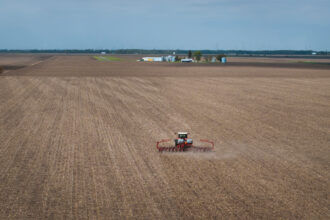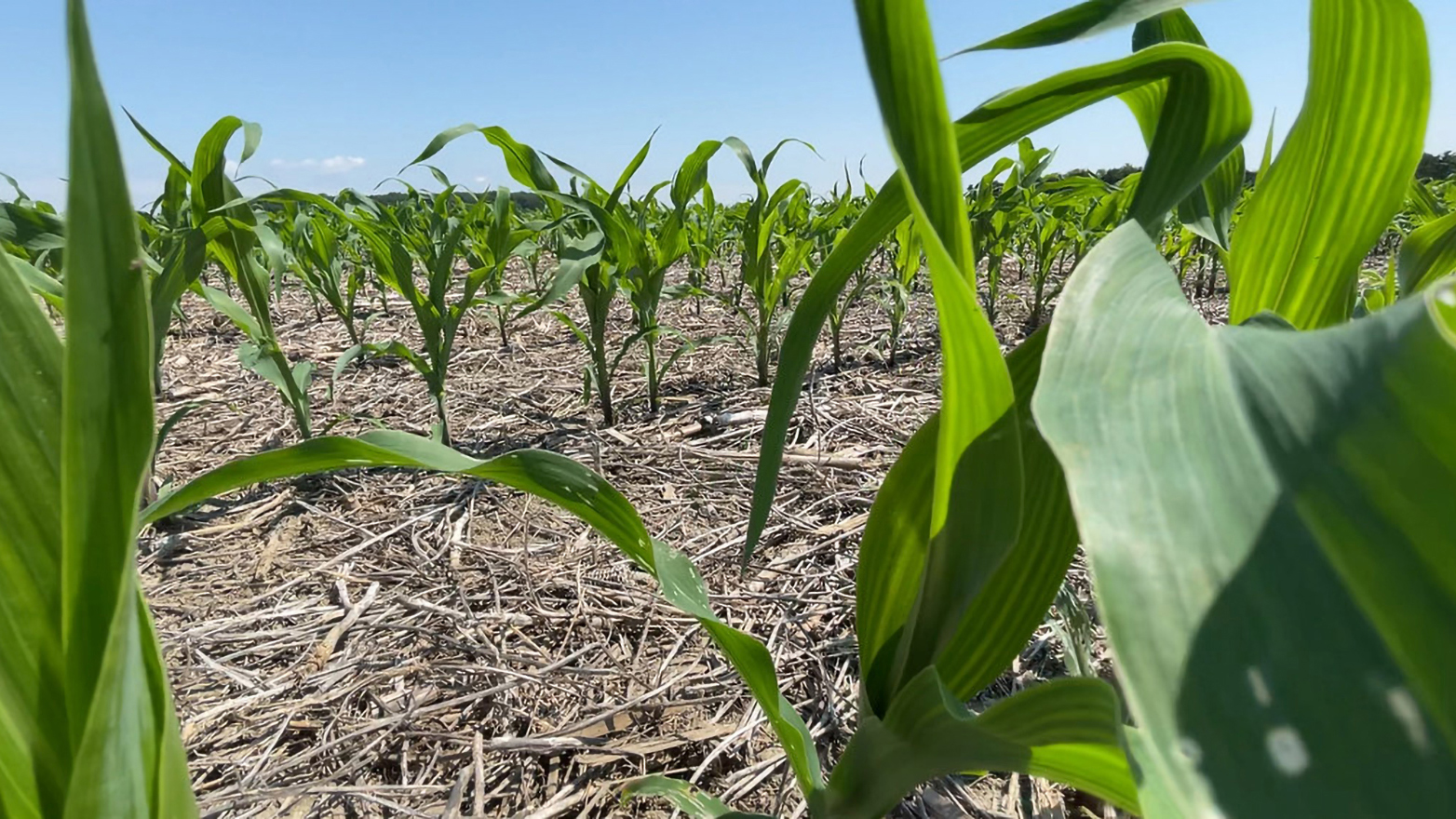


This summer, mere months after Ohio’s eighth wettest spring came its driest August on record and with it, a critical moment for both soybeans and corn. The drought hit hardest in the state’s northwest, where the bulk of its farms are.
While agronomists issued dismal yield projections across the drought zone, farmers who used regenerative techniques to cultivate healthy, carbon-rich soil beat the forecast.
But in July, Republican lawmakers at both the state and federal levels gutted incentives for those same practices, which can be too expensive for many farmers to implement on their own.
“I know [regenerative farming] helped. There’s no doubt in my mind,” said Les Seiler, a Fulton County farmer who has been practicing regenerative agriculture for 39 years. “The potential was there for one whale of a bean crop, but we got no water in August … it’s incredible what we got anyhow.”
Seiler said one of his farms set a record of 69.5 bushels per acre, and that this year, both corn and soybeans outperformed last year’s. A farm across the ditch, where the soil is light and sandy and can’t hold as much water, only yielded about 54 bushels per acre, he said.
“Somehow this year in general, those crops carried through a lot better than we would have thought,” said Dustin “Dusty” Sonnenberg, a Henry County corn, soybean and hay farmer, agriculture journalist and certified crop adviser.
The drought that hit Sonnenberg’s farm was classified as extreme. One of the “difference makers” for both Sonnenberg and his clients in northwest Ohio, he said, was regenerative practices like no-till and the use of cover crops, which helped to bank moisture from the wet spring.
Modern seed genetics, designed to combat drought, was also a major factor, he said.
According to Rattan Lal, a soil physicist, World Food Prize winner and professor at Ohio State University, for every one percent increase in organic matter content, fields can hold around 4,000 additional gallons of water per acre because organic matter is hydrophilic and acts like a sponge. Organic matter also supports earthworms, which dig channels that allow water to flow deeper into the soil, he said.
“Soil is a living entity … we must make sure that they are not starved, that they are given food to eat,” he said.
He says that healthy soil should have 10 to 15 metric tonnes of living organisms in the plow layer per hectare. But if soil has been depleted of nutrients, that organic matter content is massively reduced.
But soil degrades when its natural cycle is disrupted. In agriculture, this is usually a consequence of non-regenerative practices, such as excessive tillage, which disrupts soil composition; over-reliance on synthetic fertilizers and pesticides; and failure to replenish the carbon lost during harvesting. This kind of farming tends toward lower yields, reduced carbon sequestration and more pollution.
While spotty, soybeans did better than expected statewide this year, said Laura Lindsey, a soybean agronomist and professor at Ohio State University. Meanwhile, Osler Ortez, Ohio State’s corn agronomist, said that the drought significantly impacted corn yields. Yields for both were down in the northwest compared to the rest of the state.
According to Lindsey, OSU’s yield in Henry County, which, like all the university’s locations, uses regenerative farming methods, averaged around 75 bushels per acre, which she said was high, but not their highest location. Several locations in central Ohio averaged 86 bushels per acre and Preble County, in the southwest, averaged 92 bushels per acre.
Soybean yields in the north half of Ohio averaged 54.9 bushels per acre and 187.7 bushels per acre for corn, according to the 2025 Ohio Crop Tour, led by Ohio Ag Net and Ohio’s Country Journal.
In addition to holding the bulk of Ohio’s agriculture, northwest Ohio is the largest recipient of funds from H2Ohio, the state program that incentivizes, among other things, regenerative farming to prevent runoff pollution from entering Lake Erie. The lake’s now-annual toxic algal blooms feed off of phosphorus runoff that flows into the Maumee River watershed and then into the lake. In July, Republican lawmakers slashed H2Ohio’s budget by over $100 million—or nearly 40 percent, despite each of the main departments H2Ohio funds requesting much more.
For fiscal year 2026, the Ohio Department of Agriculture said farmer demand exceeded capacity and in its annual budget request, asked for $121.7 million in H2Ohio funding for cover crops, nutrient management, conservation tillage, manure management and buffer strips over two years. Lawmakers approved only $107.2 million, citing unspent funds. However, those funds were already budgeted and contractually obligated to pay farmers who had enrolled in best management programs, and could only be used once the practices were implemented in accordance with their contracts.
The Ohio Department of Natural Resources requested more than $93 million to restore wetlands, prevent water pollution, remove dams, clean up trash and restore natural water flow disrupted by farming, urban development and flood control practices. Republicans granted just over $42 million, drawing concerns about public land ownership and natural infrastructure projects.
The Ohio Environmental Protection Agency requested more than $55 million to improve water infrastructure, replace failing household sewage systems, improve stream monitoring and replace lead water pipes. State lawmakers approved a mere $15 million, effectively shifting those responsibilities to local communities.
At the same time, state lawmakers increased private and charter school subsidies by nearly half a billion dollars.
Gov. DeWine’s office did not respond to requests for comment on the cuts.
“The no till or reduced tillage yields were overall better than your conventional tilled stuff and you conserve that moisture you didn’t break it open this spring. So any little bit did help,” said Kyle Haselman, a Putnam County farmer and certified crop advisor. “The expansion of use of cover crops and reduced tillage in part of H2Ohio programs definitely played a factor in maintaining (higher than expected) yields.”
Aaron Wilson, Ohio’s state climatologist and an assistant professor at Ohio State University, said drought-flood-drought cycles are becoming an increasing trend in Ohio as climate change worsens, but that regenerative practices can help stave off drought while improving soil health.
This story is funded by readers like you.
Our nonprofit newsroom provides award-winning climate coverage free of charge and advertising. We rely on donations from readers like you to keep going. Please donate now to support our work.
Donate NowWilson said that one reason many farmers till is to warm soils more quickly by exposing more dirt to sunlight, which can help early crop growth in cold springs typical in Ohio’s natural climate, but that no-till can help during a drought by retaining moisture, and can also reduce soil erosion and nutrient loss.
“(Precipitation) trends are up compared to the early part of the 20th century, [for] winter and spring rainfall, but not necessarily summer. So Iowa to Ohio, you’ve got counties that have negative precipitation trends during the summertime. So you’re getting too much water in the cooler season and then not enough water on a growing crop. So that is the trend, and these oscillations toward more rapid transitions from extremely wet to dry and back and forth does have the signature of larger changes across the surface.”
Compared to trends from the early 20th century, precipitation is up across the state, Wilson said.
According to USDA data, between 2017 (two years before H2Ohio was adopted) and 2022, while the rest of Ohio saw a five percent decrease in no-till acreage, northwest Ohio increased by roughly one percent. Cover cropping acreage in the northwest increased by over 7.5 percent, while the rest of the state increased by just over two percent.
On July 4, three days after Governor Mike DeWine signed Ohio’s new budget, President Donald Trump signed the One Big Beautiful Bill Act, which, among many other things, removed the Biden-era mandate to prioritize agricultural practices that sequester carbon, like cover cropping and no-tilling.
Funds leftover from the Inflation Reduction Act were folded into broader agricultural conservation funds, including subsidies for practices like irrigation and fencing. New tax incentives can now subsidize buying heavy machinery and fertilizers. Regenerative practices can still be subsidized, although they are now competing with many more cheaper, less impactful alternatives. There is less money to combat the economic costs associated with initially implementing regenerative farming, like lower initial yields for up to three years, which Lal described as a major burden.
Funding soil health, Seiler says, requires some “creative thinking,” and he favors a mix of cash incentives, such as those given in the H2Ohio program, and tax incentives for landowners who adopt regenerative farming.
“[What] programs need to be steered to is to incentivize a landowner whose operator is doing regenerative practices … either do it through property tax incentives or something like that … So, wow, because I got this guy farming my farm the way he does, my taxes went down and see if that don’t stir some things up to make some change, because everything they’ve done in the past hasn’t worked,” Seiler said.
Lal, however, argues that no-till farming is often misunderstood and endorses sweeping changes to federal policy to provide better cash incentives for proper no-tilling.
Proper no-till, he explains, includes leaving mulch from the previous crop on the ground so that it is never bare, which reduces evaporation and runoff considerably and recycles nitrogen and phosphorus. It also involves managing nutrients through compost and manure use; adopting complex crop rotations, like rotating crops, meadows and pastures; and integrating trees and livestock into the agricultural landscape.
Lal advocates for a “Soil Health Act,” which would pay farmers $50 per metric tonne of carbon sequestered through regenerative practices.
“So if we pay farmers $50 per credit, they have no reason not to do what we are talking about. There are some companies like Bayer and others which are paying farmers to adopt their glyphosate or whatever they are selling at John Deere and Nutrien, but they pay them $8, $10, $15,” Lal said. “It’s not adequate.”
About This Story
Perhaps you noticed: This story, like all the news we publish, is free to read. That’s because Inside Climate News is a 501c3 nonprofit organization. We do not charge a subscription fee, lock our news behind a paywall, or clutter our website with ads. We make our news on climate and the environment freely available to you and anyone who wants it.
That’s not all. We also share our news for free with scores of other media organizations around the country. Many of them can’t afford to do environmental journalism of their own. We’ve built bureaus from coast to coast to report local stories, collaborate with local newsrooms and co-publish articles so that this vital work is shared as widely as possible.
Two of us launched ICN in 2007. Six years later we earned a Pulitzer Prize for National Reporting, and now we run the oldest and largest dedicated climate newsroom in the nation. We tell the story in all its complexity. We hold polluters accountable. We expose environmental injustice. We debunk misinformation. We scrutinize solutions and inspire action.
Donations from readers like you fund every aspect of what we do. If you don’t already, will you support our ongoing work, our reporting on the biggest crisis facing our planet, and help us reach even more readers in more places?
Please take a moment to make a tax-deductible donation. Every one of them makes a difference.
Thank you,