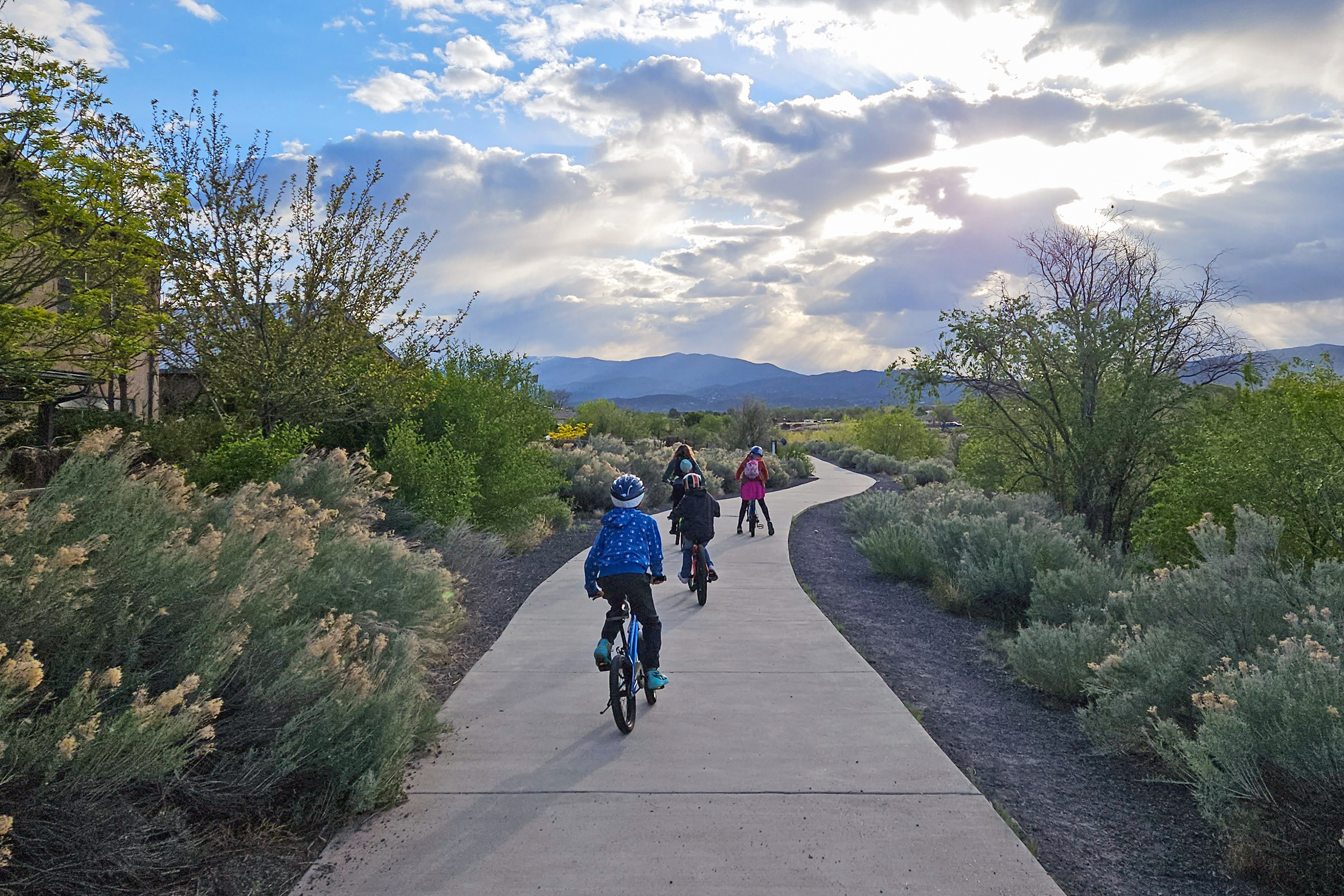


On a recent autumn morning in Tempe, Arizona, dozens of kids made their way to class on an unusual “bus.” Rather than the traditional yellow, diesel-run whale of a vehicle, this one consisted of children and parents mostly on bicycles, along with a few scooters and roller-skates.
This “bike bus” serving Broadmoor Elementary School is one of many popping up across the West as parents and schools look for ways to get students moving their bodies.
According to advocates, hopping aboard the bike bus helps boost kids’ physical and mental health, improves classroom performance and fights climate change, among other advantages. But challenges remain, including equity issues and infrastructure to support the human-powered commuters.
Bike Bus Is Born
Though the concept of a bike bus is simple—gather a group, hop on the bicycles and go—it didn’t creep into public awareness until 2021 when one in Barcelona went viral. In 2022, physical education teacher Sam Balto, who had started a bike bus in Boston in 2016 and another in Portland, Oregon, after moving there in 2018, organized the Bike Bus for Earth Day event in Portland that gained massive social media attention. By 2024, there were at least 470 bike bus routes around the globe, according to City Lab Barcelona.
Balto remains a leading advocate for bike buses as one of the cofounders of Bike Bus World, a U.S.-based organization that helps communities launch their own bike buses.
The Western U.S. has become an epicenter of this school transport model, and Portland leads the charge with bike buses at nearly two dozen schools. The program has been supported by millions of dollars in city and federal grants, and celebrity ride-alongs with singers Justin Timberlake and Benson Boone in 2025 helped to further boost awareness.
Bike buses in other Western cities like Denver; Tempe, Arizona; Orem, Utah; Seattle, and Santa Fe, New Mexico; have started up in recent years and are slowly gaining momentum as well.
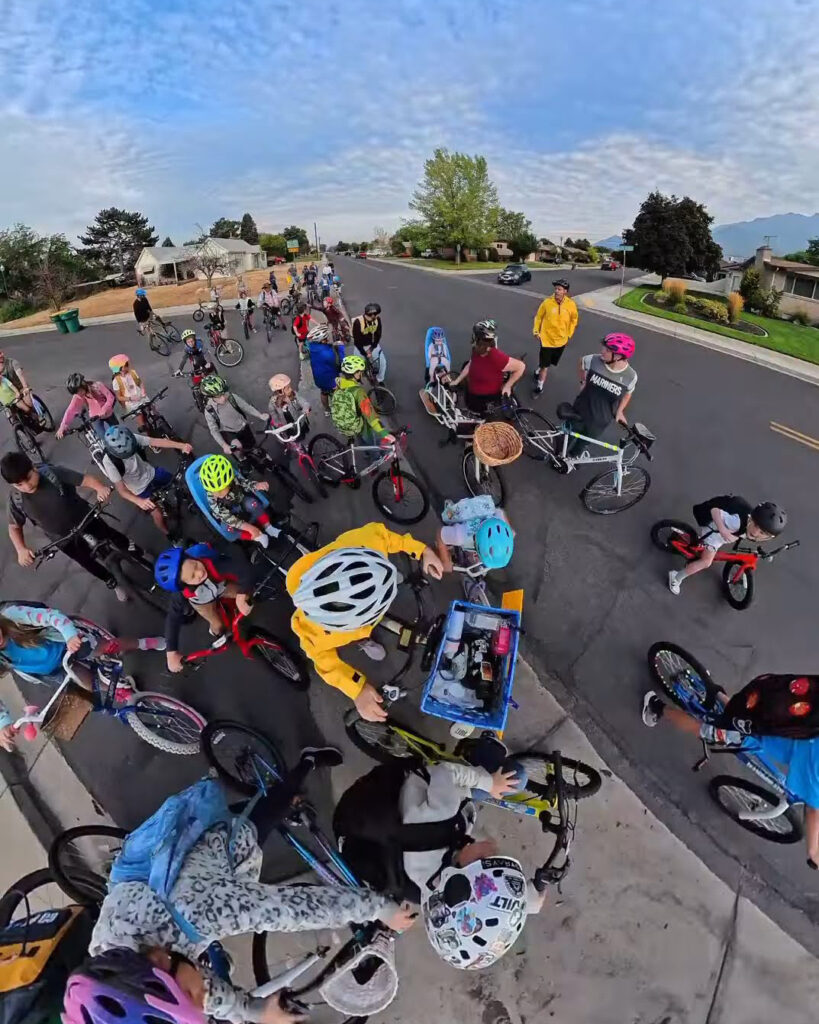
The Broadmoor Bike Bus began in 2022 when friends Hannah Moulton Belec and Kendra Flory, mothers to elementary-aged students, started chatting about the challenges of biking with a child on Tempe’s College Avenue. This designated “bike boulevard” is the busiest bicycle corridor in Arizona, according to the city.
“Over COVID we were talking about this fence that had been just totaled by a car driving recklessly and how scary that was because we bike and walk along the street all the time,” Moulton Belec said.
The two started organizing others to attend council meetings to deliver public comments and speak up about bike safety. “Then we just decided that we were going to invite people to bike with us to school and that we would try to demonstrate more demand for better infrastructure,” she said.
Since then, the bike bus has become a monthly event with anywhere from 10-40 kids riding along. Moulton Belec says the city supports the initiative, sometimes adding temporary infrastructure along the route to protect riders, including plastic posts nicknamed “candlestick dividers” that are placed between the bicycle and vehicle lanes.
On one early November ride, city officials placed cones along the route to act as a visual divider between cars and bicycles, and they brought whistles for participants. An officer from the city’s Police Bicycle Squad also rode along with the group.
Broadmoor’s bike bus has received grants from its PTA and People for Bikes, a national organization that advocates for bicycling. These funds have helped organizers arrange special events, buy treats for kids and purchase temporary protective infrastructure such as cones.
About 600 miles north in Orem, Utah, Zach Goulding and his wife were introduced to bike buses after watching a video Balto shared. Goulding said they were already regularly cycling to school with their two elementary-aged sons at the time.
“We just thought, ‘Man, this is so cool. This is amazing. How could we incorporate that into our school?’” he recalled.
Like Broadmoor’s bike bus, the one organized by the Gouldings at Cascade Elementary School in Orem started with just a few kids when it officially launched in 2023. Today, about 70 children ride together every Friday.
“Each week it grows,” Goulding said, adding that he’d like to help organize an alternative route, but that’s a challenge because the school’s boundaries are divided by a busy road that can be hard to cross.
“It would be really cool to expand that route so more kids on the other side of that street can join with us.”
Though Cascade Elementary’s bike bus hasn’t received any funding, Goulding said he’s in talks with the PTA and the school’s principal is a strong advocate who sometimes rides along with students.
School Districts Pedal Forward
Although most bike buses are organized by parents, Santa Fe Public Schools in New Mexico has a district-led model in collaboration with the nonprofit Santa Fe Conservation Trust. The Safe Routes to School Program, which started as a partnership between the City of Santa Fe and SFCT in 2021, has been run under the guidance of the school district since 2023.
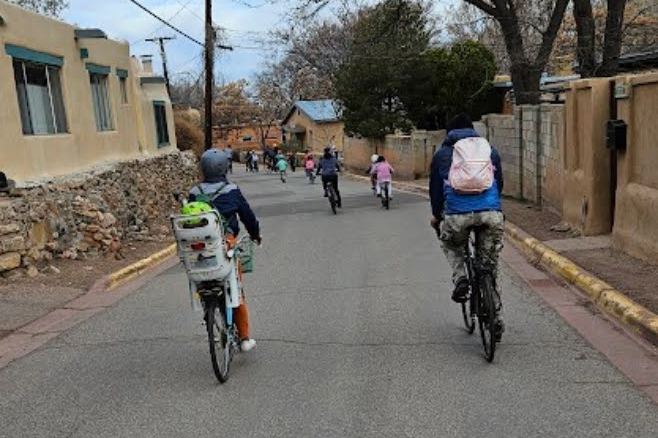
Twelve schools, mostly elementary level, participate in the program once or twice a week. While not strictly a bike bus program—only one route is dedicated to bicycles, and a handful of others get about 50/50 participation between cyclists and walkers—almost all of the events include a kid on a scooter, bike or “some sort of wheel,” according to Ryan Harris, the district’s Safe Routes to Schools coordinator.
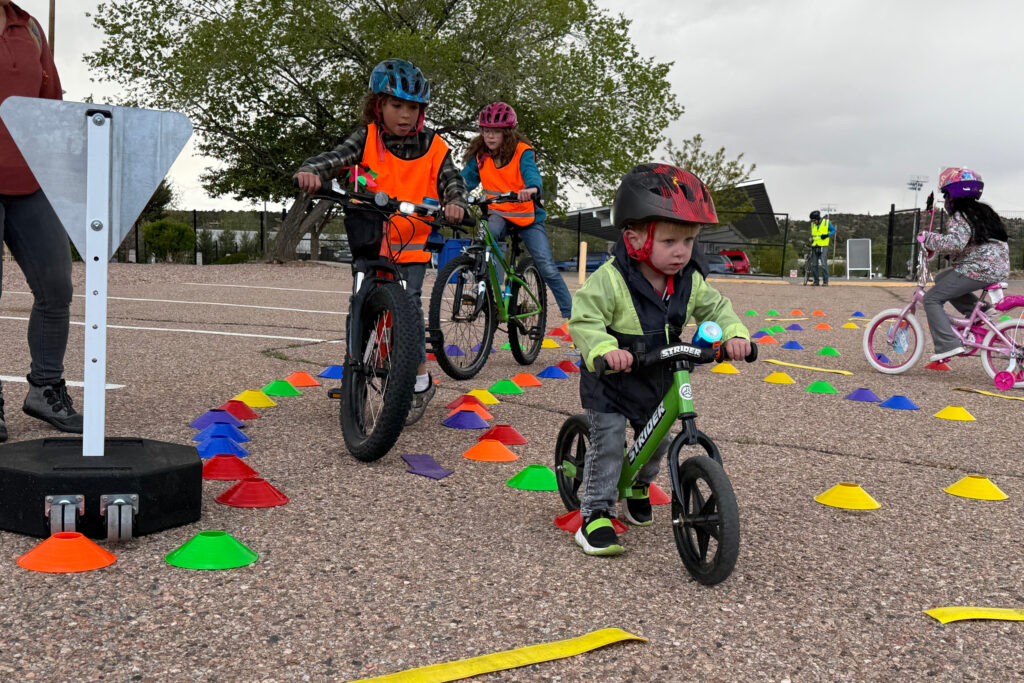
Harris doesn’t have any firm data for the first few years of the program, but he said participation has more than tripled since Santa Fe Public Schools took it over in 2023.
Santa Fe’s model differs from many bike bus models in another way: it pays teachers a stipend to meet children at a designated spot, usually a park, and chaperone them to school. Some parents drop their kids off with their bike, while others ride along. The program also offers incentives to attendees, including reflective vests and snacks.
Christina Lujan is a physical education teacher at Nina Otero Community School in Santa Fe and has served as a chaperone for bike and walk buses for around four years. She said she was motivated to become a “Walk and Roll Champion”—her official title—because she grew up biking all over Santa Fe as a young person.
“It makes me sad that everybody gets in a car and goes to school or work,” she said. “I just want to encourage kids to think about that.”
On Tuesday mornings, she meets a handful of children, mostly pre-K to 4th grade, to bike to school. On Wednesdays, they do a walking route.
Better Grades, Improved Mental Health
Bike bus proponents point to the many benefits of non-motorized physical transport to get kids to school. Bike Bus World, citing a study about the impacts of active commuting to school and cognitive performance, reported that riding to school better prepares children to learn and be engaged in schoolwork when they arrive in the classroom.
The research followed 2,859 students aged 13 to 18.5 years old in five Spanish cities from November 2000 to through June 2002. Though the study was primarily designed to assess the nutritional status of the students, “it is likely that the physical activity that takes place immediately before school might also play a role in cognition, effective learning, and academic performance,” the authors stated.
Lujan has seen these impacts firsthand with the children on her route.
This story is funded by readers like you.
Our nonprofit newsroom provides award-winning climate coverage free of charge and advertising. We rely on donations from readers like you to keep going. Please donate now to support our work.
Donate Now“The kids always tell me that they feel so much better when they bike or walk,” she said. “They’re motivated to do school, because I think it’s always good to exercise.”
Goulding, who is a certified mental health therapist, also points to the emotional benefits of hopping on a bike. In his practice, Goulding offers cycling to his clients during sessions as an alternative to sitting in an office and says that movement is especially beneficial to the younger kids he works with.
He explains that movement is one way to help children learn to be present and mindful so “they don’t become trapped or stuck with thoughts” that can otherwise become overwhelming to them.
“Whether it’s anxiety or depression or symptoms of ADHD, or just a lot of energy,” moving their bodies “teaches them that, ‘Hey, oh, this is important to me. This is helpful. This can help with me staying calm,’” said Goulding, who is also host of Ride This Out, a podcast that explores the connection between cycling, mental health and wellness.
All of that is in addition to the ways exercise like riding a bike supports children’s physical health. The Centers for Disease Control and Prevention states that an active lifestyle helps children build strong muscles, reduces risk of chronic illnesses such as type 2 diabetes and obesity, improves blood pressure and helps maintain normal blood sugar levels.
“Sitting in These Rooms Inhaling This Stuff”
Advocates also say bike buses reduce car traffic—a win for the environment and children’s health.
A number of studies have investigated pollution from idling vehicles at school dropoffs. For instance, one 2020 paper that sampled air quality at one primary school in the U.K. found that cars queuing to drop off students for school increased the concentration of fine particulate matter (PM2.5) by about three times. PM2.5 concentration at the playground was comparable to that of the main road during morning hours.
“These kids are sitting in these rooms inhaling this stuff,” Harris said. “If we have fewer cars idling in the parking lot, that would significantly reduce that.”
Long queues and traffic are an inconvenience, and a health and safety challenge, for everyone going to the school, Harris said. “One solution to that is having fewer cars in that dropoff line.”
Despite the benefits of bike buses and other active commuting programs, organizers still face challenges such as lack of cycling infrastructure in communities. Some critics also point out that they serve mostly wealthier neighborhoods, as bicycle purchase and maintenance can be financially restrictive.
Harris says Santa Fe’s Safe Routes to Schools program tries to address equity issues by partnering with the nonprofit Free Bikes 4 Kidz New Mexico, which has donated 40 bikes to students in need. It also offers free bike-repair sessions at some of the city’s lower-income schools.
Still, anyone can start a bike bus and reap the benefits, according to Moulton Belec.
“I would encourage anyone who’s thinking about getting to school another way to try it and invite people along and see what happens,” she said. “As long as you have one other person who will meet you, it can make a big difference.”
About This Story
Perhaps you noticed: This story, like all the news we publish, is free to read. That’s because Inside Climate News is a 501c3 nonprofit organization. We do not charge a subscription fee, lock our news behind a paywall, or clutter our website with ads. We make our news on climate and the environment freely available to you and anyone who wants it.
That’s not all. We also share our news for free with scores of other media organizations around the country. Many of them can’t afford to do environmental journalism of their own. We’ve built bureaus from coast to coast to report local stories, collaborate with local newsrooms and co-publish articles so that this vital work is shared as widely as possible.
Two of us launched ICN in 2007. Six years later we earned a Pulitzer Prize for National Reporting, and now we run the oldest and largest dedicated climate newsroom in the nation. We tell the story in all its complexity. We hold polluters accountable. We expose environmental injustice. We debunk misinformation. We scrutinize solutions and inspire action.
Donations from readers like you fund every aspect of what we do. If you don’t already, will you support our ongoing work, our reporting on the biggest crisis facing our planet, and help us reach even more readers in more places?
Please take a moment to make a tax-deductible donation. Every one of them makes a difference.
Thank you,