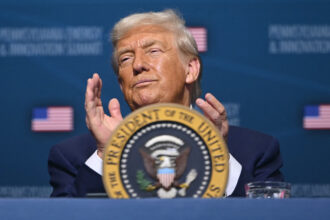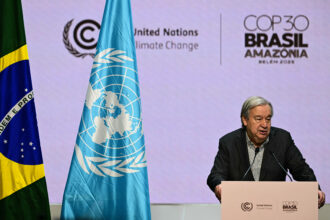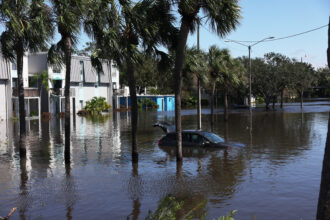


After the Trump administration announced late Wednesday that it would withdraw from the foundational agreement underpinning the international effort to slow the climate crisis, global leaders and climate advocates expressed extreme frustration and anger. Few were shocked.
“We’re appalled,” said Michael Gerrard, an environmental lawyer who founded the Sabin Center for Climate Change Law at Columbia University. “But not surprised.”
Whether—and how—the U.S. can actually exit the agreement, though, is still up for debate.
“It’s an open legal question whether a president can unilaterally withdraw from a treaty that has been ratified by the Senate. That issue has never been decided by the U.S. Supreme Court,” Gerrard said. “Another open legal question is whether the next president could rejoin without new ratification. Both of those are unsettled.”
The United Nations Framework Convention on Climate Change (UNFCCC), agreed to in 1992, is the international treaty in which the world’s countries agreed to combat climate change. The convention, which the U.S. Senate ratified in a 92-0 vote in October of that year, ultimately provided the structure through which the U.S. and nearly 190 other countries agreed to limit greenhouse gas emissions in the 2015 Paris Agreement.
The U.S. will officially exit the Paris deal on Jan. 20, one year after the administration submitted its intent to withdraw immediately upon taking office. On Wednesday, the administration also said it would leave the Intergovernmental Panel on Climate Change as well as 64 other U.N. treaties and international organizations.
Withdrawing from the UNFCCC, some legal scholars argue, goes a step further than leaving the Paris deal because the convention provides the legal obligation for the country to act on climate change.
David Victor, a professor of public policy at the School of Global Policy and Strategy at the University of California San Diego, explained that the U.S. joined the UNFCCC—and other environmental treaties including the 1987 Montreal Protocol to limit ozone-depleting substances—using the constitutional provisions of advice and consent. Since then, though, most treaties have been joined as executive agreements.
“They are still treaties in the sense that they’re binding on the United States in the eyes of international law, but the process by which we joined them was different,” Victor said. “The reason for that is it’s been so hard to get a supermajority in the Senate for anything. It’s hard to get the Senate to agree that today is Thursday.”
Victor noted that the Paris Agreement was adopted via this route, so the Trump administration has been able to more easily withdraw. “There wasn’t really a constitutional question as to whether they were allowed to because the executive, whoever’s in power, can sign these agreements and then join them formally, and then can also unjoin them,” Victor said.
The first Trump administration yanked the U.S. out of the Paris Agreement right after taking office in 2016, but under U.N. rules, the U.S. had to wait four years to fully exit. The U.N. requires a country to wait three years after the adoption of a treaty to submit its intent to withdraw, then wait another year to formally exit after giving notice. That meant the first Trump administration’s withdrawal went into effect around the time the Biden administration took office, when it promptly restored the country’s commitment to the deal. Rejoining was simply a matter of sending a letter to the U.N. climate secretariat.
It’s not clear whether the administration has yet submitted letters to the U.N. to withdraw from the UNFCCC, or any other treaty, but “as a functional matter we’re now out of the UNFCCC,” Gerrard said.
Some legal scholars said this week that because the Senate ratified the U.S. entry into the UNFCCC, withdrawing from it would also require the Senate’s approval. “It’s our legal view that it also must be exited using the same process in reciprocation,” Jean Su, energy justice director at the Center for Biological Diversity, told Reuters. “Letting this lawless move stand could shut the U.S. out of climate diplomacy forever.” Su said the center is evaluating whether to take the matter to the Supreme Court, Reuters reported.
Gerrard explained that a similar issue emerged in 1979 when President Jimmy Carter withdrew the U.S. from a Senate-ratified agreement regarding China.
At the time, Gerrard said, “the Supreme Court said that this was a political question and the courts couldn’t resolve it. It’s possible that this would happen again. … If the courts say pulling out is a political question, they might also say that rejoining is a political question.”
Legal experts said that public interest or environmental groups will likely challenge the UNFCCC withdrawal attempt in court.
Victor, who clarified that he is not a lawyer, agreed. “The issue for the court will be—if they take the case at all—whether the president has the authority to withdraw the United States from a treaty that the United States had joined via the advice and consent process,” he said. “The president clearly has the authority to withdraw from something that has been joined as an executive agreement. We’ve run that experiment with the Paris Agreement. That’s very clear. But advice and consent is a different story.”
Given the current court’s composition and recent decisions giving the executive branch greater authority, Victor says, it’s likely it would come down in Trump’s favor. And as a practical or political matter, the administration will move ahead anyway. “They don’t wait to see what the court is going to say about something that is potentially in the court’s jurisdiction,” he said. “They just go do it, and then they’ll wait and see what happens.”
“The larger story going on here, the larger strategy, is to create as much freedom of action for the United States as possible, and international law periodically is inconvenient to that,” Victor added, referring more broadly to other events of the past week, including the administration’s capture of Venezuelan President Nicolás Maduro. “They are either ignoring international law, or they’re removing those legal constraints wherever possible.”
Some legal scholars note that the Senate’s 1992 vote still stands, meaning the U.S. could re-enter the UNFCCC easily in a post-Trump world. Jean Galbraith, a law professor at the University of Pennsylvania, concluded in 2020 that if “President Trump has the unilateral power to withdraw, then his successor does and should have the unilateral power to rejoin.”
Until then, the U.S. is in an unprecedented position.
“Until yesterday, every one of the member states of the U.N. were parties to the UNFCCC,” Gerrard said. “Now the U.S. is standing utterly alone.”
He also noted that an advisory opinion issued by the International Court of Justice in July 2025, though not enforceable, said that international law required countries to act on climate change or face legal challenges.
“What the U.S. is doing now, across the board, is completely contrary to what the ICJ said is required by international law,” Gerrard said. “The court said climate change is posing massive violations of human rights, and states have an obligation to take major efforts to fight it.”
About This Story
Perhaps you noticed: This story, like all the news we publish, is free to read. That’s because Inside Climate News is a 501c3 nonprofit organization. We do not charge a subscription fee, lock our news behind a paywall, or clutter our website with ads. We make our news on climate and the environment freely available to you and anyone who wants it.
That’s not all. We also share our news for free with scores of other media organizations around the country. Many of them can’t afford to do environmental journalism of their own. We’ve built bureaus from coast to coast to report local stories, collaborate with local newsrooms and co-publish articles so that this vital work is shared as widely as possible.
Two of us launched ICN in 2007. Six years later we earned a Pulitzer Prize for National Reporting, and now we run the oldest and largest dedicated climate newsroom in the nation. We tell the story in all its complexity. We hold polluters accountable. We expose environmental injustice. We debunk misinformation. We scrutinize solutions and inspire action.
Donations from readers like you fund every aspect of what we do. If you don’t already, will you support our ongoing work, our reporting on the biggest crisis facing our planet, and help us reach even more readers in more places?
Please take a moment to make a tax-deductible donation. Every one of them makes a difference.
Thank you,