

NORFOLK, Va.—U.S. District Court Judge Jamar K. Walker granted Dominion Energy a preliminary injunction on Friday, pausing a stop work order from the Trump administration and allowing the utility to resume construction on its Coastal Virginia Offshore Wind project as a court case proceeds.
The ruling comes after the Interior Department last month issued the stop work order on Dominion’s $11 billion project and four other offshore wind farms under construction, citing national security threats without offering specifics. Dominion promptly sued.
Developers of two of those other projects, Revolution Wind in Rhode Island and Empire Wind in New York, also won preliminary injunction requests in federal court this week to resume construction. The Trump administration had previously canceled the leases for future offshore wind areas, and the attack on projects already being built was seen by many legal experts as lacking legal merit.
Dominion’s attorneys had argued in legal filings, and in the U.S. District Court for the Eastern District of Virginia Friday, that the project had a lengthy permit review process that involved regular communication with several agencies, including the Department of Defense, now called the Department of War, to address national security concerns.
The utility has had two pilot turbines within a mile of CVOW for years to learn about reducing any conflicts with the military, and has made efforts to keep from compromising national security and avoid issues with radar, Dominion also argued.
Federal agencies, which had discussed the security threats in November, had meetings with Dominion in December leading up to the stop work order but declined to share any of its national security concerns with the utility, Dominion’s attorney James Auslander argued.
“This was a total surprise, your honor,” said Auslander, adding that not seeing the classified information amid the legal case means despite having employees with security clearances, meant “we’re flying blind here, your honor.” The government can’t claim national security threats, he added, and “call it a day.”
The Bureau of Ocean Energy Management “just wants to stop wind projects,” Auslander said, and CVOW “is now caught in that net.”
U.S. Department of Justice Associate Attorney General Stanley E. Woodward Jr. was brief in court, in order to protect classified national security information. He said he did not believe the federal government had an obligation to inform Dominion that the Pentagon would be issuing classified national security concerns about the offshore wind project.
“I don’t think that’s required by the law,” he said.
After a 10-minute break, Walker said that he found Dominion had demonstrated it could win the case, and that there were inconsistencies with the security information from the federal government. Virginians had “already” begun paying for the project, he said, adding that Dominion, which recovers cost from its customers, had suffered irreparable harm by “already,” having “millions of dollars of loss.”
“This is appropriate here,” Walker said in justifying the preliminary injunction.
The ruling is a victory for Virginia’s largest utility and the offshore wind industry that has faced an onslaught of attacks from President Donald Trump, despite the need for electricity from clean sources to reduce greenhouse gas emissions that are warming the planet.
“Our team will now focus on safely restarting work to ensure CVOW begins delivery of critical energy in just weeks,” the utility said in a statement. “While our legal challenge proceeds, we will continue seeking a durable resolution of this matter through cooperation with the federal government.”
Attorneys for the federal government declined to comment after the hearing.
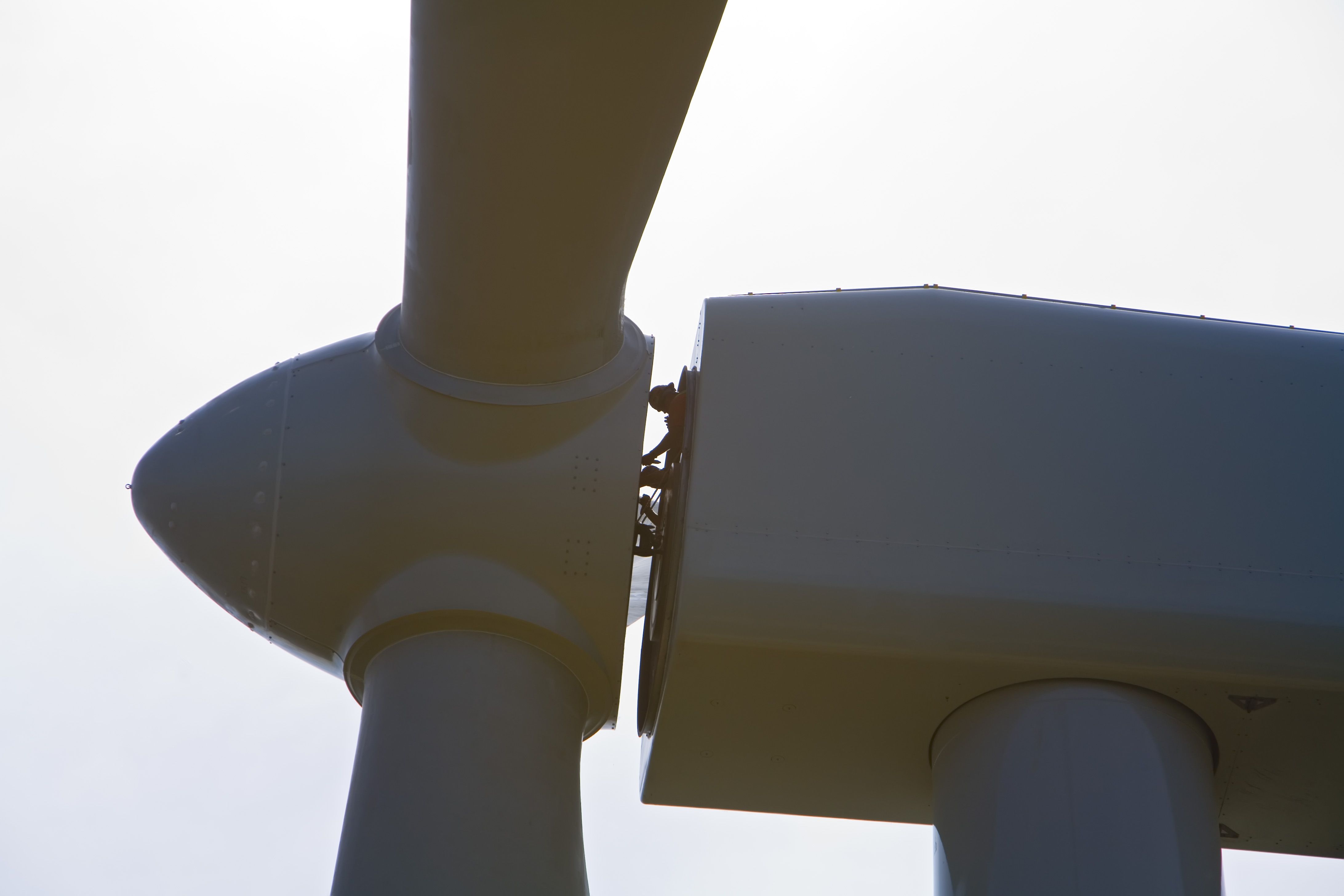
Approved in 2022, construction of the CVOW’s 176 turbines was about 70 percent complete when the Trump administration issued the stop work order The utility has planned to start sending some of the electricity to customers early this year as construction is completed by the end of 2026. At full capacity, the project would produce 2.6 gigawatts of clean energy, enough to power 660,000 homes while avoiding pollution from fossil fuels that would have been the equivalent of a million cars annually.
Trump has continuously sought to end the offshore wind industry as he champions the continued use of fossil fuels to generate electricity. But energy professionals have criticized Trump’s stop work orders, given the need for electricity as Energy Secretary Chris Wright pushes to win an energy-intensive artificial intelligence (AI) arms race with China.
Those AI functions are processed through data centers, the massive server farms that operate day and night, requiring massive amounts of electricity and, often, water to cool banks of computers.
Virginia is home to the largest number of data centers in the world, with Dominion’s grid expected to double from a peak demand for electricity of about 25 gigawatts at the end of last year to 41.5 gigawatts in 2035. PJM Interconnection, the regional grid operator for Virginia, 12 other states and the District of Columbia, had filed a brief in the case supporting the project.
“This ruling is a major win for Virginia families and our economy,” Virginia House Speaker Don Scott, who represents the Portsmouth area near Virginia Beach, said in a statement. “The Coastal Virginia Offshore Wind Project will power more than 10 percent of Dominion Energy’s all time peak load and supply clean, reliable energy … helping keep the lights on and utility costs down.”
The project is also critical to Virginia and its ratepayers, who had already begun paying fees for the project, amounting to about $4 a month over the 35-year life of the project. Higher fees had come over the past two years before leveling out in later years. Customers could be on the hook for more costs if CVOW isn’t able to generate electricity to comply with requirements of the Virginia Clean Economy Act, a 2020 law seeking to decarbonize the grid by mid-century.
“It should finish,” Republican Gov. Glenn Youngkin told Inside Climate News at the end of last year, referring to the offshore wind project. His comment represented a rare public break for the Trump ally. Youngkin had reportedly lobbied for CVOW behind closed doors, while publicly boosting fossil fuels as part of an “all-of-the-above” approach to electricity generation. Youngkin’s last day is Friday.
Virginia’s incoming governor, Abigail Spanberger, a Democrat, has vowed to fight for the project. She trounced her Trump-allied opponent in November as legislative Democrats picked up more than a dozen seats in the state house, strengthening Democratic control of both legislative chambers.
CVOW had been approved under a regulated structure ensuring costs didn’t soar and included additional ratepayer protections to have Dominion shoulder cost overruns, Youngkin said late last year in explaining his support for the project. Trump’s tariffs on steel had increased the cost by $500 million and removal of clean energy tax credits created financial challenges.
The project had also been sought for years to drive economic development in the region by making it an offshore wind development hub. Dominion had paid for a first-of-its-kind vessel, called Charybids, to safely install the turbines. A maritime economy already in place around the U.S. Naval base in Norfolk, and the region’s central location along the east coast, made it a desirable hub for the industry that was burgeoning, prior to Trump taking office.
This story is funded by readers like you.
Our nonprofit newsroom provides award-winning climate coverage free of charge and advertising. We rely on donations from readers like you to keep going. Please donate now to support our work.
Donate NowU.S. Sen. Mark Warner touted that economic potential in a media availability last week. He, and fellow Democrats Sen. Tim Kaine and U.S. Rep Bobby Scott, who represents the Norfolk area, had filed briefs in the case supporting the project. Vice chairman of the Senate Select Committee on Intelligence who is privy to national security information, Warner said that Trump’s security claims were “baloney.”
Delays on the project were costing the utility $5 million a day, given the need to schedule specialty ships for weeks at a time. And onshore substation and transmission work to receive the electricity from CVOW that would benefit the immediate surrounding area, including the naval base and shipbuilding industry, had also been paused, a consequence that drew the ire of Republican U.S. Rep Jen Kiggans, who represents a swing district including Virginia Beach.
In issuing the preliminary injunction, Judge Walker requested that Dominion and the federal government file a briefing schedule for how the case should proceed in federal district court.
About This Story
Perhaps you noticed: This story, like all the news we publish, is free to read. That’s because Inside Climate News is a 501c3 nonprofit organization. We do not charge a subscription fee, lock our news behind a paywall, or clutter our website with ads. We make our news on climate and the environment freely available to you and anyone who wants it.
That’s not all. We also share our news for free with scores of other media organizations around the country. Many of them can’t afford to do environmental journalism of their own. We’ve built bureaus from coast to coast to report local stories, collaborate with local newsrooms and co-publish articles so that this vital work is shared as widely as possible.
Two of us launched ICN in 2007. Six years later we earned a Pulitzer Prize for National Reporting, and now we run the oldest and largest dedicated climate newsroom in the nation. We tell the story in all its complexity. We hold polluters accountable. We expose environmental injustice. We debunk misinformation. We scrutinize solutions and inspire action.
Donations from readers like you fund every aspect of what we do. If you don’t already, will you support our ongoing work, our reporting on the biggest crisis facing our planet, and help us reach even more readers in more places?
Please take a moment to make a tax-deductible donation. Every one of them makes a difference.
Thank you,

Charles Paullin
Charles Paullin is a Richmond, Virginia-based reporter focusing on energy and environment issues. He’s won several awards for his previous work covering state policy with the Virginia Mercury and local news with the Northern Virginia Daily in the Northern Shenandoah Valley. His first reporting gig was with the New Britain Herald in Connecticut, a couple years after attending the University of Hartford, where he first studied sports journalism.