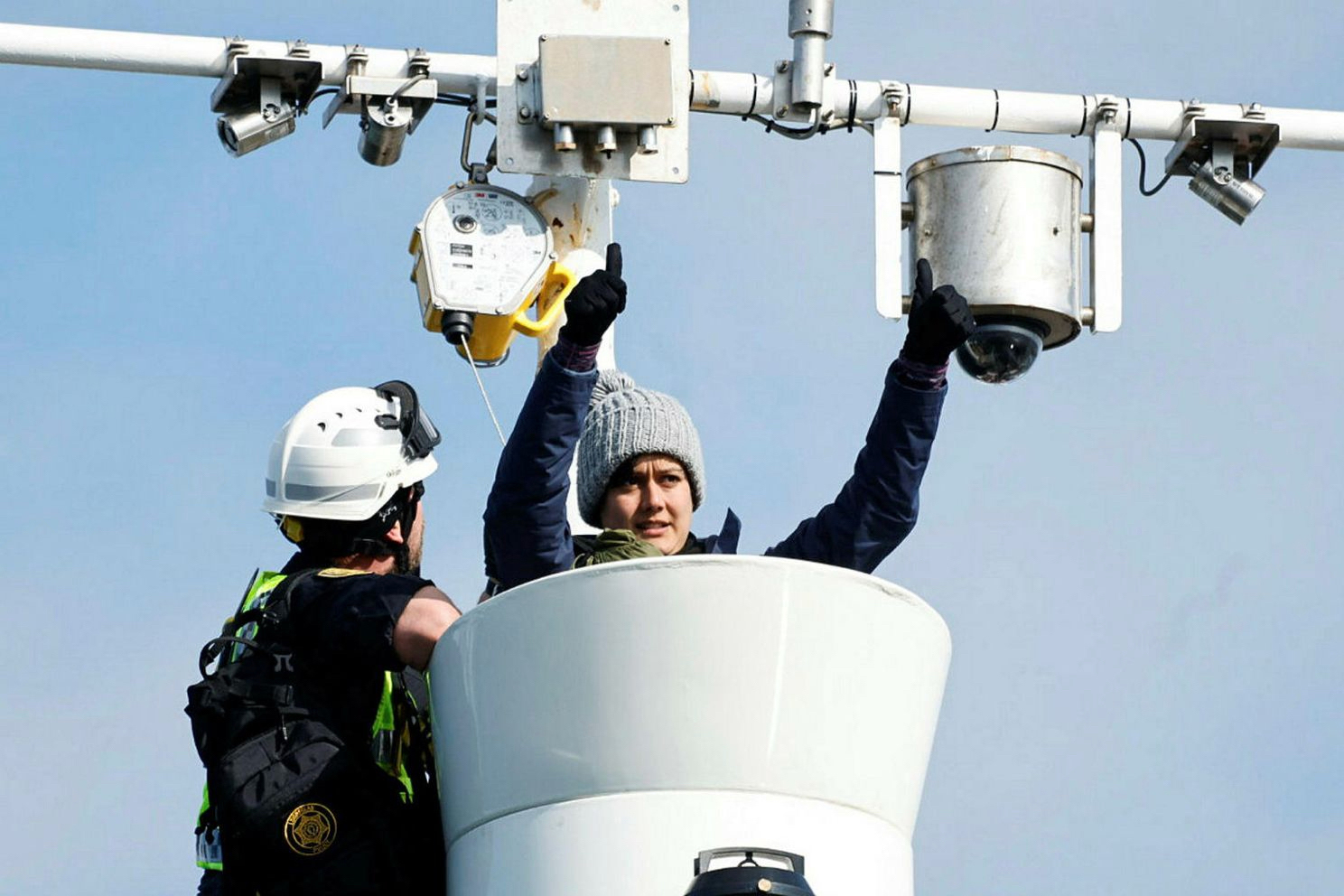


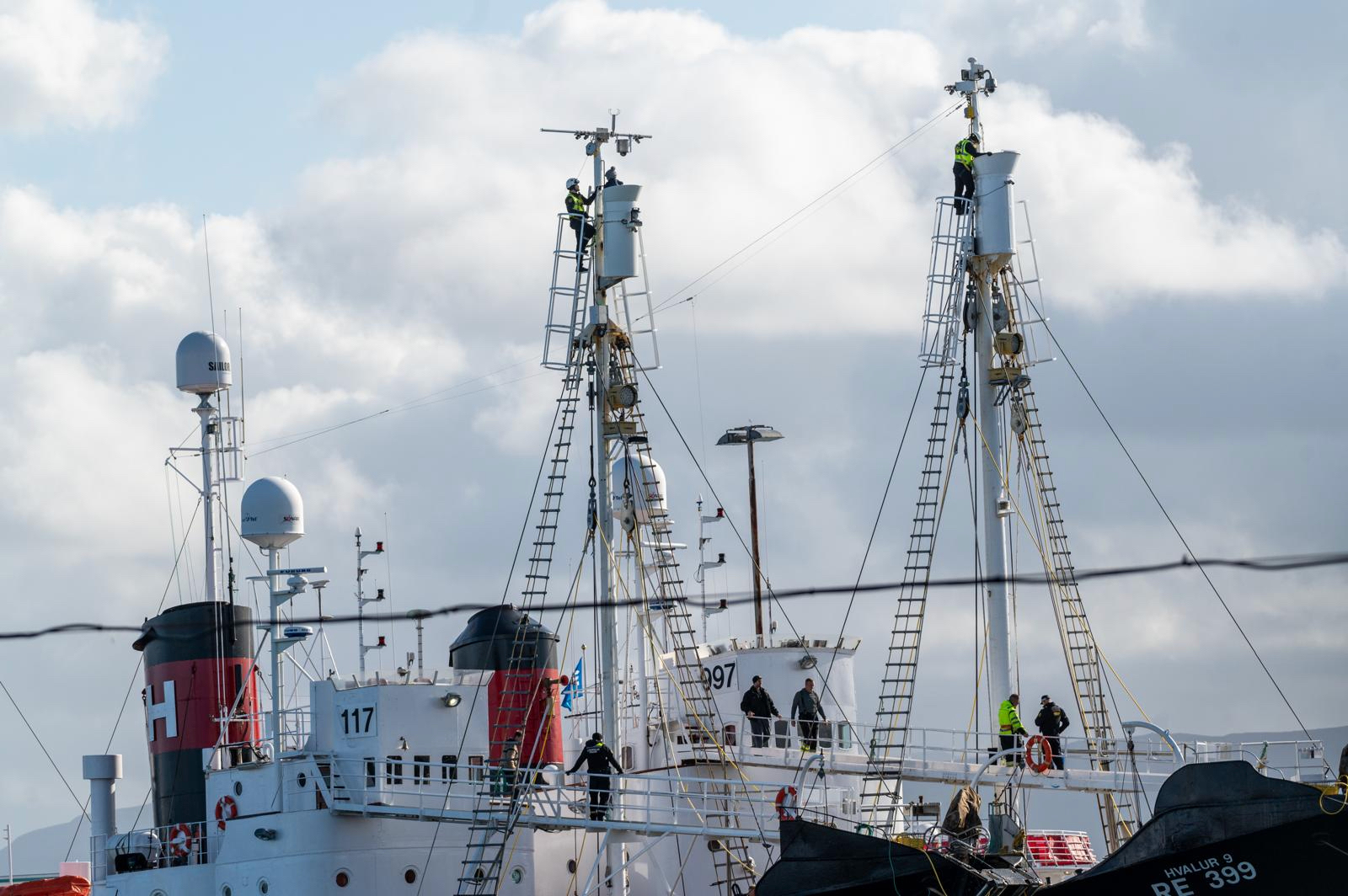
At 4 a.m. on Sept. 4, 2023, two environmental activists, Elissa Phillips and Anahita Sahar Babaei, climbed aboard a pair of aging whaling vessels moored side by side in Reykjavík harbor to stop them from heading out to sea. A temporary ban on killing whales in Iceland had just been lifted and the women believed the ships’ crew would soon resume their hunt.
“We knew it meant watching more whales being butchered unnecessarily,” said Phillips, a British citizen who, prior to boarding the vessels, had volunteered with Sea Shepherd UK, a marine conservation nonprofit now known as the Captain Paul Watson Foundation UK, documenting whale kills in Iceland.
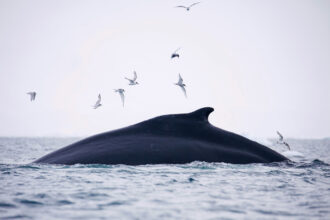
Carrying food, water, medicine, blankets, chains and padlocks, the women scaled the ships’ mast ladders, hauling themselves nearly 50 feet high to lock into the crow’s nests of Hvalur 8 and Hvalur 9. The two ships are owned by Hvalur hf., Iceland’s last remaining company that hunts fin whales—the second-largest animals on Earth, surpassed only by blue whales.
Fin whales are classified as a vulnerable species by the International Union for Conservation of Nature, meaning they face a high risk of extinction in the wild. Yet Iceland has continued to issue permits allowing them to be hunted, despite findings by both activists and government regulators that the practice violates the country’s own animal-welfare laws.
It was an act of non-violent civil disobedience Phillips said she planned independently of any organization, along with Babaei, to protect the whales.
“We had to take even more direct action and do what we could to put our bodies in the way of the harpoons,” Phillips said.
More than two years later, this act of protest has become the focal point of a criminal case unfolding this week as Iceland continues to debate whether to allow commercial whaling despite mounting domestic and international opposition.
On Thursday, Phillips and Babaei go to trial in Reykjavík on charges of trespassing and failing to comply with police orders to immediately descend from the ships’ crow’s nests, where they remained for 33 hours. They were eventually forced to come down from their posts after police confiscated their food and water supply, as well as medication. The women were then arrested.
If convicted, the activists could face jail time or substantial fines, according to their lawyer, Katrín Oddsdóttir of the Reykjavík-based firm Réttur–Aðalsteinsson & Partners, who is seeking their acquittal.
Her clients, she said, caused no damage or harm to people or property and were exercising rights protected by the Icelandic Constitution and the European Convention on Human Rights, which guarantee freedom of expression and peaceful assembly.

Regardless of the verdict, Phillips and Babaei said they plan to use the trial as another opportunity to demand a permanent ban on whaling in Iceland.
“It’s just another platform where I can speak up for the whales, for the oceans, for the environment and for people at the end of the day, because these are all connected,” said Babaei, an Iranian artist who arrived in Iceland in 2022 to film a documentary about the growing activist movement to end commercial whaling.
A Last Whaling Nation
Iceland is one of three countries, including Japan and Norway, that still permits commercial whaling despite a global moratorium in 1986 by the International Whaling Commission to halt the widespread decline in whale populations caused by decades of industrial whaling.
For decades, the country’s whaling industry has been dominated by a single fishing magnate, Kristján Loftsson, who owns Hvalur hf. and the two vessels the activists occupied. Phillips and other activists have likened him to Captain Ahab—the obsessive whaler featured in Herman Melville’s 1851 novel Moby Dick—for his determination to keep the hunt alive despite declining demand and mounting opposition.
Fifty-one percent of Icelanders are opposed to whaling, according to a 2023 survey, conducted by Icelandic polling firm the Maskina Institute.
“The majority of Icelanders are against this and essentially nobody eats this meat,” said Rósa Líf Darradóttir, a medical doctor and anti-whaling activist from Iceland.
Until a few years ago, most fin whale meat harvested in Iceland was exported to Japan. But that trade has become nearly moot since Japan resumed commercial fin whaling in its own waters in 2024. Loftsson did not respond to multiple requests for comment, but Phillips and Babaei say he has not sent his ships out in the past two seasons, citing a lack of viable buyers.
This story is funded by readers like you.
Our nonprofit newsroom provides award-winning climate coverage free of charge and advertising. We rely on donations from readers like you to keep going. Please donate now to support our work.
Donate NowIn a 2025 interview with the Icelandic newspaper Morgunblaðið, Loftsson acknowledged the downturn. “Product price developments in our main market country, Japan, have been unfavorable recently and are worsening, making the price of our products so low that it is not justifiable to engage in whaling,” he said.
But anti-whaling activists worry that this could change. Whaling season traditionally runs from June to September. And Loftsson’s company still holds a five-year permit to hunt that is valid through 2029.
“Whaling can happen any minute,” said Babaei. “As long as the potential for it exists, there will be people trying to do that.”
In 2023, Iceland temporarily suspended commercial whaling after a government-commissioned investigation by the Icelandic Food and Veterinary Authority—the country’s lead agency on animal welfare—found that the practice repeatedly violated Iceland’s primary animal welfare law. That requires animals to be rendered unconscious as quickly as possible to minimize suffering, a standard that is hard to meet when hunting fin whales.
“The bigger the animal, the more difficult it is to kill it outright,” said Mark Simmonds, director of science at OceanCare, a marine conservation organization based in Switzerland.
Fin whales can grow nearly 90 feet long and weigh more than 100 tons. To kill them, Simmonds said, whalers fire grenade-tipped harpoons designed to explode inside the animal’s body. Barbed claws at the tip of the projectile deploy on impact, penetrating the whale’s thick blubber to anchor the weapon in place and prevent it from pulling free. Ropes or cables attached to the embedded harpoon allow crews to secure the wounded animal and tow it alongside the vessel as it is hauled back toward the ship and eventually to port.
Sometimes the animal is killed outright, but other times it’s not. In 2022, 148 fin whales were killed. According to the Icelandic Food and Veterinary Authority report, 59 percent of the whales hunted that year died immediately. The mean time for animals that did not die immediately was 11.5 minutes. Some died several hours after being struck by harpoons.
“I think we should anticipate that with a large-brained, social mammal, that the suffering that they experience would be really close to suffering that we would experience if somebody did something similar to us,” Simmonds said. Other whales aware of the wounded animal’s pain may also be affected. “We have the potential for not only the animal that was struck suffering, but also other members of its group,” he said.
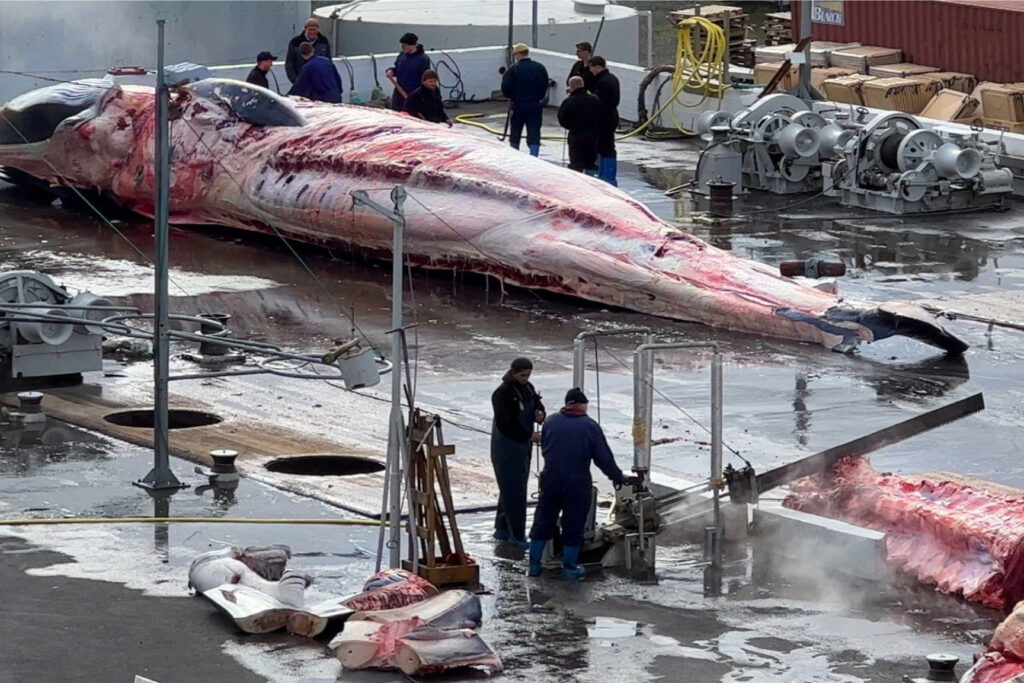
But knowledge of these animal-welfare violations was not enough for Iceland officials to implement a permanent ban on whaling. After a few months’ suspension, the ban was lifted, prompting Phillips and Babaei to plan their protest in the crow’s nest of Loftsson’s ships.
“They were the only ones who had the guts to do something radical,” said Kristín Vala Ragnarsdóttir, professor emerita at the University of Iceland’s School of Engineering and Natural Sciences, who is against whaling.
Fin whales play an important role in stabilizing Earth’s climate, as do other “great whales,” including blue whales and humpbacks. By feeding deep below the surface and releasing nutrient-rich waste in shallower waters, they stimulate the growth of phytoplankton—microscopic organisms that absorb vast quantities of carbon dioxide from the atmosphere.
“Whales act as a nutritional pump in the ocean, moving vital nutrients to the surface and keeping ocean life and biodiversity going,” Ragnarsdóttir said.
Also, when whales die in the ocean, their enormous bodies sink to the ocean floor, storing carbon for centuries. The loss of large whales, Ragnarsdóttir said, weakens this natural carbon-capture system and diminishes the ocean’s capacity to slow global warming and maintain a healthy ocean ecosystem.
Soon after the activists’ arrests in September 2023, Loftsson’s crew killed 25 fin whales. One was a pregnant female. “When they cut her open there was a fully grown fin whale inside her,” Phillips said.
Since then, Babaei said, opposition to whaling has continued to grow within Iceland and abroad, gaining the support of domestic animal-rights groups as well as prominent celebrities, including Icelandic musician Björk, Native Hawaiian actor Jason Momoa and Canadian film director James Cameron.
European lawmakers have also urged Iceland to abandon whaling. In 2024, more than 30 members of the European Parliament sent a formal appeal calling on Iceland’s government to revoke current whaling licenses and commit to a permanent ban. The letter warned that continued hunting could violate international agreements such as the United Nations’ Convention on the Law of the Sea, which obligates signatory states, which includes Iceland, to protect the marine environment.
As the trial approaches, Phillips and Babaei say they are prepared for whatever the court decides. But they also say the case has become larger than them. It is no longer just a criminal case. It is a public reckoning over whether Iceland will continue to permit the killing of some of the world’s largest and most intelligent animals or finally end the practice.
“I hope the whales win,” said Babaei.
About This Story
Perhaps you noticed: This story, like all the news we publish, is free to read. That’s because Inside Climate News is a 501c3 nonprofit organization. We do not charge a subscription fee, lock our news behind a paywall, or clutter our website with ads. We make our news on climate and the environment freely available to you and anyone who wants it.
That’s not all. We also share our news for free with scores of other media organizations around the country. Many of them can’t afford to do environmental journalism of their own. We’ve built bureaus from coast to coast to report local stories, collaborate with local newsrooms and co-publish articles so that this vital work is shared as widely as possible.
Two of us launched ICN in 2007. Six years later we earned a Pulitzer Prize for National Reporting, and now we run the oldest and largest dedicated climate newsroom in the nation. We tell the story in all its complexity. We hold polluters accountable. We expose environmental injustice. We debunk misinformation. We scrutinize solutions and inspire action.
Donations from readers like you fund every aspect of what we do. If you don’t already, will you support our ongoing work, our reporting on the biggest crisis facing our planet, and help us reach even more readers in more places?
Please take a moment to make a tax-deductible donation. Every one of them makes a difference.
Thank you,

Teresa Tomassoni
Oceans Correspondent
Teresa Tomassoni is an environmental journalist covering the intersections between oceans, climate change, coastal communities and wildlife for Inside Climate News. Her previous work has appeared in The Washington Post, NPR, NBC Latino and the Smithsonian American Indian Magazine. Teresa holds a master’s degree in Journalism from the Craig Newmark Graduate School of Journalism at CUNY. She is also a recipient of the Stone & Holt Weeks Social Justice Reporting Fellowship. She has taught journalism for Long Island University and the School of the New York Times. She is an avid scuba diver and spends much of her free time underwater.