

As fossil fuel-based carbon dioxide emissions continue to rise to record levels, a new analysis shows that a majority of these emissions can be traced back to a shrinking number of large corporate entities.
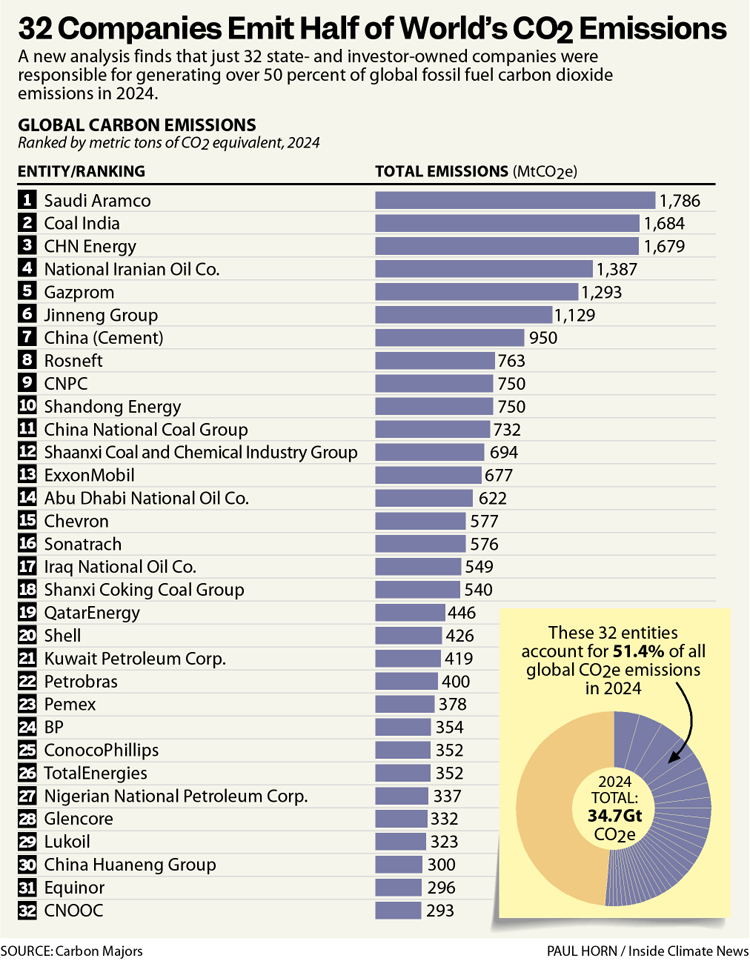
Just 32 companies accounted for over half of global fossil carbon emissions in 2024, according to a report published Wednesday by the U.K.-based think tank InfluenceMap. That is down from 36 companies responsible for half the global CO2 emissions in 2023, and 38 companies five years ago.
The analysis is the latest update to the Carbon Majors database, which tracks the world’s largest oil, gas, coal and cement producers and uses production data to calculate the carbon emissions from each entity’s production. The database, first developed by researcher Richard Heede and now hosted by InfluenceMap, quantifies current and historical emissions attributable to nearly 180 companies and provides annual updates. It is the only database of its kind tracking corporate-generated carbon emissions dating back to the start of the Industrial Revolution, research that’s being used in efforts to hold major polluters accountable for climate harms.
“Each year, global emissions become increasingly concentrated among a shrinking group of high-emitting producers, while overall production continues to grow. Simultaneously, these heavy emitters continue to use lobbying to obstruct a transition that the scientific community has known for decades is essential,” Emmett Connaire, senior analyst at InfluenceMap, said in a press statement. The findings of the new analysis, he added, “underscore the growing importance of this kind of rigorous evidence in efforts to determine accountability for climate-related losses.”
Despite dire warnings from scientists about the consequences of accelerating climate change, fossil fuel production is continuing apace. Last year, fossil fuel CO2 emissions reached a record high, topping 38 billion metric tons. In 2024 these emissions were 37.4 billion metric tons—up 0.8 percent from 2023—and traceable to 166 oil, gas, coal and cement producers, according to the report.
Much of the global carbon emissions in 2024 came from state-owned entities, which represented 16 of the top 20 emitters. The five largest emitters overall—Saudi Arabia’s Aramco, Coal India, China’s CHN Energy, National Iranian Oil Co. and Russia’s Gazprom—were all state-controlled, and accounted for 18 percent of the total fossil CO2 emissions in 2024.
ExxonMobil, Chevron, Shell, ConocoPhillips and BP—the top five emitting investor-owned companies—together were responsible for 5.5 percent of the total emissions in that year.
Historically, ExxonMobil and Chevron rank in the top five for fossil carbon emissions generated from 1854 through 2024, accounting for 2.79 percent and 3.08 percent of overall carbon pollution, respectively. According to the analysis, the 178 entities in the database have generated 70 percent of fossil CO2 emissions since the start of the Industrial Revolution, and just 22 entities are responsible for one-third of these emissions.
The report further indicates that many of the largest emitters are increasing their fossil fuel output, and hence their emissions, while lobbying against climate policies and blocking climate action. Nearly two-thirds of the 32 entities responsible for over half of CO2 emissions in 2024 saw their emissions increase compared to 2023.
“The latest Carbon Majors data shows once again that large emitters are on the wrong side of history. When we need to accelerate progress to the clean energy future that would give us greater energy security, affordability and freedom, these emitters continue to block our way,” Christiana Figueres, former executive secretary of the United Nations Framework Convention on Climate Change (UNFCCC) and a chief architect of the Paris Agreement, said in a press statement. “While clean energy and electrification is already receiving nearly twice the investment of fossil fuels globally, carbon majors are clinging on to outdated, polluting products and continue to mislead the public on the urgent real-world consequences of their actions.”
In the U.S., Big Oil executives are touting the long-term demand for oil and gas. American Petroleum Institute president and CEO Mike Sommers proclaimed last week at an industry event that “the next ten years are shaping up to be the Demand Decade,” while ExxonMobil CEO Darren Woods, speaking at a recent White House meeting on Venezuela, said: “We’re in a depletion business for a product that is in great demand and will be in demand for many, many, many decades to come.”
Scientists say that fossil fuels must be phased out if we are to avoid the most catastrophic outcomes. In a paper titled “The 2024 state of the climate report: Perilous times on planet Earth,” scientific experts note that “stiff resistance from those benefiting financially from the current fossil-fuel based system” is holding back progress on mitigating the climate problem. “Rapidly phasing down fossil fuel use should be a top priority,” they say.
At the COP28 U.N. climate summit in Dubai in 2023, countries agreed, at least in principle, on the need to transition away from fossil fuels in energy systems. But at the most recent U.N. climate summit, COP30 in Brazil last November, petrostates and major fossil fuel-producing countries blocked a proposed roadmap for this transition, which had the backing of more than 80 countries. According to the latest Carbon Majors analysis, 17 of the top 20 carbon emitters in 2024 were controlled by countries that opposed a roadmap for phasing out fossil fuels. These countries included Saudi Arabia, Russia, China, Iran, United Arab Emirates, Algeria, Iraq, Qatar and India.

Tzeporah Berman, chair and founder of the Fossil Fuel Treaty Initiative, said the analysis reveals that “a powerful, concentrated group of fossil fuel corporations are not only dominating global emissions but are actively sabotaging climate action and weakening government ambition.”
“Their increasing output and blatant opposition to a fossil fuel phase-out, as witnessed at COP30, reveal a systemic barrier to progress,” she said in a press statement. “This is precisely why a Fossil Fuel Treaty is not merely an option, but the indispensable mechanism to hold these giants accountable, break their stranglehold on climate policy, and ensure a fast and fair global transition away from the products threatening our very existence: oil, gas, and coal.”
The first steps on negotiating a fossil fuel phaseout treaty will begin to take shape this spring. The governments of Colombia and the Netherlands announced at COP30 that they will co-host the world’s first International Conference on the Just Transition Away from Fossil Fuels, which will take place April 28 and 29 in Santa Marta, Colombia.
“This will be a broad intergovernmental, multisectoral platform complementary to the UNFCCC designed to identify legal, economic, and social pathways that are necessary to make the phasing out of fossil fuels,” Irene Vélez Torres, Colombia’s minister of environment and sustainable development, said in the announcement.
About This Story
Perhaps you noticed: This story, like all the news we publish, is free to read. That’s because Inside Climate News is a 501c3 nonprofit organization. We do not charge a subscription fee, lock our news behind a paywall, or clutter our website with ads. We make our news on climate and the environment freely available to you and anyone who wants it.
That’s not all. We also share our news for free with scores of other media organizations around the country. Many of them can’t afford to do environmental journalism of their own. We’ve built bureaus from coast to coast to report local stories, collaborate with local newsrooms and co-publish articles so that this vital work is shared as widely as possible.
Two of us launched ICN in 2007. Six years later we earned a Pulitzer Prize for National Reporting, and now we run the oldest and largest dedicated climate newsroom in the nation. We tell the story in all its complexity. We hold polluters accountable. We expose environmental injustice. We debunk misinformation. We scrutinize solutions and inspire action.
Donations from readers like you fund every aspect of what we do. If you don’t already, will you support our ongoing work, our reporting on the biggest crisis facing our planet, and help us reach even more readers in more places?
Please take a moment to make a tax-deductible donation. Every one of them makes a difference.
Thank you,