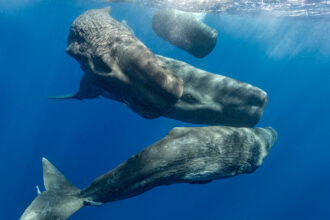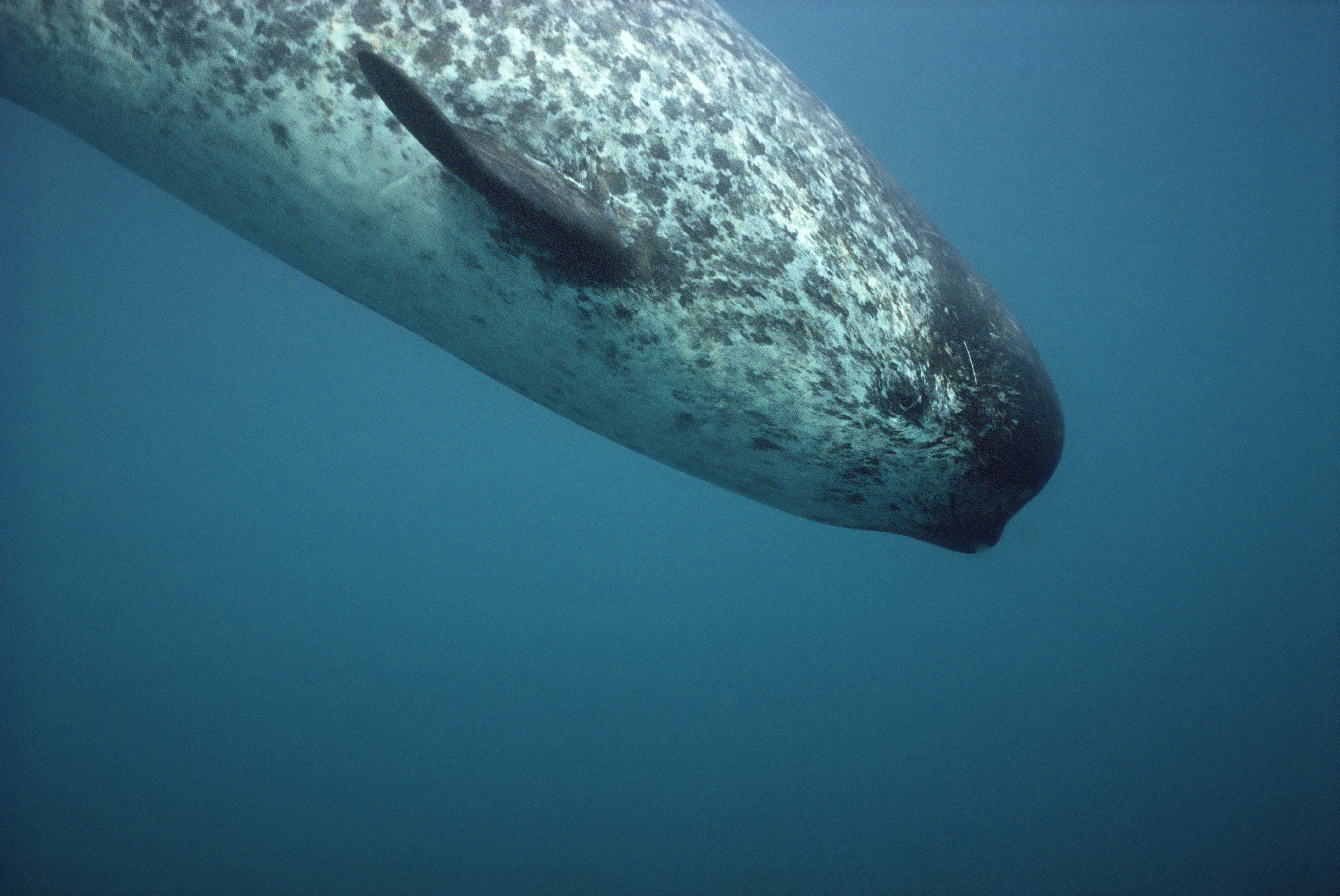


For most of their evolutionary history, narwhals have relied more on sound than sight to survive in the Arctic’s dark icy waters.
The speckled toothed whales—sometimes referred to as “unicorns of the sea” for the long, spiral tusks that protrude from the heads of males—navigate, hunt and communicate using echolocation. By emitting a series of calls, whistles and high frequency clicks—as many as a thousand per second—and listening for the echoes that bounce back, they are able to locate prey hundreds to thousands of feet deep and detect narrow cracks in sea ice where they can surface to breathe.
But as global temperatures continue to rise, the acoustic world narwhals depend on is rapidly shifting throughout their range, from northeastern Canada and Greenland to Norway’s Svalbard archipelago and Arctic waters in Russia. It’s getting louder.
The Arctic is warming at least three times faster than the rest of the planet, and as sea ice continues to shrink, vast stretches of ocean, once inaccessible to most humans, are opening up. Over the past decade, cargo vessels, fishing fleets, cruise ships and oil and gas tankers have started moving through the region with increasing frequency and ease.
Throughout their journeys, they generate disturbing levels of noise that mask the sounds made by narwhals, as well as their hearing.
“Underwater noise is a growing problem, contributing to serious impact on the Arctic ecosystem,” said Sarah Bobbe, senior manager in the Arctic program at Ocean Conservancy, in a statement.
Other whales that are endemic to the Arctic, including belugas and bowheads, are in jeopardy, too.
“We know that all three species are sensitive to underwater noise produced by ships,” said Melanie Lancaster, senior specialist for Arctic species for the global Arctic program at the World Wide Fund for Nature, better known as WWF. “Even small amounts of noise can have large impacts on these species.”
Last month, that growing threat was a central topic at a multi-day meeting convened in London by the International Maritime Organization (IMO)—a United Nations body that regulates global shipping—where they reviewed recent research on the impact of ocean noise pollution on marine life and discussed methods and technologies for reducing it.
“Member states agreed on clear guidance on how we must reduce underwater noise pollution,” Bobbe said.
A mix of improved ship design, regular maintenance and stronger regulations could significantly help tackle the problem, according to the Ocean Conservancy, which has been working with the IMO to push for mandatory rules that oblige commercial vessels to reduce their noise emissions. Currently, the IMO relies on voluntary guidelines encouraging quieter ship design and operation, which conservation advocates say are not adequate.
“We need to take action now,” Lancaster said. “If we carry on with no regulation of underwater noise in Arctic waters, by 2030 the amount of noise from shipping will nearly quadruple.”
A recent analysis by WWF found that the number of crude oil and gas tankers operating in Arctic waters has doubled over the past decade. Traffic from liquefied natural gas carriers has grown even faster, climbing to about 120 vessels in 2024, up from just 44 in 2014.
Various technologies exist that can help reduce shipping noise. Quieter propellers can be installed on both new and older vessels, for instance. Keeping ship hulls clean and improving engine insulation can further cut noise.
One of the most effective strategies for quieting a vessel is slowing down. Lower speeds not only reduce underwater noise, but also reduce the risk of collisions with whales like bowheads, which are particularly susceptible to ship strikes, Lancaster said. Ship operators also benefit.
“There’s less fuel burned. There’s more energy efficiency. There’s fewer emissions,” she said.
Protecting Migration Routes
Ahead of January’s meeting, WWF submitted a paper to the IMO outlining how ships could also reduce their impact on whales by accounting for key migratory routes and avoiding them.
Narwhals, belugas and bowhead whales travel thousands of kilometers across the Arctic Ocean each spring and autumn to reach seasonal feeding and breeding grounds. In summer, for example, female narwhals gather in sheltered fjords, sounds and bays, where calm conditions provide safe places to give birth and raise calves. In winter, the animals migrate to deeper waters to pursue dense concentrations of prey.
WWF has mapped many of these pathways, which it refers to as Arctic “blue corridors,” and shared them with the IMO to help guide ship operators. Existing IMO guidelines already call on mariners to take special care around sensitive habitats, including migration routes, but conservation groups say more awareness is needed of where and when whales are likely to be present so companies and captains can plan accordingly.
When Narwhals Go Silent
If concrete measures are not adopted to limit the impacts of vessel traffic, underwater noise will continue to hurt whales, as well as other marine life, including fish and crustaceans, Lancaster said. Indigenous communities that rely on these marine ecosystems for food security may also be harmed.
Inuit communities in Canada and Greenland, for example, have hunted narwhals for generations to help sustain families through long winters and withstand a high cost of living in the region, according to Alex Ootoowak, an Inuk hunter who recently helped conduct a multi-year study of narwhals’ responses to shipping traffic in Eclipse Sound. That is a critically important summer calving ground for a distinct population of narwhal in Nunavut, Canada.
This story is funded by readers like you.
Our nonprofit newsroom provides award-winning climate coverage free of charge and advertising. We rely on donations from readers like you to keep going. Please donate now to support our work.
Donate NowThe study, led by researchers from the Scripps Institution of Oceanography at the University of California San Diego and Canadian marine conservation nonprofit Oceans North, found narwhals went silent when ships were passing.
“These animals are hearing and responding to ships from distances much further than we would have predicted,” said Joshua Jones, one of the study’s authors. “We learned that narwhals go quiet or move away when a ship is within about 20 kilometers of the site.” They also stopped eating.
“They stopped doing their deep dives to the bottom to feed during a ship transit,” said Ootoowak.
In Eclipse Sound, much of the vessel traffic is driven by industrial shipping linked to the Mary River Mine, a large iron ore operation on Baffin Island operated by Baffinland Iron Mines Corp., Ootoowak said. The number of tourism vessels, such as cruise ships, private yachts, sailboats and speed boats that visit the area is also rising.
“We’re getting about 30 cruise ships a year now,” Ootoowak said. “Our waters are a lot louder than they traditionally were.”
With so much traffic and noise, Ootoowak said he worries narwhals may be abandoning their traditional calving grounds for quieter waters. Neighboring communities in Greenland are already reporting what they describe as “foreign narwhals” appearing in their waters—animals, Ootoowak said, that match the behavior and appearance of those from Eclipse Sound.
About This Story
Perhaps you noticed: This story, like all the news we publish, is free to read. That’s because Inside Climate News is a 501c3 nonprofit organization. We do not charge a subscription fee, lock our news behind a paywall, or clutter our website with ads. We make our news on climate and the environment freely available to you and anyone who wants it.
That’s not all. We also share our news for free with scores of other media organizations around the country. Many of them can’t afford to do environmental journalism of their own. We’ve built bureaus from coast to coast to report local stories, collaborate with local newsrooms and co-publish articles so that this vital work is shared as widely as possible.
Two of us launched ICN in 2007. Six years later we earned a Pulitzer Prize for National Reporting, and now we run the oldest and largest dedicated climate newsroom in the nation. We tell the story in all its complexity. We hold polluters accountable. We expose environmental injustice. We debunk misinformation. We scrutinize solutions and inspire action.
Donations from readers like you fund every aspect of what we do. If you don’t already, will you support our ongoing work, our reporting on the biggest crisis facing our planet, and help us reach even more readers in more places?
Please take a moment to make a tax-deductible donation. Every one of them makes a difference.
Thank you,

Teresa Tomassoni
Oceans Correspondent
Teresa Tomassoni is an environmental journalist covering the intersections between oceans, climate change, coastal communities and wildlife for Inside Climate News. Her previous work has appeared in The Washington Post, NPR, NBC Latino and the Smithsonian American Indian Magazine. Teresa holds a master’s degree in Journalism from the Craig Newmark Graduate School of Journalism at CUNY. She is also a recipient of the Stone & Holt Weeks Social Justice Reporting Fellowship. She has taught journalism for Long Island University and the School of the New York Times. She is an avid scuba diver and spends much of her free time underwater.