

A Permian Basin landowner alleges in a lawsuit that saltwater injection wells contributed to well blow-outs that caused extensive pollution on his property.
Billy Wayne Meister Jr. filed the lawsuit in December in Crane County, Texas, district court. Meister alleges that the eight oil and gas companies named as defendants have failed to properly operate produced water injection wells, and also failed to properly plug old oil wells, and then abandoned them. The lawsuit alleges that these failures have led to “catastrophic impacts” on his property.
Produced water, also known as brine or saltwater, is a waste product of oil and gas drilling that contains high levels of chlorides and other harmful constituents. It is typically injected deep underground into disposal wells.
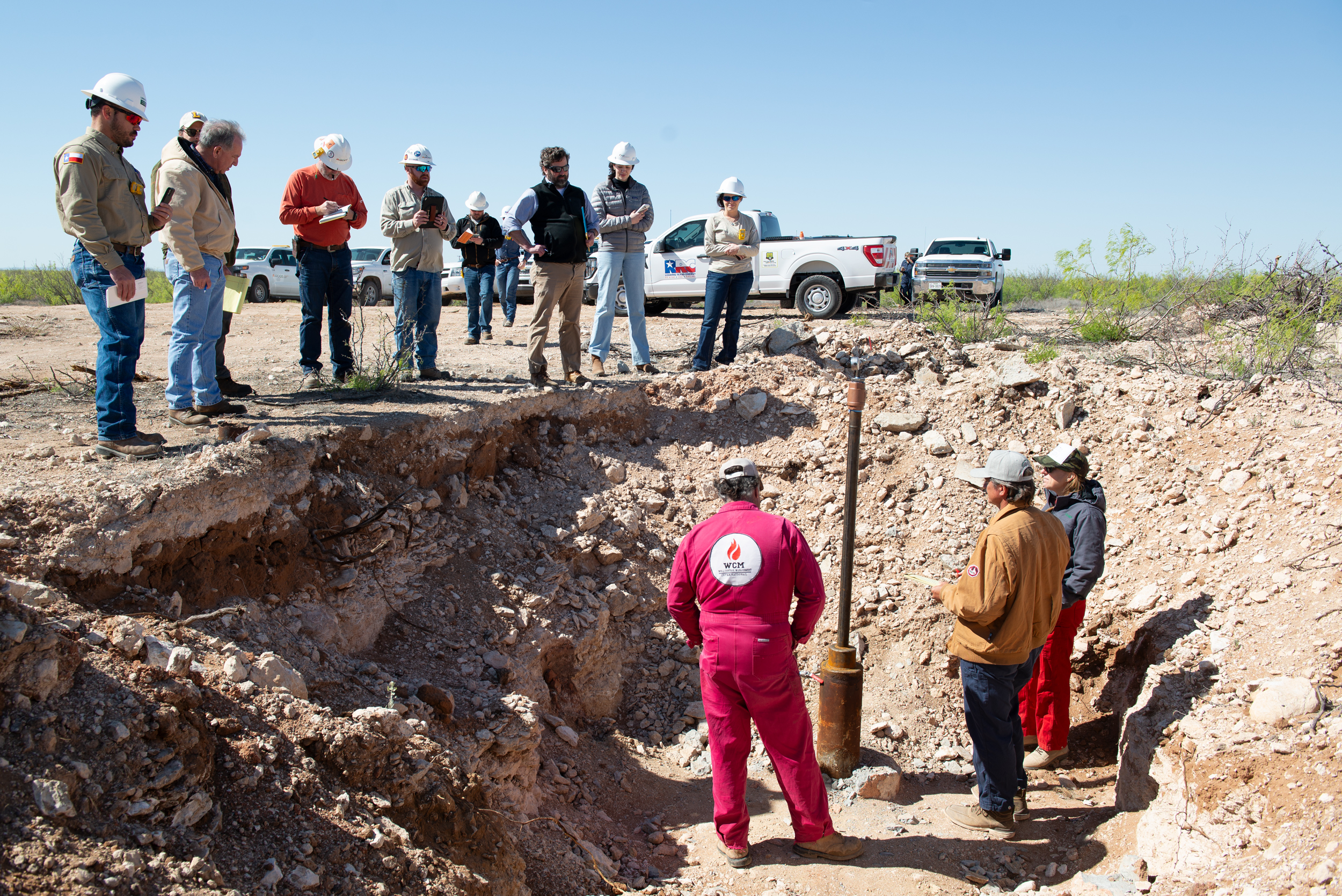
In January 2022, a geyser of produced water erupted through an old well on Meister’s property in Crane County. It took months to control and plug. He subsequently documented “fissures” in the land through which produced water was flowing from underground.
The lawsuit alleges that injection wells created an over-pressurized plume of produced water under the ranch. The pressurized wastewater has found conduits to flow to the surface through old wellbores that were previously plugged and abandoned, the lawsuit claims.
The Meister lawsuit is the latest chapter in the debate over produced water injection and aging wells in the Permian Basin. Landowners in West Texas have reported numerous blow-outs, geysers and sinkholes in recent years. Experts warn they are linked to the massive amounts of produced water being injected underground. The Railroad Commission, which regulates the oil and gas industry, has introduced new rules for injection wells since the blowouts began and has increasingly acknowledged the risks of over-pressurization underground.
Another Crane County landowner, Ashley Watt, recently settled a lawsuit against Chevron for damages on her ranch associated with old wells. But this new lawsuit goes further to draw a direct link between surface blowouts and injection wells.
The defendants are Blackbeard Operating, Citation Oil and Gas Corp., Conoco Inc., Formentera Operations, Goodnight Midstream Permian, Milwee Inc., Petex Corp. and Walsh & Watts Inc. These companies operate injection wells on or near the property or are responsible for plugged and abandoned wells at the property. Inside Climate News has reached out to the companies for comment.
An attorney for Meister declined to comment on the case. A Railroad Commission spokesperson said the agency does not comment on pending private litigation.
Lawsuit Ties Injection Wells to Surface Level Pollution
The 6,000-acre Meister West Ranch in Crane County has been in the Meister family for generations. As is common in the Permian Basin, oil companies have operated at the ranch for decades. But problems burst to the surface in January 2022, when produced water began spewing out of an old wellbore. The water formed a geyser some 200 feet high, leaving a salty residue on the soil. The Railroad Commission responded and the well was eventually plugged.
Another well blowout occurred just a mile away at a neighboring ranch owned by Bill Wight in December 2023. That month, according to the lawsuit, Meister toured his own ranch and “observed saltwater flowing to [the] surface through what appeared to be a new fissure in the ground.”
Meister began to investigate other active and abandoned oil and gas wells on the ranch in the months that followed, according to the lawsuit. He found “visible compromised wells leaking saltwater, hydrocarbons and other waste contaminants.” In April 2024, another fissure opened and saltwater flooded a road, according to the lawsuit.
The lawsuit seeks a judgement on liability for the pollution and monetary damages. Meister also seeks an end to the flow of oil and gas waste, proper plugging of abandoned and inactive wells, an investigation of impacted groundwater and soil and cleanup and restoration of the property.
The lawsuit references a 2024 study by researchers at Southern Methodist University, previously reported by Inside Climate News and the Texas Tribune, that traced the cause of the 2022 blowout on the Meister ranch to a cluster of nine injection wells 12 miles to the northwest. The researchers used publicly available injection data and satellite imagery to show how the volume of wastewater injected matched an uplift of the ground surface at the ranch prior to the blowout. According to the paper, leading up to the blowout, up to 1.5 million gallons a day of produced water were injected at the wells, which are operated by Goodnight Midstream and Blackbeard Operating.
This story is funded by readers like you.
Our nonprofit newsroom provides award-winning climate coverage free of charge and advertising. We rely on donations from readers like you to keep going. Please donate now to support our work.
Donate NowA Blackbeard Operating spokesperson said in 2024 in response to questions about the study that the company “is committed to ensuring prudent operations” and “will continue to operate its assets in accordance with all applicable laws.”
A Goodnight Midstream spokesperson said in 2024 that the company is dedicated to operating its facilities in full compliance with legal requirements. “We work proactively with regulatory agencies and industry workgroups to ensure our operations are at the forefront of geologically sustainable solutions,” the spokesperson said.
The lawsuit goes on to state that Meister “has reason to believe that all the wells on his property are compromised.” This argument mirrors that of a previous lawsuit at nearby Antina Ranch, also reported in Inside Climate News, when Watt alleged that the plugs on old oil wells were no longer protecting against leaks and contamination and sought damages from the company responsible for the abandoned wells. Watt settled last year.
In May 2025, the Railroad Commission introduced new guidelines for injection well permitting. The agency expanded the area of review for injection sites and set limits on the maximum injection pressure at the surface. But if the lawsuit is any indication, the injection well debate is far from over.
About This Story
Perhaps you noticed: This story, like all the news we publish, is free to read. That’s because Inside Climate News is a 501c3 nonprofit organization. We do not charge a subscription fee, lock our news behind a paywall, or clutter our website with ads. We make our news on climate and the environment freely available to you and anyone who wants it.
That’s not all. We also share our news for free with scores of other media organizations around the country. Many of them can’t afford to do environmental journalism of their own. We’ve built bureaus from coast to coast to report local stories, collaborate with local newsrooms and co-publish articles so that this vital work is shared as widely as possible.
Two of us launched ICN in 2007. Six years later we earned a Pulitzer Prize for National Reporting, and now we run the oldest and largest dedicated climate newsroom in the nation. We tell the story in all its complexity. We hold polluters accountable. We expose environmental injustice. We debunk misinformation. We scrutinize solutions and inspire action.
Donations from readers like you fund every aspect of what we do. If you don’t already, will you support our ongoing work, our reporting on the biggest crisis facing our planet, and help us reach even more readers in more places?
Please take a moment to make a tax-deductible donation. Every one of them makes a difference.
Thank you,

Martha Pskowski
Reporter, El Paso, Texas
Martha Pskowski covers climate change and the environment in Texas from her base in El Paso. She was previously an environmental reporter at the El Paso Times. She began her career as a freelance journalist in Mexico, reporting for outlets including The Guardian and Yale E360. Martha has a B.A. in Environmental Studies from Hampshire College and a master’s degree in Journalism and Latin American Studies from New York University. She is a former Fulbright research fellow in Mexico. Martha can be reached on Signal at psskow.33.