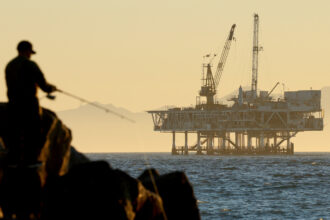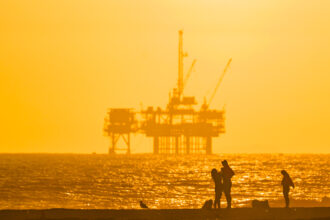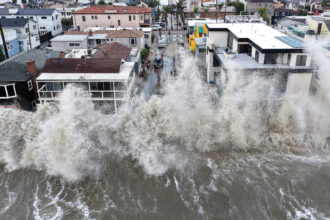


A sweeping proposal by the Trump administration to expand offshore oil and gas drilling could result in more than 4,000 oil spills in U.S. waters, according to a new analysis by the Center for Biological Diversity.
Trump’s draft proposal, announced last November, would authorize up to 34 offshore oil and gas lease sales over the next five years. That would open as much as 1.27 billion acres of federal waters to drilling in the Gulf of Mexico, off California and along Alaska’s coast—an expansion that far exceeds leasing offered under previous administrations. These new leases would come on top of the 36 additional offshore lease sales mandated by Congress under the One Big Beautiful Bill Act.
If the plan is enacted, it could lead to the release of more than 12 million gallons of crude into some of the nation’s most ecologically important marine areas—some of which have never been drilled before, researchers report.
The Bureau of Ocean Energy Management—the federal agency charged with implementing the plan if it moves forward—did not respond to multiple requests for comment.
“This plan would open up a massive amount of waters to new oil and gas drilling,” said Kristen Monsell, legal director of the oceans program at the Center for Biological Diversity, an Arizona-based conservation nonprofit. And it would be detrimental to marine life, she said.
“This would just be devastating for species from walrus and polar bears in the Arctic to Rice’s whales in the Gulf of Mexico,” Monsell said.
Rice’s whales, in particular, offer a stark example of a species already harmed by offshore drilling.
Only around 50 of the endangered baleen whales remain in the Gulf of Mexico, which is the only place on Earth where the species exists. Scientists estimate the population declined by more than 20 percent following the catastrophic Deepwater Horizon disaster in 2010—the largest offshore oil spill in U.S. history—which released more than 210 million gallons of oil into the gulf.
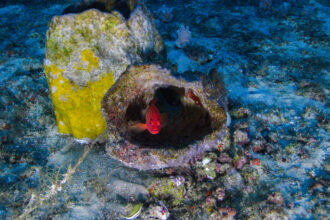
Tens of thousands of birds, sea turtles, dolphins and other marine animals were choked, trapped or poisoned by the toxic sludge. Since then, Rice’s whales have been observed looking abnormally thin and have hardly reproduced, suggesting they may have been affected long-term by the toxic spill, according to the National Oceanic and Atmospheric Administration.
The Center for Biological Diversity’s analysis draws on decades of federal records revealing historical data on average spill rates for platforms and pipelines between 1974 and 2015. Its researchers used that to conclude the likelihood of spills that would result from the Trump administration’s offshore drilling plan known as the 11th National Outer Continental Shelf Oil and Gas Leasing Program.
And the exact number of anticipated spills— 4,232— is likely an underestimate, Monsell said. It doesn’t include spills that could come from oil tankers or rare but catastrophic disasters such as Deepwater Horizon.
More than half of these spills will likely occur in the Gulf of Mexico, which is already the epicenter of offshore drilling in the U.S.
“They call us the sacrifice zone down here,” said Christian Wagley, an organizer in Florida and Alabama for Healthy Gulf, a nonprofit organization working to protect and restore natural resources in the region. The western and central Gulf are already saturated with oil and gas infrastructure, Wagley said. “It’s covered over with rigs and platforms and pipelines, constant vessel traffic. It’s complete chaos for a whale.”
Rice’s whales spend the majority of their lives near the surface, and especially at night in heavily trafficked shipping areas, making them easy victims of accidental vessel strikes.
Only in the eastern Gulf, which has largely been protected from oil and gas activity to date, can the whales find some refuge, Wagley said. But now that habitat is also at risk as one of the places the Trump administration is proposing to drill. Around 20 million acres of the eastern Gulf could be opened to offshore drilling, Wagley said. “That could be the nail in the coffin for the whales.”
Under the proposed plan, oil rigs could be located 100 miles from Florida’s coastline—a distance, Wagley said, that is meant to serve as a protective buffer. But he knows from experience 100 miles is not enough.
Oceanographers at Current Lab—an ocean intelligence company specializing in high-resolution coastal ocean modeling—recently released new oil-spill visualizations that show how far ocean currents and winds can carry surface oil from spill sites.
“The Gulf simulation showed significant oil beaching in Cuba and the beginning of oil beaching around Miami Beach,” said Kevin Rosa, founder of Current Lab. “I expect that more oil would continue to beach along Southeast Florida’s coastline if we continued the simulation past 14 days,” he said in an email.
In some cases, Trump’s plan aims to drill areas in the Gulf that will be particularly hard to clean up if there were spills.
“They’re looking at going into much deeper, more dangerous areas where it’s very far from land,” said Joseph Gordon, who is leading efforts to stop offshore drilling at Oceana, an ocean conservation nonprofit based in Washington, D.C.
The Deepwater Horizon spill, for instance, happened about 40 miles off the coast of Louisiana. The areas the Trump administration is looking at in the Gulf are much farther out, Gordon said. “If a spill happens, it would be harder to detect, harder to control.”
Similarly, the offshore drilling proposal includes areas in the Arctic, off the coast of Alaska, where a spill would be very difficult to clean up. There would also be great risks to marine environments that currently serve as some of the country’s most lucrative, productive fishing grounds, according to Doug Helton, former regional operations supervisor at NOAA’s emergency response division, who supported teams across the country in responding to oil spills for more than 30 years.
Some areas being targeted include habitats for endangered species such as Cook Inlet—a watershed in south-central Alaska, where a sub-population of just over 300 beluga whales has already been harmed by oil and gas extraction and commercial shipping.
High levels of noise from oil and gas exploration has interfered with the white whales’ ability to use echo-location to hunt, communicate and find mates. Increasing drilling could be fatal for these belugas, according to the Center for Biological Diversity analysis on projected oil spills, which would be nearly impossible to contain in the region.
Most of the places being proposed for drilling offshore Alaska are extremely remote and subject to severe weather. Limited access to ports, response vessels and equipment would delay any intervention if there were a spill, Helton said.
“It would take weeks or months just to get there,” he said. Even once response crews arrive, the tools available to contain spilled oil would likely be constrained.
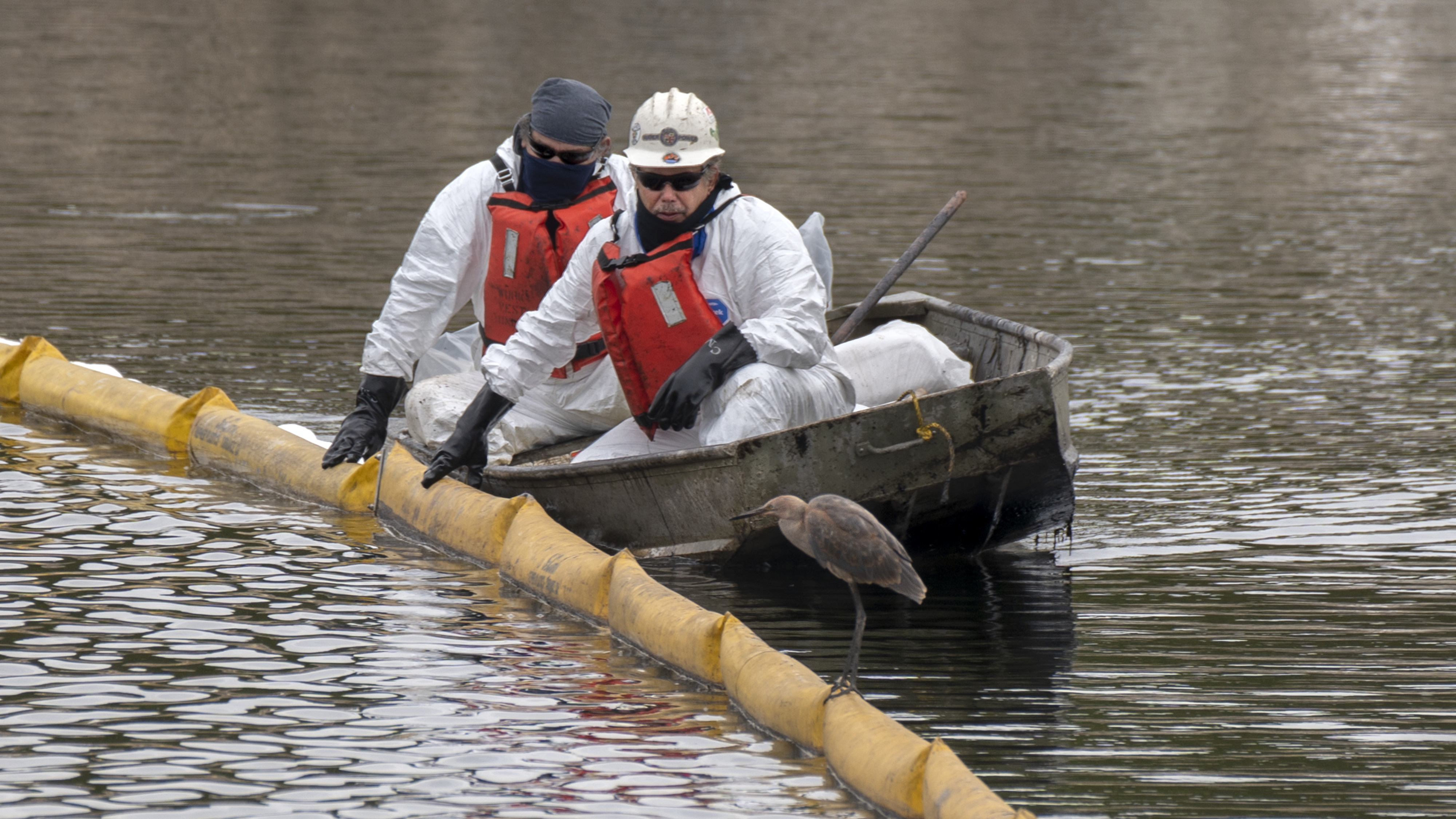
A common method is booming, which involves using floating barrier-like structures called booms designed to corral oil and steer it away from sensitive areas. Different types of booms, including fence, curtain and absorbent designs, can be deployed depending on the circumstances. Another device, called a skimmer, is sometimes also used to recover spilled oil.
But those tools have limits, Helton said. “You can’t use booms and skimmers in rough seas,” he said. Nor can you burn the oil as is done in some cases to remove floating oil from the surface, he added. High waves spread the oil too thin to be burned.
Dispersants—chemical agents sprayed from aircraft to break surface slicks into tiny droplets that biodegrade more quickly—also can’t be used in wind, fog or the dark.
“You can’t use dispersants in the Arctic at night because you don’t have visibility. And it’s night for half the year,” Helton said. With those combined limitations, he said, response options often disappear.
This story is funded by readers like you.
Our nonprofit newsroom provides award-winning climate coverage free of charge and advertising. We rely on donations from readers like you to keep going. Please donate now to support our work.
Donate Now“Eighty percent of the time you can’t even use that technology at all,” he said. “A lot of that oil is going to end up either dispersing at sea or coming ashore on some remote shoreline.”
Widespread public opposition to the plan suggests many Americans understand the multitude of risks involved in expanding offshore drilling, Oceana’s Gordon said.
“We’re looking at a moment where we could stop this and help make the transition to renewable energy and protect these coasts,” he said. “Or we could sink deeply, more deeply, into fossil fuels and be stuck for generations cleaning up the mess.”
During a 60-day public comment period that ended in January, roughly 300,000 people submitted objections to the administration’s draft offshore drilling plan, according to environmental groups. Organizing continues, and legal challenges are likely.
“This isn’t a done deal yet,” said Monsell, from the Center for Biological Diversity. If it were to move forward, she said, “I don’t see any universe in which we don’t take the Trump administration to court over it.”
About This Story
Perhaps you noticed: This story, like all the news we publish, is free to read. That’s because Inside Climate News is a 501c3 nonprofit organization. We do not charge a subscription fee, lock our news behind a paywall, or clutter our website with ads. We make our news on climate and the environment freely available to you and anyone who wants it.
That’s not all. We also share our news for free with scores of other media organizations around the country. Many of them can’t afford to do environmental journalism of their own. We’ve built bureaus from coast to coast to report local stories, collaborate with local newsrooms and co-publish articles so that this vital work is shared as widely as possible.
Two of us launched ICN in 2007. Six years later we earned a Pulitzer Prize for National Reporting, and now we run the oldest and largest dedicated climate newsroom in the nation. We tell the story in all its complexity. We hold polluters accountable. We expose environmental injustice. We debunk misinformation. We scrutinize solutions and inspire action.
Donations from readers like you fund every aspect of what we do. If you don’t already, will you support our ongoing work, our reporting on the biggest crisis facing our planet, and help us reach even more readers in more places?
Please take a moment to make a tax-deductible donation. Every one of them makes a difference.
Thank you,

Teresa Tomassoni
Oceans Correspondent
Teresa Tomassoni is an environmental journalist covering the intersections between oceans, climate change, coastal communities and wildlife for Inside Climate News. Her previous work has appeared in The Washington Post, NPR, NBC Latino and the Smithsonian American Indian Magazine. Teresa holds a master’s degree in Journalism from the Craig Newmark Graduate School of Journalism at CUNY. She is also a recipient of the Stone & Holt Weeks Social Justice Reporting Fellowship. She has taught journalism for Long Island University and the School of the New York Times. She is an avid scuba diver and spends much of her free time underwater.