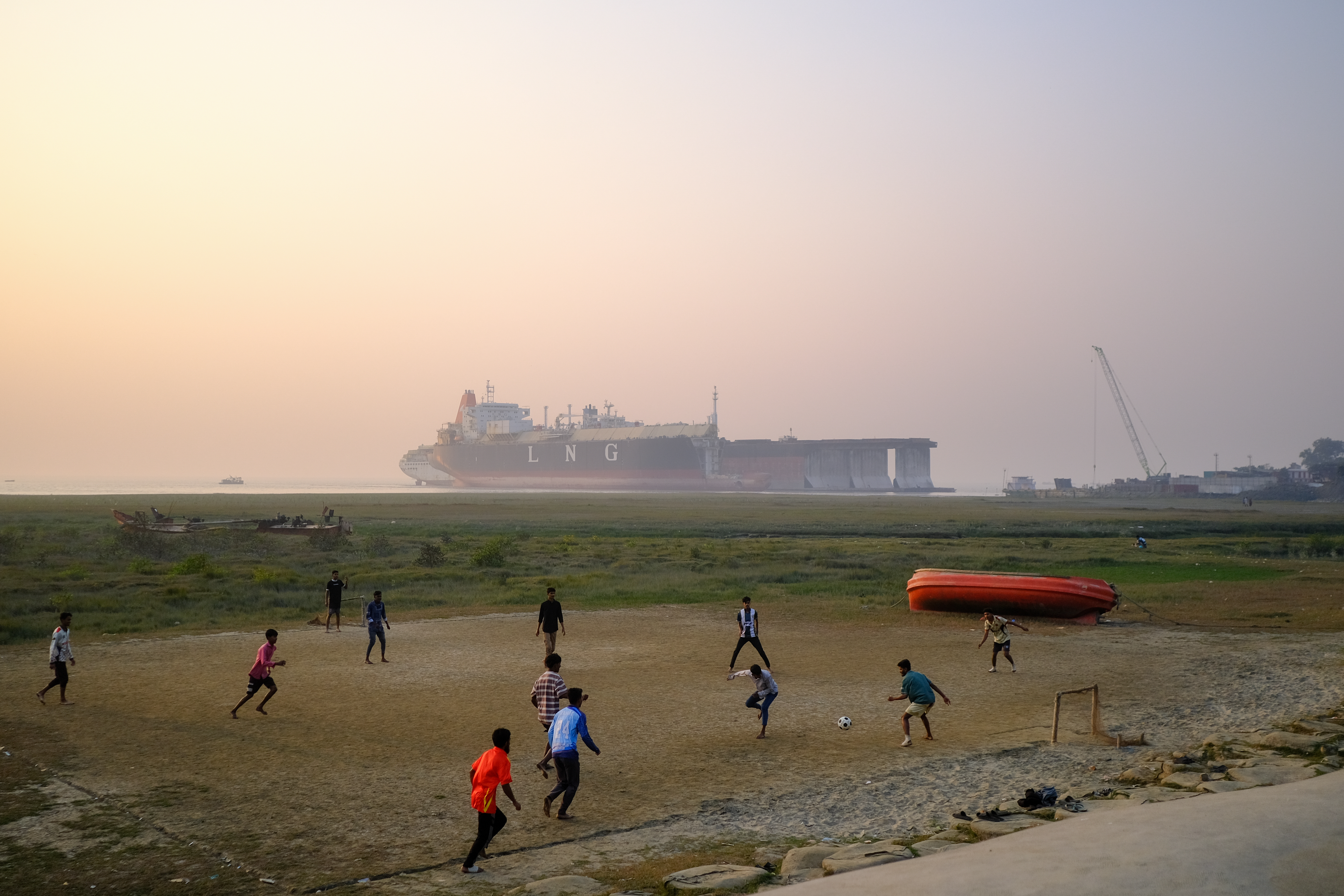


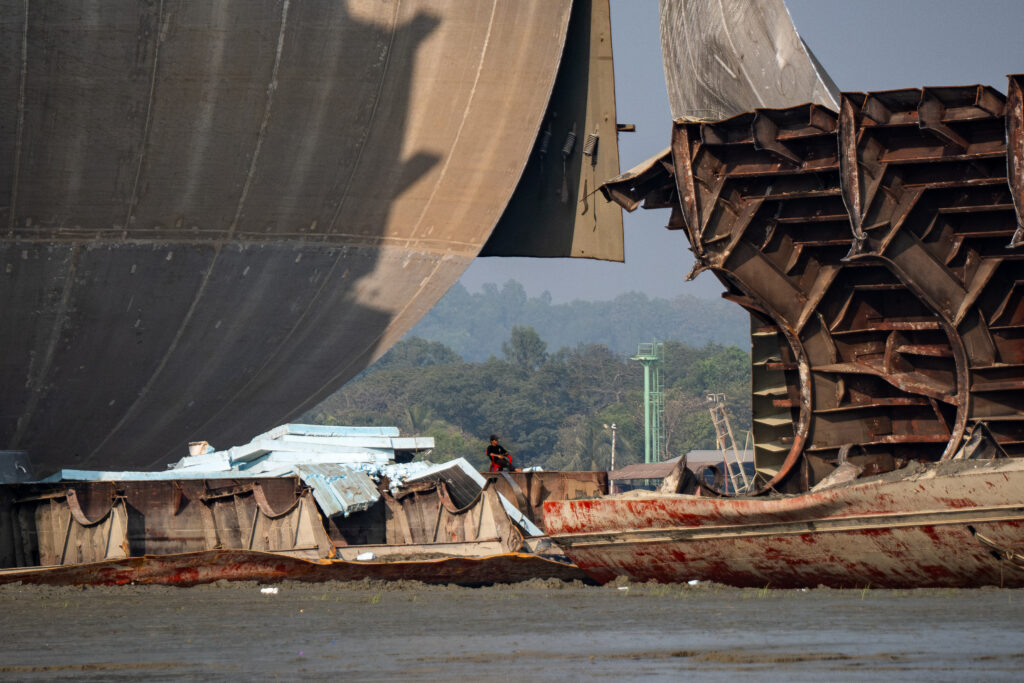
Every day along the coast of Sitakunda, Bangladesh, the earth recoils without warning. The ground shudders as steel sections, hundreds of feet in length, fall away from the carcasses of former long-distance liners and pummel the mudflats of the world’s largest ship graveyard. Picked apart by local hands, this will become the final act for many of the 68,000 vessels that move over 90 percent of global trade.
Last year, 85 percent of all scrapped ships—when measured by weight—ended up on just three beaches in Bangladesh, India and Pakistan, according to data released Monday by the NGO Shipbreaking Platform, based in Brussels.
The industry—often criticised for exporting the waste problems of wealthy nations to the Global South—has been characterized by the International Labour Organization as the most hazardous work in the world. Despite the Hong Kong Convention entering into force in June 2025 to improve standards, loopholes ensure the continuation of environmental destruction and workplace fatalities at scale, according to the NGO.
“It’s a systemic global failure. A failure linked to this greed of mainly the Global North, that for money exports toxics to vulnerable countries,” said Nicola Mulinaris, policy advisor at the NGO Shipbreaking Platform. “It’s a new form of colonialism. A toxic colonialism and toxic trade at its best.”
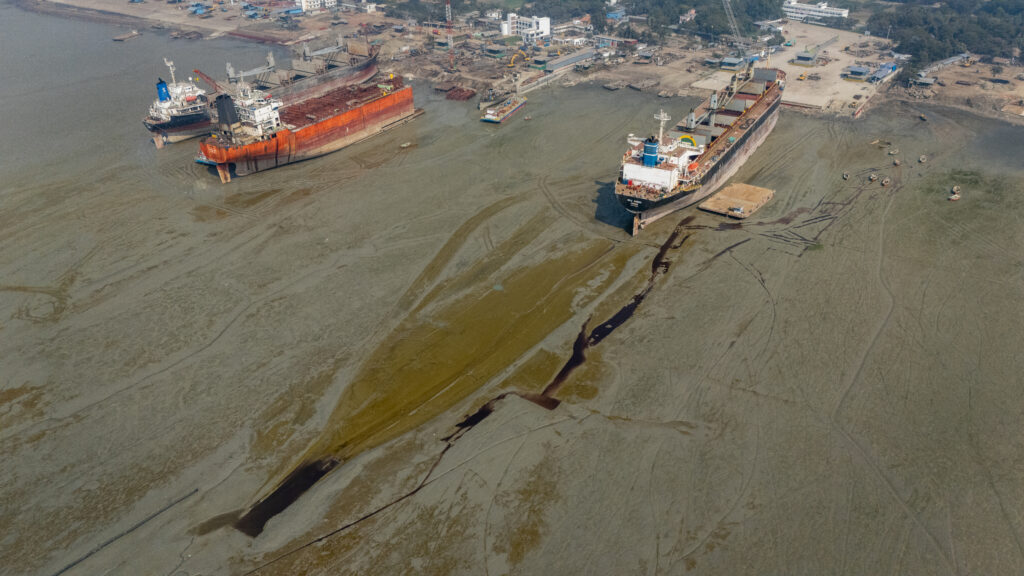
Beaching involves ramming ships at full speed toward land during high tide, leaving local communities to break down the beached beasts. “It is as if a ship-sized piñata has burst open, raining its contents across roadsides and villages,” said Spencer Call, a photographer who has spent time interviewing families and workers along the shipbreaking beaches of Sitakunda, near Chattogram (formerly known as Chittagong), Bangladesh.
In total, 321 vessels were dismantled globally in 2025. Bangladesh, Pakistan and India were the top destinations of choice, with 214 ships scrapped in South Asia alone. China dumped the most with 21 beached vessels, followed by 19 South Korean ships and 17 UAE-owned boats, the new data shows.
Though a decrease from 409 vessels broken worldwide in 2024, the decline hides a growing backlog of ever-aging “dark fleet” ships—allegedly trading illicitly in crypto and foreign currencies to avoid sanctions—that will soon need dismantling.
Older ships are toxic cocktails of heavy metals, radioactive material and hazardous paints. Twice a day, the ocean’s tidal rhythm rises to hide the environmental damage, washing away all waste as it retreats. Though most oil is siphoned off to be resold, what’s left behind leaks freely into the Bay of Bengal. In South Asia, sea snails and fish reproductive rates have decreased as toxic substances are absorbed into sediment; some species have even been wiped out by the pollution.
In Bangladesh, an estimated 60,000 mangrove trees have been cut down in recent years to make space for additional shipbreaking yards, NGO Shipbreaking Platform said, citing figures from the local nonprofit Young Power in Social Action. “Now all villages suffer periodic flooding due to the fact that the mangrove trees are not anymore there to protect them,” said Mulinaris.
Mangroves normally act as barriers to monsoons and are rich carbon stores. What remains of them, however, is often covered in a fine powder of industrial waste, while the smell of burning rubber floats through the temporary homes of those who depend on the industry as their only source of income.
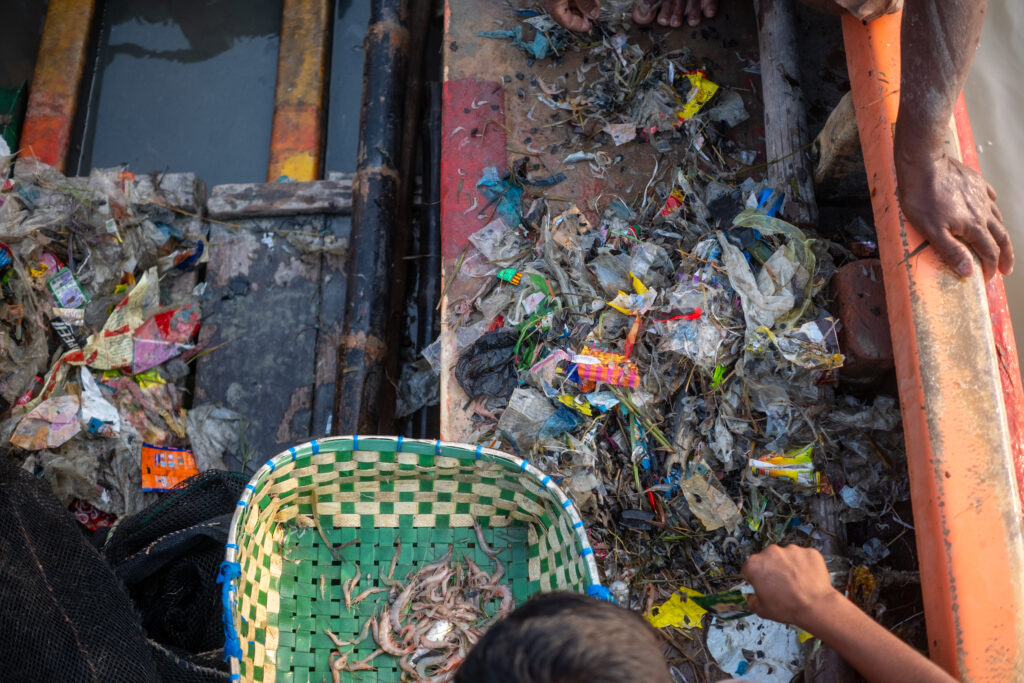
Here, ships’ emergency lifeboats are refashioned into fishing boats, while liferaft canisters become troughs for goats and cattle. On average, a single ship contains seven tons of asbestos-laden particle boards; this hazardous material is frequently repurposed into makeshift ovens, said Call.
Last year, 11 workers died and 62 were injured in South Asian shipbreaking operations, according to the report. Operating with little protection, workers are exposed to asbestos fibers, toxic fumes and radioactive material, leading to increased development of mesothelioma—an often-fatal cancer.
“Accidents [occur] on a weekly basis almost. Sometimes on a daily basis,” said Mulinaris, highlighting how workers regularly fall from heights, get crushed by large debris, suffocate or experience fires while dismantling ships.
Many workers come from rural areas with little formal education. Though initially awestruck by the vessels as they protrude from the horizon, they soon realize the peril. One man in his thirties—who lost his right foot to a winch—told Call that his wife and daughter left him, given his inability to provide financial support. Injured, he now depends on begging to survive.
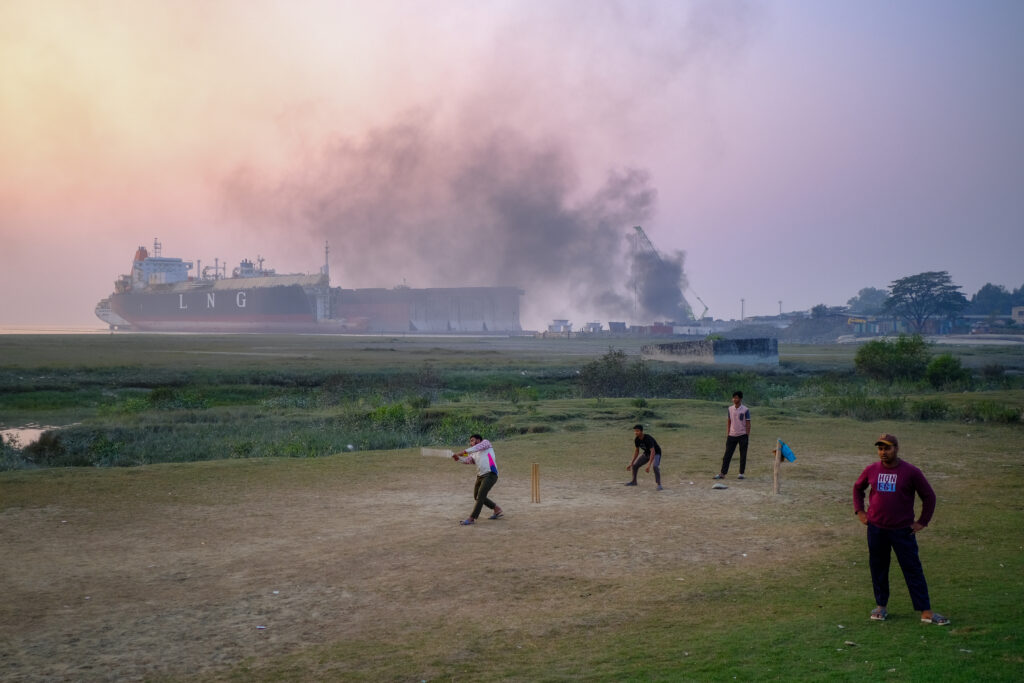
“The villages surrounding the area are oddly reminiscent of communities that have just endured battle,” said Call, who has experience documenting displaced peoples. “A disproportionate number of men bear permanent injuries,” relying on crutches or wheelchairs after limb loss.
In March 2025, a 47-year-old worker named Foysal fell to his death from the Greek-owned Lakatamia in Chattogram. Just two months later, 20-year-old Satur Bhai fell from the seventh floor of South Korean-owned Rem in Alang, India, according to local news outlets.
This story is funded by readers like you.
Our nonprofit newsroom provides award-winning climate coverage free of charge and advertising. We rely on donations from readers like you to keep going. Please donate now to support our work.
Donate NowDespite the International Maritime Organization introducing new safety standards in June 2025, the industry remains opaque, largely unregulated and unsafe. In Bangladesh, 17 yards were approved under the scheme; however, none of India’s 150-plus facilities were formally authorized, according to Monday’s data report.
“Clearly, the Hong Kong Convention does not set a standard that ensures safe and environmentally sound practices,” said Ingvild Jenssen, executive director of the NGO Shipbreaking Platform.
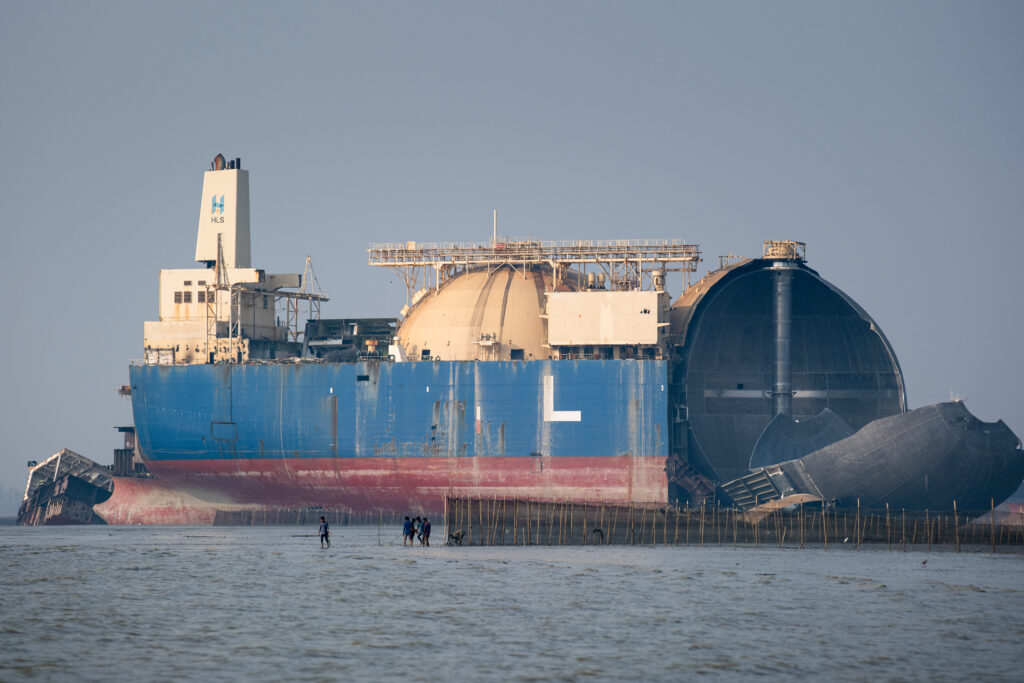
The report highlights how transboundary movement of hazardous ships without prior permission violates the Basel Convention and the European Union’s Ship Recycling Regulation, yet owners frequently “flag hop” to low-oversight nations to circumvent these end-of-life laws.
In the early hours of Jan. 1, two shipbreaking workers were killed during the beaching of a vessel in Sitakunda, Bangladesh. The boat, the K Asia, had changed its flag designation from Spain to the Bahamas in September 2025, and then to St. Kitts and Nevis in December 2025, according to the findings.
“A lot goes unreported and the industry tries to cover up,” said Mulinaris. “There’s a whole system of, let’s say, trying to dodge transparency” through intentionally opaque ownership structures and offshore intermediaries.
“We are witnessing a system that is based on double standards, that is being built to serve an exclusively wealthy elite,” said Mulinaris. Until the fatally flawed beaching method of ships is banned, the weak health and safety laws and destructive environmental practices of South Asia’s shipbreaking yards will remain a dumping ground for the Global North’s toxic waste, he said.
About This Story
Perhaps you noticed: This story, like all the news we publish, is free to read. That’s because Inside Climate News is a 501c3 nonprofit organization. We do not charge a subscription fee, lock our news behind a paywall, or clutter our website with ads. We make our news on climate and the environment freely available to you and anyone who wants it.
That’s not all. We also share our news for free with scores of other media organizations around the country. Many of them can’t afford to do environmental journalism of their own. We’ve built bureaus from coast to coast to report local stories, collaborate with local newsrooms and co-publish articles so that this vital work is shared as widely as possible.
Two of us launched ICN in 2007. Six years later we earned a Pulitzer Prize for National Reporting, and now we run the oldest and largest dedicated climate newsroom in the nation. We tell the story in all its complexity. We hold polluters accountable. We expose environmental injustice. We debunk misinformation. We scrutinize solutions and inspire action.
Donations from readers like you fund every aspect of what we do. If you don’t already, will you support our ongoing work, our reporting on the biggest crisis facing our planet, and help us reach even more readers in more places?
Please take a moment to make a tax-deductible donation. Every one of them makes a difference.
Thank you,
Johnny Sturgeon
Fisheries Reporter
Johnny Sturgeon is a London-based reporter covering fisheries and aquaculture. Joining us from the Outlaw Ocean Project, he has experience producing in-depth maritime investigations for nonprofit newsrooms. A former boatbuilder, he holds a B.A. in History & Politics from the University of Oxford, and an M.S. from Columbia Journalism School.