
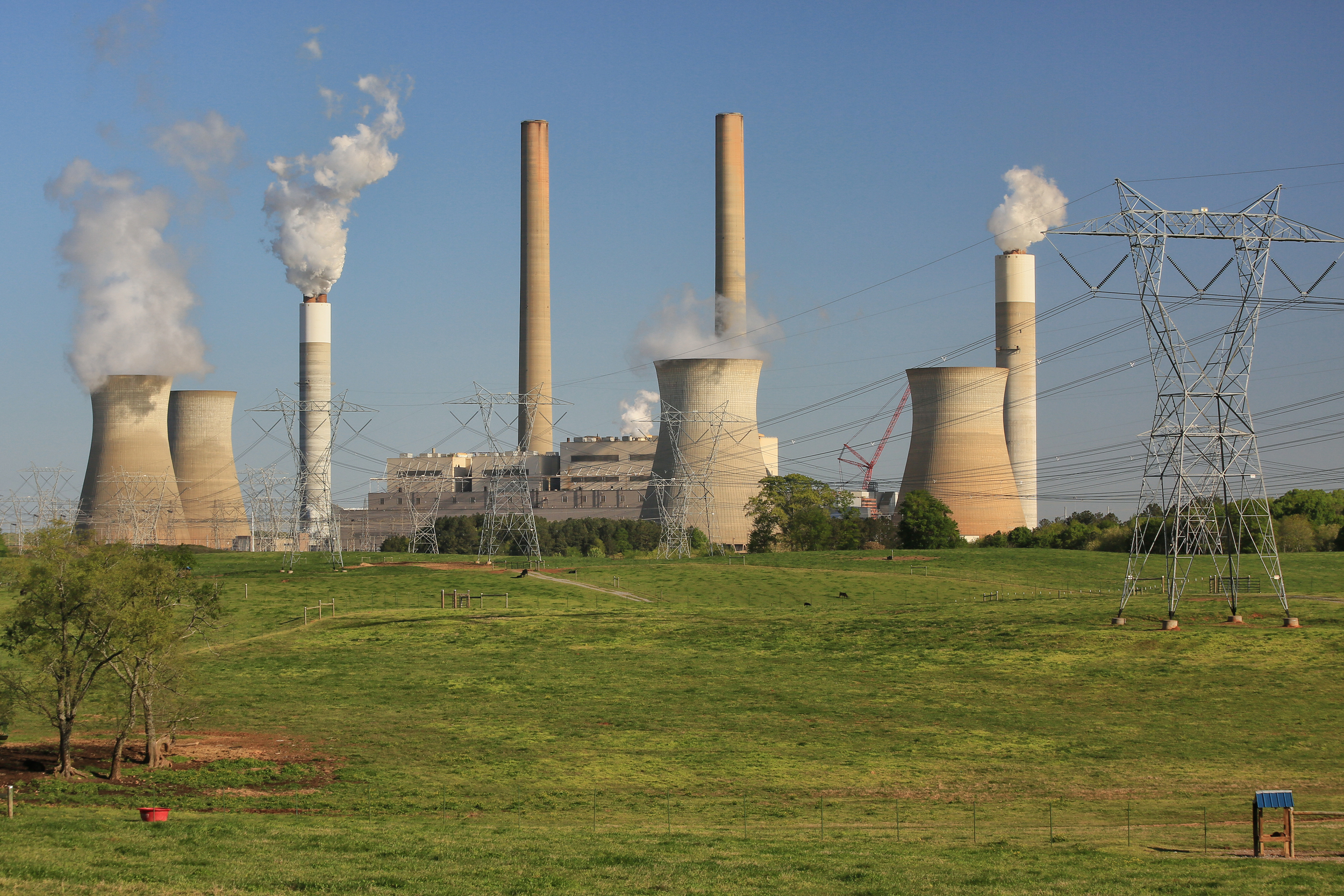


Georgia regulators have approved a massive expansion of natural gas power plants that could dramatically increase the state’s climate pollution, largely to support the rapid growth of data centers.
The projects approved by Georgia’s Public Service Commission in December include additions to nine natural gas facilities owned or backed by Georgia Power. Since the plan was first announced, environmental groups have criticized it as an unnecessary fossil fuel expansion that could lock the state into decades of emissions.
“The approval is going to set us even further back on making climate progress,” said Jennifer Whitfield, a senior attorney with the Southern Environmental Law Center. “It’s really frustrating, because we were making incremental progress as a state.”
The expansion will add roughly 10 gigawatts to Georgia’s power grid—about half of the state’s current capacity—by 2031. Georgia Power, the state’s largest utility and a Southern Co. subsidiary, is investing more than $16 billion in new transmission and generation infrastructure, and is poised to earn double-digit returns.
The push for additional power has been driven mainly by Georgia’s rapid data center growth over the past year, according to Georgia Power and the PSC. However, advocacy groups such as the Southern Alliance for Clean Energy and Georgia Interfaith Power & Light argue there is little evidence to justify an additional 10 gigawatts of capacity.
Roughly 60 percent of that will come from the natural gas build-out, while the remainder will be supplied by battery storage and two solar projects.
Decades of New Emissions
Three of the largest natural gas expansions will take place at Georgia Power’s own Bowen, Wansley and McIntosh plants, which together account for more than half of the planned gas capacity.
According to company filings, if all of these new natural gas turbines operated at full capacity, they could produce roughly 13.8 million metric tons of CO2-equivalent emissions each year—the equivalent of over 3 million gasoline-powered cars on the road—and would raise Georgia’s total annual emissions by more than 13 percent.
Six other natural gas expansions will be backed by Georgia Power through power-purchase agreements, meaning the total potential impact of the 10-gigawatt plan could reach over 20 million metric tons of CO2-equivalent annually.
This story is funded by readers like you.
Our nonprofit newsroom provides award-winning climate coverage free of charge and advertising. We rely on donations from readers like you to keep going. Please donate now to support our work.
Donate NowGeorgia Power and the PSC say the projects are designed to meet growing demand while protecting customers.
Georgia Power disputes that the expansion undermines its climate progress. In a statement to Inside Climate News, a company representative said, “We’re proud of our diverse energy mix, which includes a variety of generation sources to serve customers. As our mix has evolved, we’ve actually reduced our overall carbon emissions by more than 60 percent since 2007.”
The PSC said regarding its decision to approve the expansion, “the commission takes all presented testimony and evidence into consideration, including evidence regarding emissions and environmental concerns.”
Georgia Power’s natural gas expansion is among the largest fossil fuel projects in the country. In Texas, a project described as the “largest power project” in the U.S. will add 7.65 gigawatts of natural gas to the state’s grid, also driven by data center growth. Dominion Energy, which serves roughly a million more customers than Georgia Power, has outlined plans to add about 5.9 gigawatts of natural gas generation—paired with more than 20 GW of renewable energy—to meet rising demand.
Beyond the Georgia expansion’s contribution to climate change, environmental groups are raising alarms about localized air pollution near communities. For example, the expansion at Georgia Power’s Bowen plant alone would emit an estimated 325 tons of volatile organic compounds and more than 400 tons of nitrogen oxides each year—levels that place the facility among major industrial pollution sources and contribute directly to smog formation and respiratory risk.
“Much of these new gas facilities and data centers, with their own diesel generators, are popping up in the Atlanta metro area, which already has air quality worse than national standards,” said Whitfield. “This poses a very real health threat.”
While Bowen’s emissions would add to Atlanta’s worsening air quality, the McIntosh expansion would place new industrial pollution near the Savannah National Wildlife Refuge, an ecologically sensitive coastal area already vulnerable to climate change and development pressure.
Natural gas power plants are designed to operate for around 50 years, meaning the projects would extend Georgia’s reliance on fossil fuels past 2050—well beyond key global emission-reduction targets. Even if used sparingly, they would still require costly maintenance and eventual cleanup.
“We will be paying for these for 45 years, even if they are not used,” said Whitfield. “Either we are investing for fossil fuel usage as far as 2070, or we are agreeing today to pay for stranded assets in the future—neither of which are a good deal for Georgians.”
A coalition of energy and environmental groups represented by the Southern Environmental Law Center has formally petitioned the PSC to reconsider its approval of Georgia Power’s expansion plan. A decision on whether the commission will revisit the plan is expected later this month.
If the plan moves forward with Georgia Power’s natural gas projects intact, advocates warn the state could reverse more than two decades of emission reductions—progress driven largely by rapid renewable energy growth and coal-fired power plant retirements.
About This Story
Perhaps you noticed: This story, like all the news we publish, is free to read. That’s because Inside Climate News is a 501c3 nonprofit organization. We do not charge a subscription fee, lock our news behind a paywall, or clutter our website with ads. We make our news on climate and the environment freely available to you and anyone who wants it.
That’s not all. We also share our news for free with scores of other media organizations around the country. Many of them can’t afford to do environmental journalism of their own. We’ve built bureaus from coast to coast to report local stories, collaborate with local newsrooms and co-publish articles so that this vital work is shared as widely as possible.
Two of us launched ICN in 2007. Six years later we earned a Pulitzer Prize for National Reporting, and now we run the oldest and largest dedicated climate newsroom in the nation. We tell the story in all its complexity. We hold polluters accountable. We expose environmental injustice. We debunk misinformation. We scrutinize solutions and inspire action.
Donations from readers like you fund every aspect of what we do. If you don’t already, will you support our ongoing work, our reporting on the biggest crisis facing our planet, and help us reach even more readers in more places?
Please take a moment to make a tax-deductible donation. Every one of them makes a difference.
Thank you,