

Standing inside the New Jersey Statehouse last month, Claudia Mutzus wore a T-shirt from the Service Employees International Union and held a banner emblazoned with the words, “Built by New Jersey workers for New Jersey families.”
She’d gathered with other union members to mark the start of a new organized labor coalition, Climate Jobs New Jersey, with lofty ambitions: to secure energy independence through solar construction and, in the process, address the state’s electrical affordability crisis.
New Jersey residents have been facing increasingly high electrical bills since they began to spike as much as 20 percent in June 2025. With large electricity demands from data centers and the state’s need to purchase off-grid power to meet energy requests, costs have surged, leaving many residents baffled with no relief.
One of Climate Jobs New Jersey’s priorities is a statewide solar and battery storage program that coalition leaders say will enable the state to take back control of planning its own energy needs from PJM Interconnection, the grid operator that oversees the regional wholesale electricity market.
“This is an opportunity for us to work together and tackle head-on one of the most pressing issues facing our state today,” said Charlie Wowkanech, president of both the New Jersey AFL-CIO and Climate Jobs NJ. “We need to act quickly, and state generation is key to solving our problems.”
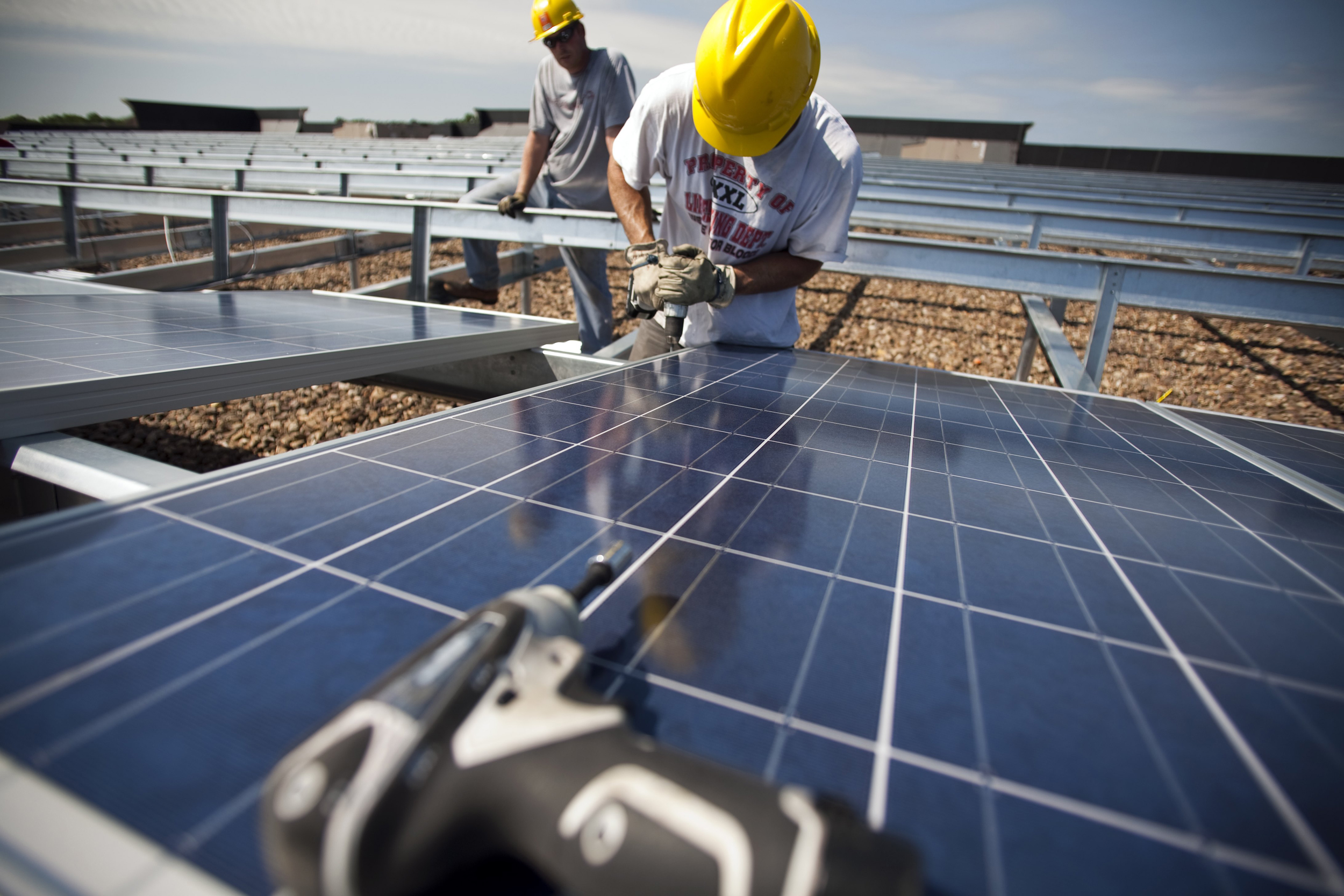
The statewide solar and battery storage program would help quickly deploy vast amounts of rooftop solar and battery storage, Wowkanech said, adding that the program could be online within the next 24 months and is the fastest way to add clean energy to the grid and lower electricity prices.
In late December, outgoing Gov. Phil Murphy signed “smart solar” permitting legislation that will expedite the approval process for residential solar and battery storage systems that comply with building codes. The bill also requires the Department of Community Affairs to create a digital, automated permitting platform for rooftop solar and battery storage installations that must be available statewide within 18 months of its signing.
Previously, Murphy had signed two other bills in August expanding solar and storage.
Taking back control of energy systems would mean putting the state in charge of planning and purchasing at least some of its energy, coalition members say. This way, New Jersey can plan for its energy needs by stimulating in-state clean energy generation and guarantee that workers benefit from every new project, according to the coalition’s website.
New Jersey generates approximately 13 gigawatts of electricity daily, but its consumption is around 19 GW, according to Greg Lalevee, business manager of Operating Engineers Local 825. This causes the state to buy off the grid, leading to a fifth of New Jersey’s power being imported from out of state. Lalavee also said that electricity is generated from “outmoded and outdated” sources.
Natural gas and nuclear power fueled about 90 percent of New Jersey’s 2024 total electricity generation. Renewable energy accounted for about 9 percent, with 8 percent from solar energy.
New Jersey is also experiencing climate change at a faster rate than other states, with temperatures 3.5 degrees Fahrenheit higher since 1895, and is struggling to combat increasing precipitation and sea level rise.
Mutzus, holding her placard, explained her presence inside the statehouse and her interest in Climate Jobs NJ. “I’m here because I think there’s a few issues that are really important: One is climate change, another one is quality jobs and personally, one issue that’s very important to me is pollution,” she said, talking about living with pollution in Harrison, New Jersey, with her children.
Also partnering with the coalition are researchers at Cornell University’s Climate Jobs Institute, who published a report outlining a roadmap to address the state’s climate change and economic inequality. In 2021, Cornell and its partners at the Climate Jobs National Resource Center began meeting with New Jersey labor leaders to understand how climate change and clean energy are affecting workers in the state, said Lara Skinner, founding executive director of Cornell’s Climate Jobs Institute.
“This campaign understands the simple truth that climate action must work for working people,” said Ana Maria Hill, vice president and New Jersey state director of 32BJ SEIU, the largest property services union in the country (32BJ is a merger of Locals 32B and 32J in New York City).
“If we don’t center affordability, job quality and equity, then we’re not actually solving the crisis,” she said. “We are shifting the costs onto the same communities that have already paid the high price.”
This story is funded by readers like you.
Our nonprofit newsroom provides award-winning climate coverage free of charge and advertising. We rely on donations from readers like you to keep going. Please donate now to support our work.
Donate NowThe report contains 14 recommendations for building energy infrastructure in New Jersey in recognition of a climate, energy and affordability crisis facing the state, Skinner said. She also said that central to the recommendations is the construction of 24.2 GW of in-state, union-built clean energy, along with a parallel transmission and distribution network by 2035.
The 24.2 GW would include 9.7 GW of solar, comprising 3.1 GW of utility-scale solar and 6.6 GW of smaller, decentralized installations. Also, 5 GW of energy storage; 7.7 GW of offshore wind, 0.7 GW of onshore wind, 1 GW of new advanced nuclear reactors and 925 GW-miles of transmission. The coalition will work to secure legislative commitments to support its clean energy construction, coalition leaders say.
Gov. Mikie Sherrill’s priorities partially align with the coalition’s. Her first two executive orders directed the acceleration of constructing solar and battery projects, as well as research into how nuclear energy fits into the state’s future.
The offshore wind proposal is a different story, given federal hostility. Gov. Sherrill also has not spoken about her plans for offshore wind. In an earlier interview, New Jersey Rate Counsel Division Director Brian Lipman cautioned against utilities transferring the cost of these projects and upgrades to consumers.
The recommendations also include decarbonizing the state’s building stock, developing new union-built affordable housing, constructing a resilient stormwater system, climate-safe roadways, EV charging and a more circular and effective waste system.
“Taken together, if these recommendations are implemented, they will deliver a clean energy economy that benefits working people across New Jersey,” Skinner said. “Just in the clean energy and building sector, we would create 34,000 direct jobs through 2030, including 7,300 construction trade jobs in that time period.”
The coalition is also providing opportunities for a six-week-long multi-trade pre-apprentice program, said Bernard Callegari, assistant regional manager for Laborers International Union of North America Eastern Region. Callegari said the program would review about 120 applications to select a class of 15 to 20 apprentices, with a class starting soon in East Orange, New Jersey.
“We would be able to really help create a pipeline of workers from underserved communities to serve on these projects,” Callegari said, explaining how the formerly incarcerated are a large target for their programs.
Even with federal tax credits for solar and wind projects running scarce, Wowkanech acknowledged that the work cannot be done overnight and that there will be a transition period, but he said he sees solar as a “very doable” path and the quickest way to put people to work and improve energy.
Rambo Talabong contributed to this report.
About This Story
Perhaps you noticed: This story, like all the news we publish, is free to read. That’s because Inside Climate News is a 501c3 nonprofit organization. We do not charge a subscription fee, lock our news behind a paywall, or clutter our website with ads. We make our news on climate and the environment freely available to you and anyone who wants it.
That’s not all. We also share our news for free with scores of other media organizations around the country. Many of them can’t afford to do environmental journalism of their own. We’ve built bureaus from coast to coast to report local stories, collaborate with local newsrooms and co-publish articles so that this vital work is shared as widely as possible.
Two of us launched ICN in 2007. Six years later we earned a Pulitzer Prize for National Reporting, and now we run the oldest and largest dedicated climate newsroom in the nation. We tell the story in all its complexity. We hold polluters accountable. We expose environmental injustice. We debunk misinformation. We scrutinize solutions and inspire action.
Donations from readers like you fund every aspect of what we do. If you don’t already, will you support our ongoing work, our reporting on the biggest crisis facing our planet, and help us reach even more readers in more places?
Please take a moment to make a tax-deductible donation. Every one of them makes a difference.
Thank you,

Raeanne Raccagno
Fellow
Raeanne Raccagno is a reporting fellow following environmental issues and solutions in New Jersey. She started her journalism career covering community news in Bucks County, Pennsylvania. After writing about the aftermath of a natural disaster, she began using her passion for nature to report on additional environmental concerns. Raeanne is currently a senior at The College of New Jersey, majoring in environmental studies and journalism with a marketing minor.