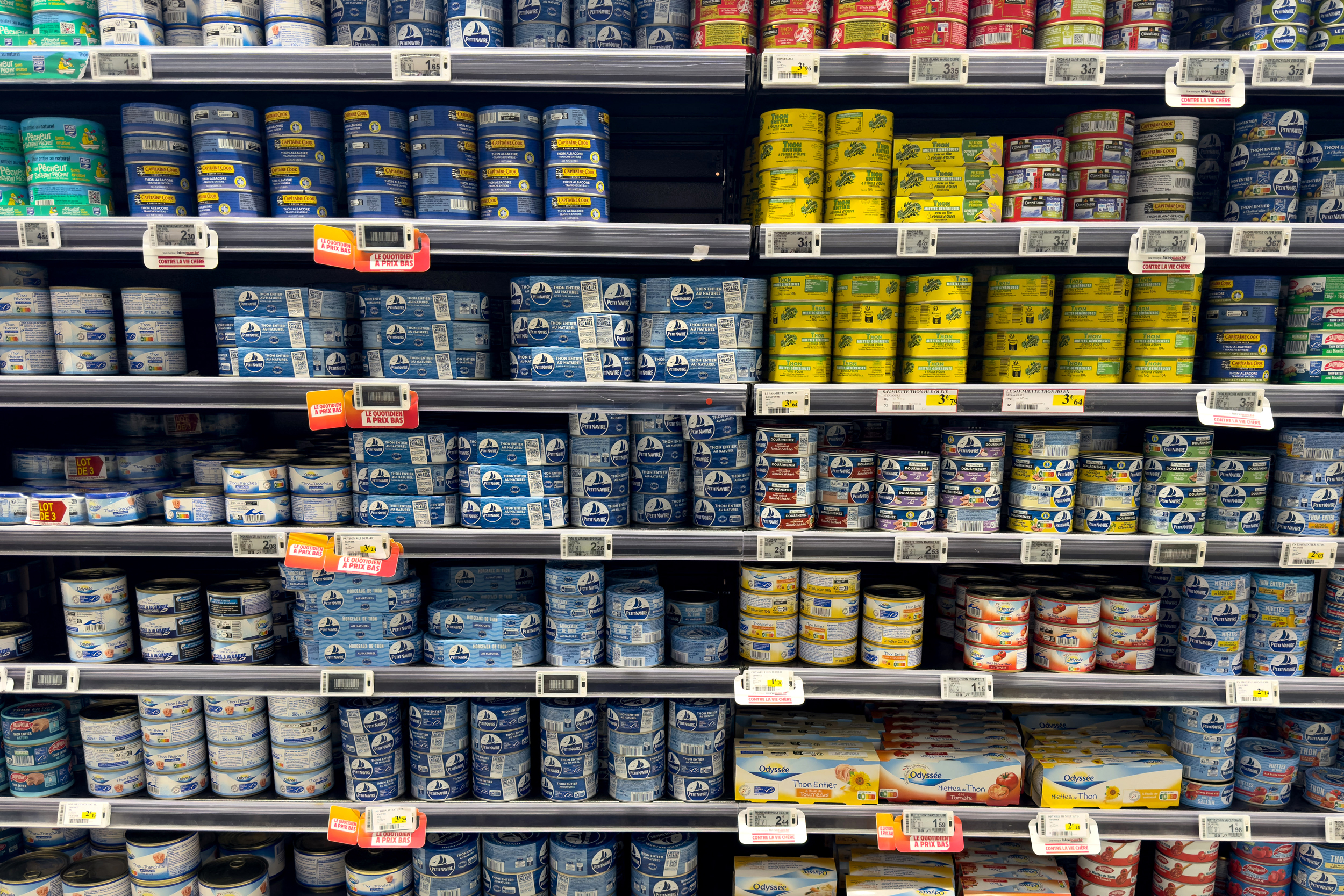


From Los Angeles’ luxurious sushi restaurants to Latin America’s roadside ceviche stands, consumers are being lied to. The canned tuna sold on supermarket shelves in Europe or the tiger prawns grilled on Australian barbecues aren’t always what they claim to be.
Up to 20 percent of fishery and aquaculture products globally are mislabelled, according to a report published this month by the United Nations Food and Agriculture Organization. The $195 billion industry is uniquely vulnerable to fraud due to complex supply chains and over 12,000 traded species.
“Mislabelling and fraud are more prevalent in the aquatic sector than in many other food sectors,” said Esther Garrido Gamarro, a U.N. fishery officer and one of the paper’s lead authors. “It can have real downstream impacts that most people never see.”
The report—which provides the first global baseline of industry-wide wrongdoing—defines fish fraud as the deliberate deception regarding species specification for unfair economic advantage. Produced in collaboration with the International Atomic Energy Agency, the report highlights how novel nuclear forensic tools might be the solution.
Handheld X-ray devices can establish the composition of seafood tissue by identifying chemical markers unique to certain environments, while MRI technology can analyze water molecules to verify if a product has ever been frozen.
Malpractices include coloring tuna to appear fresher and false sustainability claims. The most common form of fraud, however, is substitution of expensive fish products with cheaper alternatives.
“This study highlights how consumers can easily be fooled,” said Francesca Chipparoni, a fisheries scientist and former illegal fishing observer off the coast of Gabon. “If it is that easy to mislabel and sell tilapia for red snapper, how can consumers be certain that their filet was caught sustainably and ethically, not in [a marine protected area] and without the use of slave labor?”
The report—combining a patchwork of empirical studies—suggests that as much as a third of goods sold in the U.S. might be mislabelled, yet less than one percent of imports are ever tested.
“The fact that mislabelling occurs widely in sophisticated markets with robust regulatory frameworks suggests the problem isn’t just ‘bad practice of actors somewhere else,’ but structural weaknesses in global supply chains,” said Garrido Gamarro.
Mislabelling is especially prevalent in restaurants and catering services given the challenges of visual identification. “That means fraud happens in plain sight, hidden behind menus and labels,” said Garrido Gamarro, referencing how in European schools and hospitals, the rates of fish fraud might be as high as 50 percent.
For the 185 million tons of aquatic goods produced annually, the report cites financial incentives as the biggest driver of fraud. Farmed Atlantic salmon sold as wild-caught Pacific salmon carries a $10 per kilogram premium in North America, while seabass farmed in Greece can triple in value if falsely labelled as local Italian catch.
Environmentally, mislabelling hides instances of illegal fishing, exceeding quotas or the sale of critically endangered species. For example, blue shrimp caught in the protected conservation waters of the critically endangered vaquita porpoises are often shipped to Mazatlán and exported to the U.S. through forged papers to hide the environmental crimes.
Selling expired products or not declaring allergens can be hazardous to human health. Many species, when consumed raw as sushi, carry risks of herring worm disease or bacterial infection. Similarly, the potent neurotoxins in puffer fish can be deadly when sold under other names.
“If pregnant women or children are unknowingly eating shark, they are being exposed to potentially higher levels of mercury and heavy metals,” said Chipparoni, highlighting a 2025 report that found over 60 percent of imitation crab sold in Los Angeles grocery stores contained shark.
Citing over a dozen individual case studies from across the globe, the report highlights fraud affecting nearly all species. That ranges from fake shrimp made out of moulded starch-based compounds to frozen-then-thawed whitefish sold as fresh.
The report is not without hope, highlighting possible solutions like the development of portable, handheld X-ray devices used in Australia to provide real-time provenance verification. The U.N. Food and Agriculture Organization is also pushing for the roll out of advanced testing technology—such as magnetic resonance assessments—at global ports to identify what really ends up on the plate.
Chipparoni believes consumer pressure—like the relatively successful dolphin-free tuna campaign—might be what ultimately shifts industry awareness. “The global fisheries trade can feel like a bit of smoke and mirrors,” she said. “I would love to see more people asking restaurants where their fish is from, how it was caught and when it was caught.”
About This Story
Perhaps you noticed: This story, like all the news we publish, is free to read. That’s because Inside Climate News is a 501c3 nonprofit organization. We do not charge a subscription fee, lock our news behind a paywall, or clutter our website with ads. We make our news on climate and the environment freely available to you and anyone who wants it.
That’s not all. We also share our news for free with scores of other media organizations around the country. Many of them can’t afford to do environmental journalism of their own. We’ve built bureaus from coast to coast to report local stories, collaborate with local newsrooms and co-publish articles so that this vital work is shared as widely as possible.
Two of us launched ICN in 2007. Six years later we earned a Pulitzer Prize for National Reporting, and now we run the oldest and largest dedicated climate newsroom in the nation. We tell the story in all its complexity. We hold polluters accountable. We expose environmental injustice. We debunk misinformation. We scrutinize solutions and inspire action.
Donations from readers like you fund every aspect of what we do. If you don’t already, will you support our ongoing work, our reporting on the biggest crisis facing our planet, and help us reach even more readers in more places?
Please take a moment to make a tax-deductible donation. Every one of them makes a difference.
Thank you,

Johnny Sturgeon
Fisheries Reporter
Johnny Sturgeon is a London-based reporter covering fisheries and aquaculture. Joining us from the Outlaw Ocean Project, he has experience producing in-depth maritime investigations for nonprofit newsrooms. A former boatbuilder, he holds a B.A. in History & Politics from the University of Oxford, and an M.S. from Columbia Journalism School.