

Ritidian Point, at the northern tip of Guam, is home to an ancient limestone forest with panoramic vistas of warm Pacific waters. Stand here in early spring and you might just be lucky enough to witness a breaching humpback whale as they migrate past. But listen and you’ll be struck by the cacophony of the island’s live-fire testing range.
Widely referred to as the “tip of the spear” in the American arsenal, Guam—which is smaller than New York City but home to a military community of nearly 23,000—is a dichotomy of majestic nature and military might.
The real powerhouse of the Pacific exists not on land but just below the water’s surface in its biological resilience, which is now threatened by the Pentagon’s quest for strategic deterrence. The weapons that miss their target on the testing range will soon find a different one, sinking down to the most diverse coral reef of any U.S. jurisdiction. A battle between the two is now emerging.
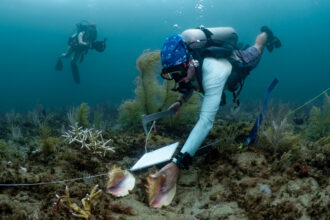
The U.S. government is accelerating coral reef collapse around Guam, alleges a team of international researchers in a letter released this month in Science. They warn administration pressures to prioritize national security—through dredging projects, increased military infrastructure and live firing ranges—will cause harm to endangered habitats.
Additionally, a fundamental misunderstanding of coral taxonomy in the Endangered Species Act (ESA) is exacerbating the ecological harm to fisheries and reefs. Without intervention, these Pacific habitats now risk the same “functional extinction” experienced in Florida.
“The United States government seems to be softening conservation policies in ways that allow companies and the military to avoid regulation,” said Colin Anthony, a doctoral fellow at the University of Tokyo and the paper’s lead author.
For a time last summer, conservation seemed ascendant. In July, the National Oceanic and Atmospheric Administration (NOAA) rejected a Navy request to expand exempt military zones in northern Guam, citing conservation benefits outweighing national security concerns at Ritidian Point. On the same day, NOAA finalized a rule designating critical habitat for five threatened coral species across 92 square miles of the Pacific, including in Guam and American Samoa.
However, the victories were short-lived. Following President Trump’s issuance of Executive Order 14154—“Unleashing American Energy”—on his first day in office in January 2025, federal agencies were pressured to remove any “undue burdens” on energy production and security. In November 2025, NOAA followed up by proposing expanded authority to bypass critical habitat regulations.
The provisions sought to remove language that required decision-making to be made “without reference to possible economic or other impacts.” Researchers have warned this prioritizes short-term economic interests over science and opens up vulnerable marine preserves to deep-sea mining, fishing and military expansion.
NOAA’s proposed changes also look to reclassify the “environmental baseline,” meaning the Navy could treat a degraded reef not as a problem to be addressed but as the fixed starting point. Baking in decades of ecological harm effectively insulates activity from ESA scrutiny and allows the Navy to cite “national security” as a blanket justification for any new projects, even if they fall in endangered marine habitats.
Additionally, owing to a “conservation gap” in ESA policy, reef-building corals are disappearing faster than scientists can identify them. Guidelines require clear categorization of species to determine their endangered status, however, corals are “phenotypically plastic,” meaning they change their features depending on light, water flow or depth.
Unlike land animals, it is difficult for researchers to neatly categorize species based on reproduction compatibility. Scientists must instead acquire genetic material and decide on a set of identifiable traits for a species that can sometimes span the entirety of the Pacific Ocean.
“Many of the corals in the Indo-Pacific, such as those in Guam, have not been taxonomically verified via DNA barcoding,” said Laurie Raymundo, a biology professor and director of the University of Guam Marine Laboratory. Although DNA analysis is now the norm, it is costly and time-consuming, meaning endemic species could disappear before ever being documented.
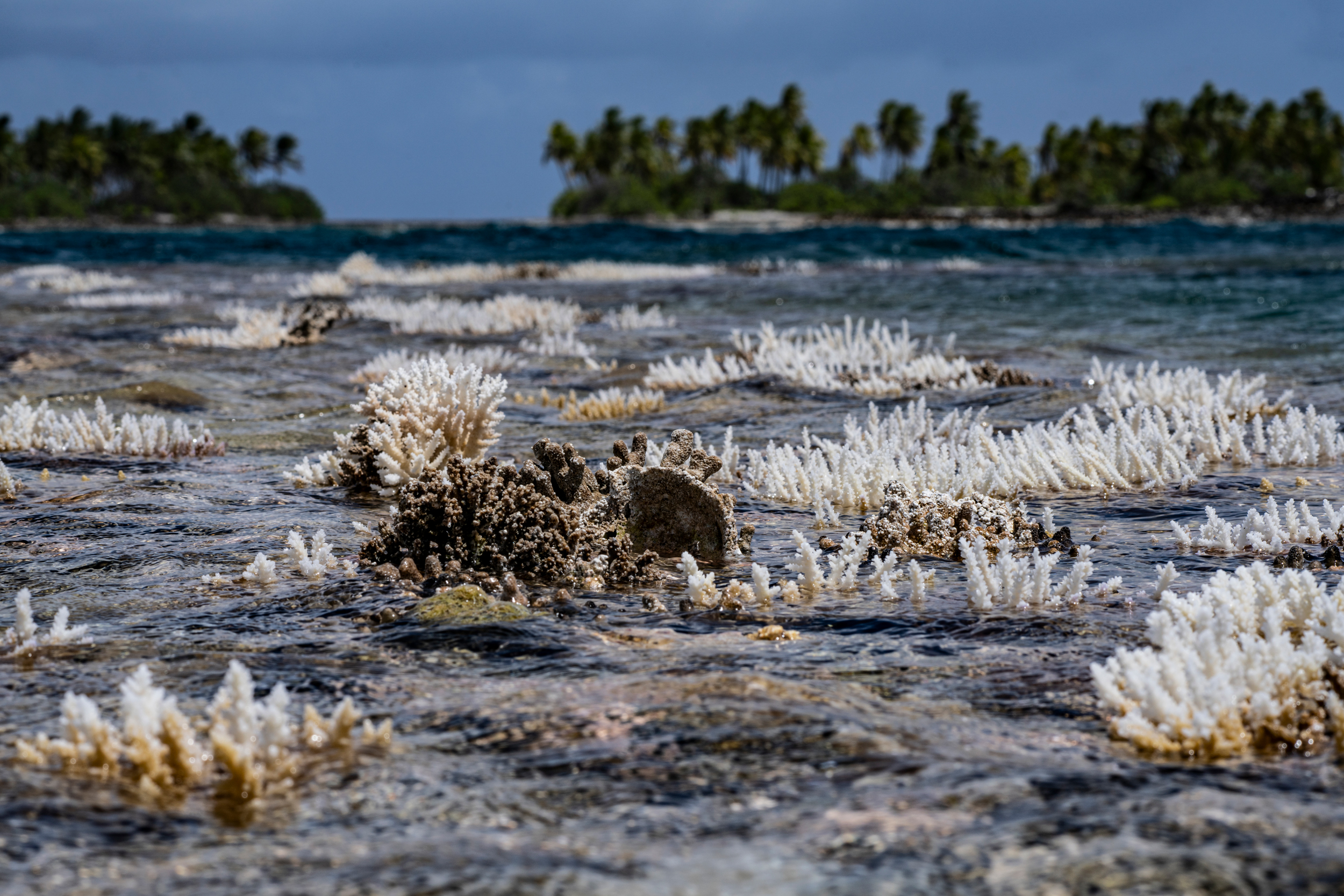
Chief among them are Acropora corals, a foundation species that build the structural framework of many reefs. Though all arborescent Acropora corals—those with tree-like branches—from Guam and the wider Pacific are classified as “Endangered” on the International Union for Conservation of Nature Red List, many remain unprotected under the ESA.
This story is funded by readers like you.
Our nonprofit newsroom provides award-winning climate coverage free of charge and advertising. We rely on donations from readers like you to keep going. Please donate now to support our work.
Donate NowGuam lost between 34 percent and 37 percent of its live coral between 2013 and 2017 due to repeated heatwaves, low tides and infectious diseases. While the island has escaped bleaching episodes since, future heatwaves could prove similarly fatal. “Each year, we brace ourselves for the next one,” said Raymundo, who highlighted how difficult a time it is to be a conservation biologist in the region.
Staghorn Acropora corals also tend to grow in massive thickets hundreds of meters in diameter. Often composed of a single genotype, these corals are unable to self-fertilize and therefore have very little chance of new settlements.
The researchers’ urgency stems from the recent collapse of similar corals in Florida. In 2023, a marine heatwave resulted in a roughly 98 percent mortality rate of elkhorn and staghorn colonies. Now declared “functionally extinct,” these corals do not exist in sufficient numbers in the state’s waters to provide effective coastal protection or thriving habitats for marine life.
“The problem is, if you’re the U.S. military, anything you do can be cited as being for national security,” said Anthony. “Even if the appropriate process would just be an extra round of ecological surveys to make sure everything is done with the best intention to avoid unnecessary harm.”
Indigenous Chamorro people on Guam—who can trace their roots back over 3,000 years—have also not forgotten the environmental harm caused by the military’s past use of PCBs, PFAS and dieldrin.
“I do see signs of anger and frustration among communities impacted by the need of a few to make money,” said Raymundo, highlighting how small island nations contribute little to climate change but are at the forefront of the impacts. “Too often we see that economic gain does not translate into food, health and education security for the majority of people.”
Some outer-lying islands in the region have already lost homes and can no longer grow crops due to salt water intrusion. Meanwhile, in January 2026, NOAA launched a survey to map over 30,000 square miles of waters off American Samoa for critical mineral reserves. A move described as the federal agency “shifting from science to prospecting,” by The New York Times.
Researchers are calling for NOAA to reverse its ESA proposals and extend protections to the Acropora genus, regardless of specific species. They argue this would bypass taxonomic uncertainty, simplify surveys and ensure increased levels of protection.
They note that the ESA already allows for the inclusion of specific populations or sub-species—like the Cook Inlet beluga whale or the southern resident killer whale—and so call for the same logic to be applied before Guam’s rich marine ecosystem goes the way of Florida’s.
“Florida has become a glimpse into the future for the Pacific Ocean,” said Anthony. “Unlike Florida, for the Pacific, it’s not too late. We still have corals. They’re recoverable, especially if appropriate policy is implemented.”
About This Story
Perhaps you noticed: This story, like all the news we publish, is free to read. That’s because Inside Climate News is a 501c3 nonprofit organization. We do not charge a subscription fee, lock our news behind a paywall, or clutter our website with ads. We make our news on climate and the environment freely available to you and anyone who wants it.
That’s not all. We also share our news for free with scores of other media organizations around the country. Many of them can’t afford to do environmental journalism of their own. We’ve built bureaus from coast to coast to report local stories, collaborate with local newsrooms and co-publish articles so that this vital work is shared as widely as possible.
Two of us launched ICN in 2007. Six years later we earned a Pulitzer Prize for National Reporting, and now we run the oldest and largest dedicated climate newsroom in the nation. We tell the story in all its complexity. We hold polluters accountable. We expose environmental injustice. We debunk misinformation. We scrutinize solutions and inspire action.
Donations from readers like you fund every aspect of what we do. If you don’t already, will you support our ongoing work, our reporting on the biggest crisis facing our planet, and help us reach even more readers in more places?
Please take a moment to make a tax-deductible donation. Every one of them makes a difference.
Thank you,

Johnny Sturgeon
Fisheries Reporter
Johnny Sturgeon is a London-based reporter covering fisheries and aquaculture. Joining us from the Outlaw Ocean Project, he has experience producing in-depth maritime investigations for nonprofit newsrooms. A former boatbuilder, he holds a B.A. in History & Politics from the University of Oxford, and an M.S. from Columbia Journalism School.