

In a new report that outlines a dozen high-risk pollutants given new life thanks to weakened, delayed or rescinded regulations, the Environmental Protection Network, a nonprofit, nonpartisan group of hundreds of former Environmental Protection Agency staff, warns that the EPA under President Donald Trump has abandoned the agency’s core mission of protecting people and the environment from preventable toxic exposures.
Americans may not realize the scope and scale of their exposure risk from diverse industrial and agricultural sources or understand how much those risks are rising as political appointees destroy the safety net the EPA has always provided, said Marc Boom, EPN’s senior director for public affairs, at a press briefing Thursday.
“While we may hear about one chemical or one EPA rule being changed,” Boom said, “so much is happening at once that it’s very difficult to see the full picture and connect it to our everyday lives.”
That’s why EPN developed a report, Terrible Toxics, to connect the dots, said Boom, who was joined by several EPN volunteers and medical experts on Thursday.
The report details how recent EPA decisions have relaxed restrictions on harmful chemicals in food, consumer products, water and air, increasing Americans’ exposure to 12 of the most dangerous and ubiquitous pollutants.
The list includes brain-damaging mercury and pesticides in food; hormone-bending phthalates in consumer products and cancer-causing PFAS “forever chemicals,” lead, arsenic and trichloroethylene in drinking water. Also on the list are the carcinogens benzene, formaldehyde and vinyl chloride in the air, along with heart- and lung-damaging soot and smog. All of these pollutants cause multiple health harms.
The list does not cover pollutants like greenhouse gases, which also exacerbate health harms, but is meant to illustrate the escalating health costs of Trump administration policy decisions.
“Political leadership is steering the agency away from its responsibility to protect human health and the environment,” the report warns. “Making Americans safer is a choice and EPA’s current leadership has chosen to make Americans sicker.”
The vast majority of Americans want their government to do more to protect them from dangerous chemicals, a new survey from The Pew Charitable Trusts found. More than 80 percent want the government and business to increase transparency around the use of chemicals.
Yet getting information from the current EPA is “like pulling teeth,” Boom said. “It’s probably the least transparent EPA we’ve ever had.”
The EPA has abandoned its oversight duty and failed to let Americans know what chemicals are doing to their health, said Betsy Southerland, former director of EPA’s Office of Science and Technology in the Office of Water.
As one example, said Sutherland, who is an expert on the health effects of notoriously indestructible forever chemicals, “we’re seeing fewer guardrails to prevent PFAS exposure and much less transparency about the risk.”
PFAS contaminate nearly half of all drinking water across the country, scientists with the U.S. Geological Survey reported in a 2023 study. Nearly all Americans, including babies, have PFAS in their blood.
Companies who handle PFAS have been given more leeway while the EPA is delaying safeguards and withholding science data, Sutherland said.
EPA officials have delayed deadlines that prohibit companies from discharging PFAS into waterways and require drinking water systems to take the hormone-disrupting chemicals out of tap water, she said. They have proposed exempting importers from PFAS reporting requirements, leaving consumers in the dark about what’s in the products they buy, and they’ve buried reports on PFAS health risks, she added.
“That means Americans’ toxic exposure is going up,” Southerland said, “and so are our health risks.”
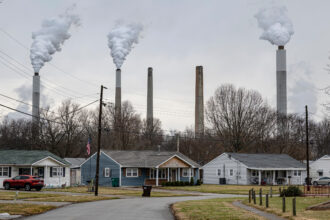
Inside Climate News asked the EPA to comment on the EPN report and explain how delaying water standards for PFAS and granting waivers to coal-fired plants, which emit mercury, lead and other pollutants, makes Americans healthier.
“Referring to EPN as nonpartisan is laughable; its staff and board is loaded with Democratic operatives,” an EPA spokesperson said in a statement. “While, unsurprisingly, EPN is engaging in dishonest fearmongering to drum up media attention and donations, the Trump EPA is taking real steps to protect human health and the environment.”
Although the EPA is rolling back regulations on PFAS and allowing higher lead levels in soil, the spokesperson called the Trump EPA “unmatched” in fighting these contaminants. “The Trump EPA is committed to transparency and gold-standard science like never before to deliver on our core statutory responsibilities of protecting human health and the environment while Powering the Great American Comeback.”
Less Regulation, More Disease
Hundreds of the 80,000 chemicals registered for use under the U.S. Toxic Substances Control Act are known to be dangerous, though just a fraction have undergone safety testing. The multiple harms associated with the chemicals listed in the EPN report are well-documented.
America’s nurses are on the front lines of addressing the health impacts of toxic chemical exposures, said Sarah Bucic, a registered nurse and policy analyst with the nonpartisan Alliance of Nurses for Healthy Environments.
At the briefing, Bucic ran through the ills she expects the EPA’s deregulatory agenda will cause. More soot in the air will mean more children treated for asthma and lung diseases. More lead will result in more children with developmental, behavioral and attention-deficit problems. More benzene will lead to higher rates of blood cancers while more trichloroethylene will contribute to kidney and liver cancers, Parkinson’s disease and fetal heart defects.
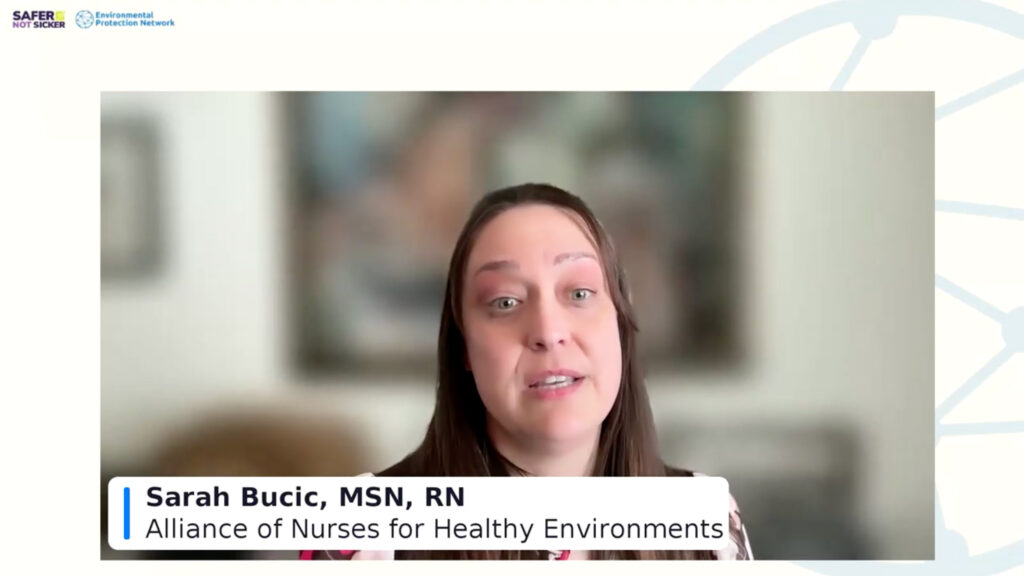
“There’s nothing more heartbreaking than treating a patient, especially a child, who is sick because of something we could have prevented,” Bucic said.
Afif El-Hasan, an Orange County pediatrician and board director of the American Lung Association, is most concerned about loosened rules that increase exposure to soot, or PM2.5.
These tiny particles easily bypass the defenses of the lungs and enter the bloodstream, posing outsize risks to children’s still-developing lungs and immune system.
The EPA strengthened the national PM2.5 standard in 2024 based on hundreds of scientific studies, El-Hasan said, a move that was projected to prevent thousands of premature deaths and millions of asthma attacks over time. “Now, unfortunately, the EPA is failing to enforce these standards and is even trying to roll them back.”
And the EPA recently repealed measures to make coal and oil-fired power plants cleaner, El-Hasan said.
This story is funded by readers like you.
Our nonprofit newsroom provides award-winning climate coverage free of charge and advertising. We rely on donations from readers like you to keep going. Please donate now to support our work.
Donate NowWeakening the guardrails that keep soot out of the air will mean more kids in the emergency room struggling to breathe, he said. “It means more missed school days. It means more missed work days for the parents that have to stay home and take care of the children.”
El-Hasan hopes that academic and public health institutions monitor and document the health consequences of all these rollbacks. “It’s very important that that is captured,” he said. “So that this mistake is never made again.”
Exposure Is a Choice
Health experts with EPN hope the report helps people understand the complex web of toxic exposures they encounter in daily life, where they come from and how recent policy decisions are increasing those exposures.
For decades, Americans have relied on EPA scientists to answer basic questions about the harms posed by exposure to a toxic chemical in the air, water and soil, said Chris Frey, a former EPA science advisor and leader of the Office of Research and Development, the agency’s independent scientific arm. “Over the last 13 months, EPA’s scientific backbone has been substantially diminished in ways that will affect Americans’ health and safety.”
Frey pointed to formaldehyde as just one example of the consequences of the EPA’s decision to overturn safeguards against toxic chemicals.
Nearly all Americans are exposed to some level of formaldehyde, which escapes from building materials like cabinets and flooring, and from personal care products like cosmetics.
In 2024, the EPA concluded, after more than three decades of scientific review, that formaldehyde poses cancer risk at any exposure level. The agency was on track to require companies to lessen or eliminate formaldehyde-related health risks, Frey said. “But current EPA leadership is now moving to ignore its own scientific findings,” he said, “effectively letting companies put this dangerous chemical back into play.”
There are steps consumers can take to reduce their risks, like using certified filters to reduce PFAS in their tap water and avoiding solvents with formaldehyde.
“But the burden should not fall on individuals and families to manage chemical risks on their own,” Frey said. “EPA needs to follow the science and ensure that polluting companies follow safeguards that put Americans’ health first.”
Even as the EPN team recounted numerous ways the EPA is stripping Americans of health protections, they remain hopeful that the rollbacks can be reversed.
Although ORD is now almost completely depopulated and is going to be shuttered formally, Frey said, a significant amount of its former workforce remain at the EPA. “They may not be in the roles that are best suited to their talents and experience and capabilities, but they’re still there,” he said, adding that the physical infrastructure of the research labs is still intact.
Both could be harnessed to restore the EPA’s mission, Frey said. “But you know, time is ticking. And the longer the destruction continues, the harder it will be to recover.”
There’s even a remedy for what Southerland sees as the biggest detrimental actions taken by this EPA: revocation of the endangerment finding, the basis for regulating greenhouse gases as a public health threat, and removing protections for wetlands and other ephemeral waterways under the Clean Water Act.
Congress can craft legislation to reinstate the endangerment finding and restore protections for the so-called “waters of the United States,” she said, though such laws would need a president who’s willing to sign them or a veto-proof majority in Congress. If the midterm elections give Democrats majorities in the House and Senate, she said, they could pass a budget that requires replacing all the staff this administration fired “as soon as possible.”
Ultimately, Boom said, exposure is not inevitable but the result of choices.
“We know how to filter PFAS from drinking water. We know how to replace lead-service lines, and we know how to reduce pesticide drift and develop safer alternatives,” Boom said. “Under the law, EPA’s mission is to protect human health and the environment. That mission was never meant to be optional.”
Correction: An earlier version of this story misspelled Marc Boom’s first name.
About This Story
Perhaps you noticed: This story, like all the news we publish, is free to read. That’s because Inside Climate News is a 501c3 nonprofit organization. We do not charge a subscription fee, lock our news behind a paywall, or clutter our website with ads. We make our news on climate and the environment freely available to you and anyone who wants it.
That’s not all. We also share our news for free with scores of other media organizations around the country. Many of them can’t afford to do environmental journalism of their own. We’ve built bureaus from coast to coast to report local stories, collaborate with local newsrooms and co-publish articles so that this vital work is shared as widely as possible.
Two of us launched ICN in 2007. Six years later we earned a Pulitzer Prize for National Reporting, and now we run the oldest and largest dedicated climate newsroom in the nation. We tell the story in all its complexity. We hold polluters accountable. We expose environmental injustice. We debunk misinformation. We scrutinize solutions and inspire action.
Donations from readers like you fund every aspect of what we do. If you don’t already, will you support our ongoing work, our reporting on the biggest crisis facing our planet, and help us reach even more readers in more places?
Please take a moment to make a tax-deductible donation. Every one of them makes a difference.
Thank you,

Liza Gross
Reporter, California
Liza Gross is a reporter for Inside Climate News based in Northern California. She is the author of The Science Writers’ Investigative Reporting Handbook and a contributor to The Science Writers’ Handbook, both funded by National Association of Science Writers’ Peggy Girshman Idea Grants. She has long covered science, conservation, agriculture, public and environmental health and justice with a focus on the misuse of science for private gain. Prior to joining ICN, she worked as a part-time magazine editor for the open-access journal PLOS Biology, a reporter for the Food & Environment Reporting Network and produced freelance stories for numerous national outlets, including The New York Times, The Washington Post, Discover and Mother Jones. Her work has won awards from the Association of Health Care Journalists, American Society of Journalists and Authors, Society of Professional Journalists NorCal and Association of Food Journalists.