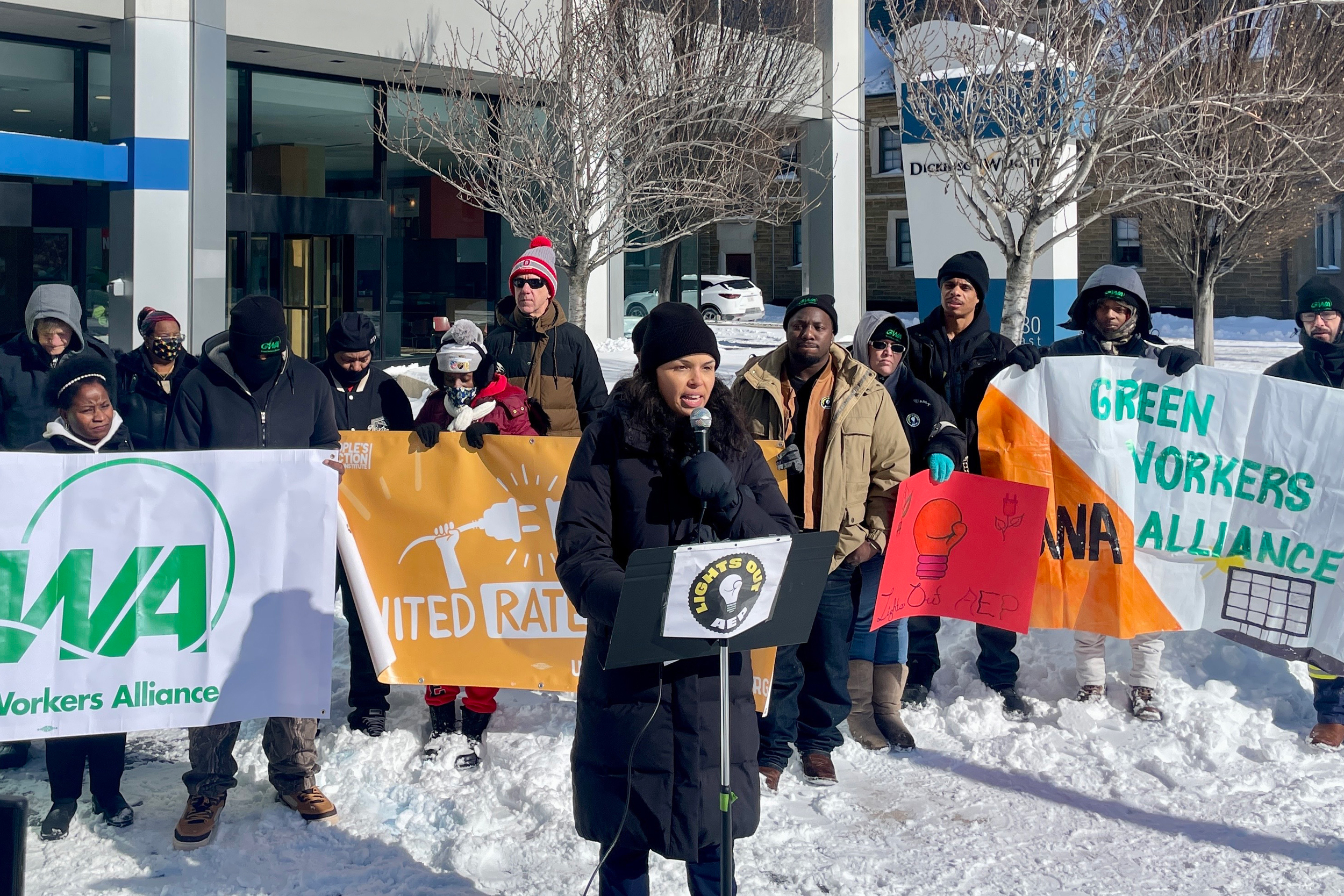


COLUMBUS, Ohio—Protestors stood in the snow outside the offices of Ohio’s utility regulator in January to say they were fed up with rising electricity rates.
Even a few years ago, the scene would have been hard to imagine, considering the complexity of utility costs and the obscurity of state regulatory agencies. But rate hikes in Ohio and across the country have provoked frustrated consumers to demand answers.
“It’s just getting harder and harder now to live,” said Steve Van Kuiken, a United Church of Christ pastor in Columbus who is part of a community group opposing rate increases. “The working class is really getting squeezed, and everything’s going up.”
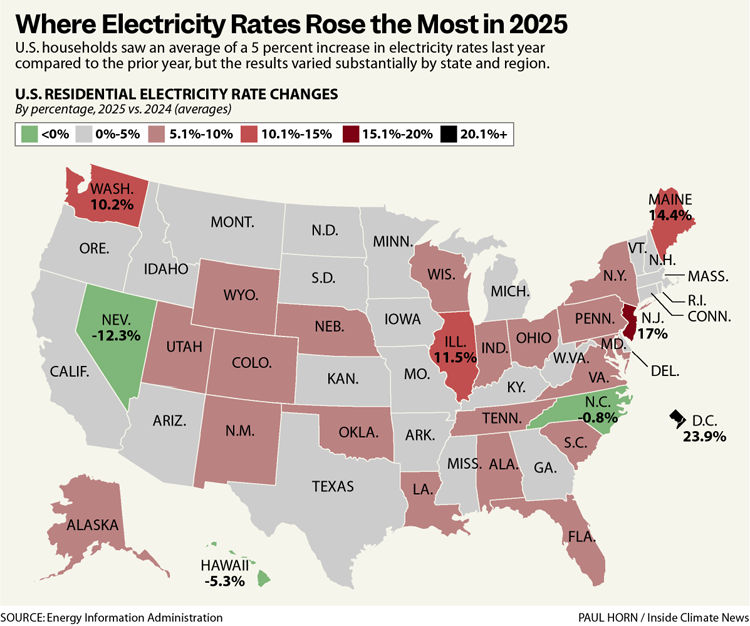
Van Kuiken was describing the resentment that has gripped much of the country. U.S. residential electricity rates increased by 5 percent in 2025 compared to the prior year, according to data released Feb. 24 by the Energy Information Administration that provides a comprehensive look at the price shift during President Donald Trump’s first full year in office. A few states, particularly in the Northeast and Midwest, saw double-digit growth, which has an extra sting because it followed a period of relatively flat growth.
Consumers are asking why, but the answers don’t come easily and vary by state and utility. One factor is utilities’ surge in spending on wires and other equipment used to deliver electricity, a trend partly attributable to rising power demand from data centers, according to researchers. Another factor is the increase in natural gas prices, which hits hardest in states such as Pennsylvania that rely heavily on gas for generating electricity.
Among the other drivers are state policies that require utilities to meet benchmarks for buying renewable energy. The effect is most evident in the Northeast and Mid-Atlantic and barely noticeable in other regions.
And then there are some highly local reasons, such as wildfires in California and hurricanes in Florida.
While the list of factors is long, data centers get a disproportionate share of the blame. But the problems are deeper, touching on the financial motivation of utility companies, said Charles Hua, founder and executive director of PowerLines, an advocacy group that seeks to reduce utility bills.
He explained that utilities earn a profit by investing in infrastructure such as power plants, poles and substations—capital expenditures, or “capex.” For years, the companies were limited in their spending because electricity demand was flat.
“Now demand is growing,” he said. “So that’s a perfect excuse or opportunity for [utilities] to go to the regulators and say, ‘Hey, we need cost recovery and a return on equity on these new generation capex investments.’”
Hua said it’s worth asking whether the incentives in this system are having a perverse effect that foists unnecessary costs on consumers. For example, utilities have a financial incentive to build rather than increase the efficiency of the current grid.
Utilities have endured criticism about rising rates and said that some of the discussion lacks proper context. In a report last month, the Edison Electric Institute, a trade group for electricity utilities, said price increases are in line with inflation in most states and the national average is skewed by a few states with the largest rate hikes.
The demonstrators in Ohio urged officials to reject a proposed rate plan from AEP Ohio, a Columbus-based utility. Asked for comment, AEP said many of the reasons for rising rates are beyond the company’s control, such as the costs of being part of the multi-state PJM Interconnection grid.
“We know our customers are frustrated by the high cost of energy. We are frustrated, too,” an AEP spokesperson said in an email.
So far, we’ve been talking about rates, but this may undersell the extent of hardship because it doesn’t account for the fact that electricity consumption is also growing. The average monthly electricity bill for a U.S. household—which takes into account the rate and consumption—was $151.89 last year, an increase of 7 percent from the prior year.
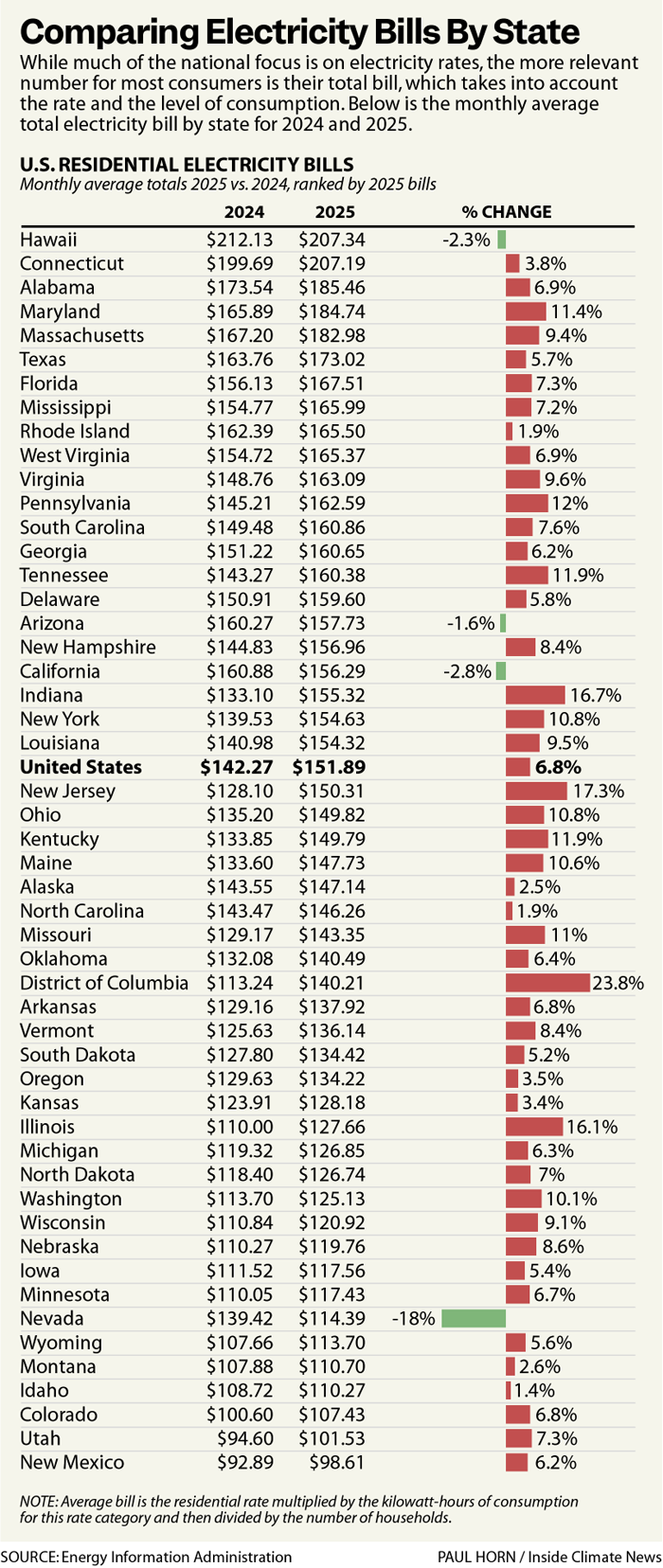
Following a frigid start to winter in which Brittany Sawyer’s electricity use for heating was high, the Columbus resident is looking at a monthly bill of $643.93. Sawyer, a mother of two who works three jobs, was stunned when she saw the amount. That’s an unusually high bill considering that the average Ohio household paid $149.82 per month for electricity last year, up 11 percent from the prior year.
“I don’t know what I’m going to need to do, or how I’m gonna figure it out,” she said, adding that most likely she will cover the costs by taking on debt and reducing spending for entertainment, such as going to movies.
“You’re robbing Peter to pay Paul at this point,” she said.
It’s not surprising that electricity prices have become a key political issue in the run-up to the November midterm elections, given that Trump campaigned on a promise to cut energy prices by 50 percent within one year, sometimes saying this would include a 50 percent cut to electricity prices. Climate action advocates see prices as an energizing issue for their movement, pointing to steps the Trump administration has taken that could contribute to future rate increases, such as halting development of offshore wind and forcing older coal plants to stay open.
Here is a closer look at what’s driving the rise in electricity bills.
Utilities Are Spending More to Deliver Power
Ryan Hledik, a principal at The Brattle Group, a consulting firm, has closely examined the factors driving electricity prices and is reluctant to name a single factor as the most significant.
“It’s complicated, is the short answer,” he said.
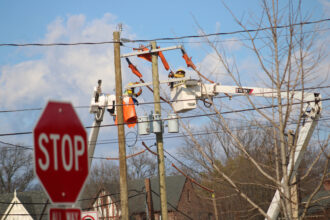
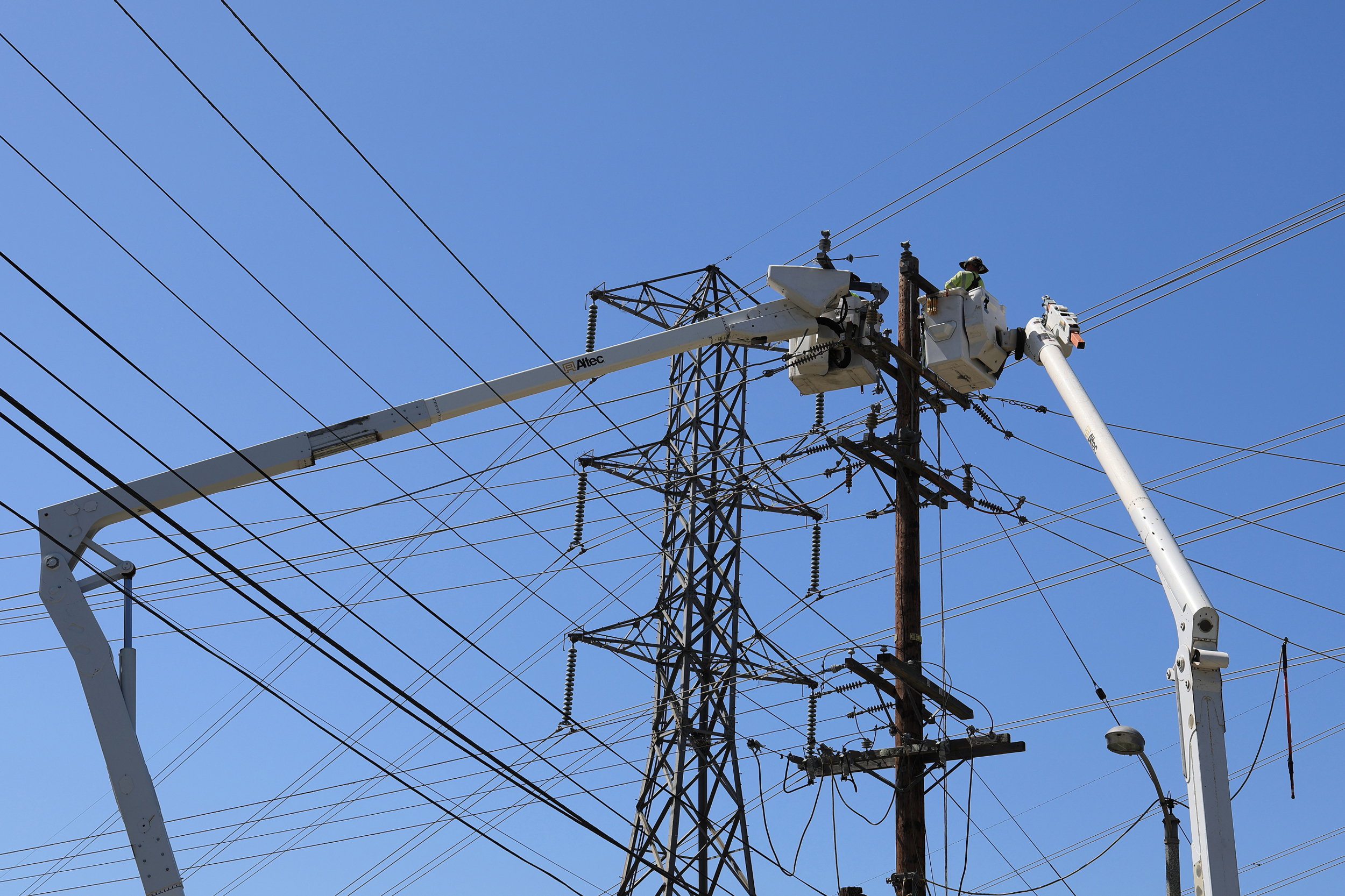
But Hledik has found one cost driver that is significant in every state: the growth in utilities’ infrastructure spending. He explained that the companies are faced with a combination of aging equipment—some of which is 80 years old or older—and an economy in which the costs of replacing equipment have soared.
The Edison Electric Institute has tracked the growth in spending on long-lived equipment, which went from $108.6 billion in 2015 to a forecasted $207.9 billion in 2025, according to a recent report. The largest one-year percentage increase during that time was between 2024 and 2025, signaling an acceleration.
A notable shift from 2015 to 2025 is that utilities are now investing a larger share of their money in equipment for delivering electricity, including the transmission system of large power lines and the distribution system of local lines. In 2025, transmission and distribution accounted for 50 percent of this spending, up from 45 percent in 2015.
There are many possible explanations for the growing emphasis on the delivery system, including the need to repair damage from extreme weather and a desire to increase the system’s capabilities to accommodate large power consumers such as data centers.
Paying for Natural Gas
Natural gas was the country’s leading fuel for power plants in 2025, accounting for 41 percent of the gigawatt hours produced by U.S. power plants.
Some states depend so heavily on natural gas for electricity that there’s not much they can do when gas prices rise. Pennsylvania stands out as a major gas producer that also has seen large percentage increases in electricity rates.
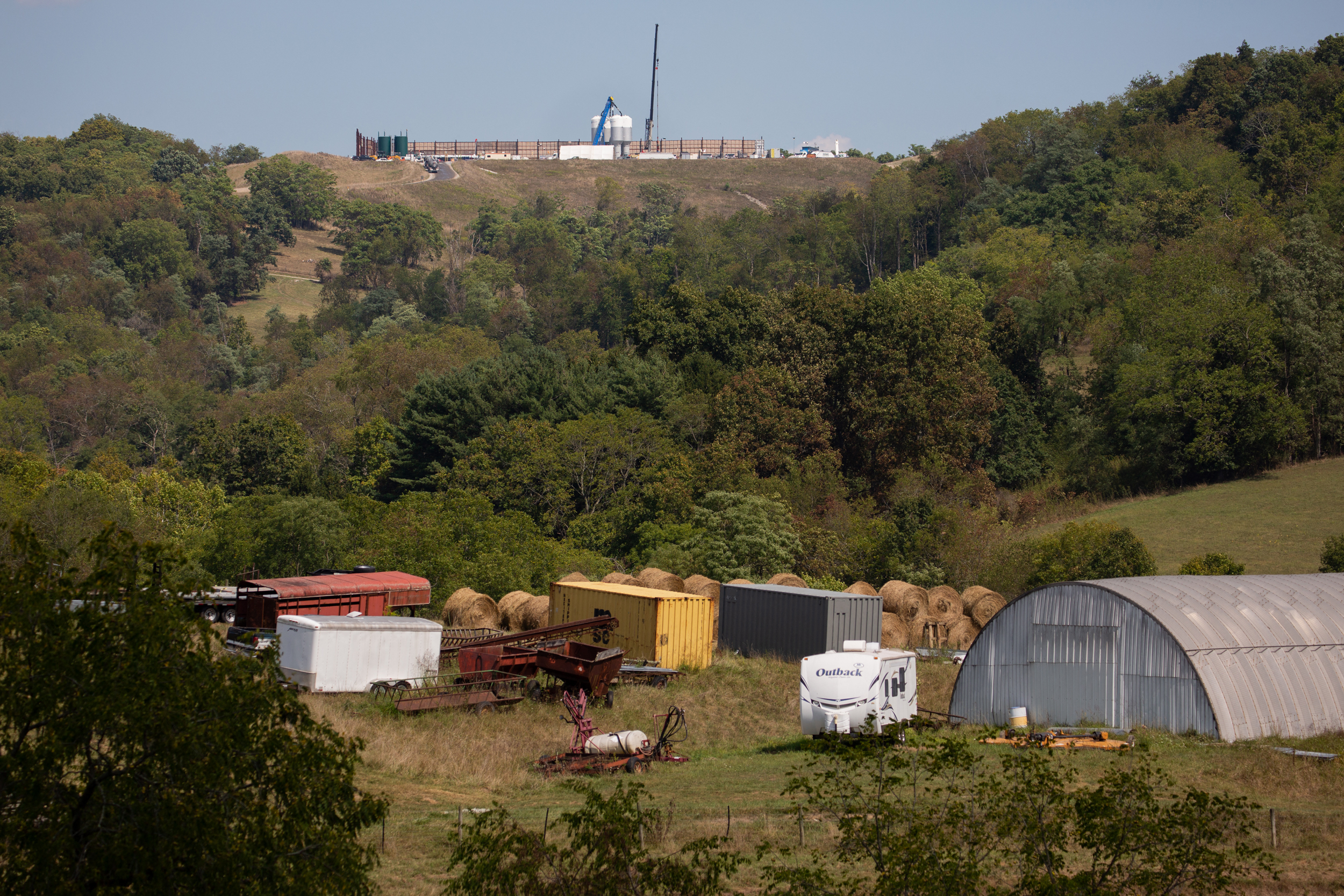
The pain of high gas prices was the opposite of what some of those states experienced in the late 2010s, when prices were low.
Eric Gimon, a senior fellow at the think tank Energy Innovation, explains this with a football analogy. In the late 2010s, the low price of natural gas was like an offensive lineman, shielding consumers from some of the factors driving up electricity costs, such as infrastructure spending.
“For a long time, we were in a period of a kind of stasis,” he said, about how different factors counteracted each other. But now that gas prices are rising, “that stasis goes away.”
In other words, the offensive lineman has stopped protecting consumers.
A paper Hledik co-authored with researchers at the Lawrence Berkeley Lab in October 2025 quantified the relationship between gas prices and states’ dependence on gas. The authors found that once a state gets at least 40 percent of its electricity from gas, it becomes much more sensitive to changes in gas prices, both when prices rise and when they fall.
About 20 states got 40 percent or more of their in-state electricity generation from gas last year. But there was substantial variation in their rate increases. Among the half dozen states that are the most gas-reliant, Rhode Island, Delaware, Massachusetts and Florida saw above-average power rate increases over the past five years in percentage terms, while Mississippi and Louisiana had rate increases slightly below the national average.
Forecasts, including those from the Energy Information Administration, indicate that gas prices will continue to increase through the remainder of this year and into next year.
Prices are rising for many reasons, including the increase in liquefied natural gas exports and rising demand for gas for power plants serving data centers.
The People Who Set Rates
In early February, state utility regulators gathered in Washington, D.C., during the thaw after a historic storm. Outside, sidewalks had slippery spots and ice slid in large chunks from rooftops. In a downtown hotel’s conference space, the visitors contemplated an equally treacherous landscape—the uproar over rising energy costs.
It was the annual winter summit of the National Association of Regulatory Utility Commissioners, or NARUC, and attendees used the polite term “affordability” to describe the pressures facing these typically little-known state government officials.
“What I’m hearing across the board is that we are in a very unique and challenging situation for a lot of different reasons,” said Kelsey Bagot, chair of the Virginia State Corporation Commission, moderating one panel.
The more than 2,000 conference participants included not only state regulators but also officials of the investor-owned utilities they regulate, as well as energy-hungry big businesses engaged in the issues before their commissions. The corporate logos of Google, Microsoft and power industry trade groups lined the walls as co-sponsors of the event. And some regulators took a field trip across the Potomac River to a Google facility in the data center capital of the world, Northern Virginia, where they could witness firsthand the technology explosion upending their world.
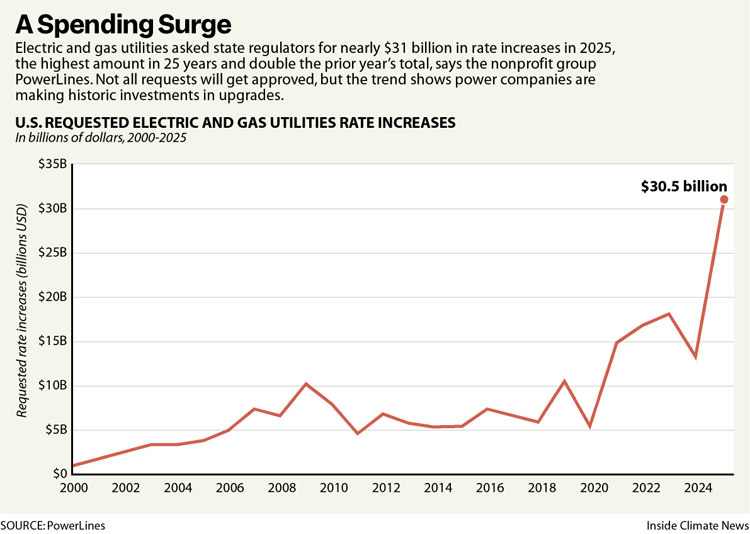
For these state public utility commissioners, tasked under federal law with ensuring that electricity rates are “just and reasonable,” 2025 was a year like no other. Electric and gas utilities requested nearly $31 billion in rate increases, more than double the $15 billion they requested in 2024, according to research by PowerLines. S&P Global’s Regulatory Research Associates said it was the highest level of utility rate requests since the early 1980s.
With an onslaught this unprecedented, how do the commissions decide what price is needed to ensure the companies can cover their costs and earn a “reasonable” return on their investments?
“First and foremost, we are looking for anything we can find that’s going to help with customer affordability,” said Kimberly Barrow, vice president of the Pennsylvania Public Utility Commission, at a panel dedicated to boosting grid efficiency.
Are Renewables to Blame?
Organizations with ties to fossil fuels are often quick to blame the rapid rise of wind and solar power for electricity price increases. But researchers interviewed for this story say the effects, where they exist, are small.
Twenty-nine states and the District of Columbia have renewable portfolio standards, which are laws that require utilities to meet benchmarks for buying renewable or carbon-free electricity. The standards play a role in electricity price increases, but not a major one in most states, Hledik said.
“It definitely was not the most significant driver of rate increases,” he said. “I think ‘modest’ is probably the best word that I would use.”
This story is funded by readers like you.
Our nonprofit newsroom provides award-winning climate coverage free of charge and advertising. We rely on donations from readers like you to keep going. Please donate now to support our work.
Donate NowLawrence Berkeley Lab has tracked the effects of these policies and, in a 2024 paper, found that renewable energy development far outpaced state requirements in the West, Midwest and Texas, indicating strong market support for renewables and minimal effects on rates. The Southeast has few, if any, renewable requirements, so there is essentially no effect on rates.
That leaves the Northeast and Mid-Atlantic, which stand out because the states all have renewable laws and face market challenges due to a lack of developable land or other factors that make it more difficult to meet the requirements. As a result, the policies have the greatest effect in these states, but the effect is not major.
It’s important to note that there is voluminous research on the effects of renewable portfolio standards on rates. The findings run the gamut from showing major rate increases to determining no correlation. One challenge is that the market is constantly changing, with volatile gas prices and wind and solar getting less expensive.
Gimon said renewable portfolio standards help to diversify the energy mix in gas-dependent states, and he expects that these investments are “about to pay off big time” as gas prices continue to rise.
A related question is whether high levels of wind and solar have helped reduce prices in states with the most wind and sun. For example, many of the states with the smallest rate increases, such as Iowa, also have abundant wind resources.
But it’s difficult to separate the effects of different factors. In Iowa’s case, low electricity rates probably have something to do with having inexpensive wind power, but the state also has a small share of electricity generation from natural gas, which also helps at a time when gas prices have risen.
Another factor related to renewable energy is the growth of customer-owned power sources such as rooftop solar. Several aspects of rooftop solar can contribute to increased costs for non-solar customers.
So far, the cost shifts are small. For example, economists at the University of Maryland wrote in a working paper last year that the adoption of rooftop solar has led to a 2.35 percent decrease in utility companies’ revenue, which the companies partially recovered by raising customer rates by 1.48 percent.
Different States, Varied Challenges
The National Academy of Engineering once named the U.S. power system the greatest engineering achievement of the 20th century. But with three interconnections, seven regional grid operators and price decisions made in 51 jurisdictions, it has become a fragmented system under strain in an era of climate change, with each state confronting different challenges.
Wildfires are driving California’s electricity rates, which rose 39 percent in inflation-adjusted terms between 2019 and 2025, faster than those in any other state, according to an analysis by the Energy Institute at Haas at the University of California, Berkeley. California’s three big investor-owned utilities received approval to collect $40 billion in wildfire mitigation and liability costs from ratepayers since 2019, according to a Jan. 30 report by the California Public Utilities Commission.
“Our existing system places outsized and unsustainable burdens on utilities and utility ratepayers,” said the report. California’s PUC argues that part of the problem is the state’s strict liability system—the only one in the West that holds utilities strictly liable for damages from fire involving their equipment, without regard to whether they acted negligently. The commission is urging California to consider capping or limiting tort liability for electric utilities, or to find other ways to cover the wildfire management costs now being borne by utility ratepayers.
Far from the wildfire zone, residents of Washington, D.C., saw their electricity rates rise by 24 percent in 2025, more than in any state. Members of the D.C. Council were posting their own big February electric bills online last week ($1,100 in one councilmember’s case) to let their constituents know they were feeling the pain, and to put a spotlight on the electric utility Pepco, an Exelon company.
Pepco did get a rate increase in late 2024 that was expected to raise customer bills about $7 per month in 2025 and $3 per month this year. But Pepco said the much larger source of increased costs is the skyrocketing rates the utility had to pay to the regional grid operator, PJM Interconnection, the nation’s largest grid, for its electricity supply. Unlike the 13 states in PJM, Washington has no power plants of its own. Pepco must import all of the power it delivers to customers, leaving it especially vulnerable to the fast-rising prices that have had the region’s governors calling for reform.
“It’s something that we can’t control,” said Charles McDade, a Pepco spokesman. “And because we know it’s higher than it has been before, we’ve been looking at ways to help our customers, through our customer relief fund and other assistance programs to help offset those costs.”
The nation’s largest electricity rate hike proposed in 2025 was a $9.8 billion request by Florida Power & Light, which told regulators it needed to invest in new generation and battery storage to serve a growing population, to harden the grid against severe weather and to deploy smart technology to curb outages. In November, the Florida Public Service Commission approved a reduced rate hike—about $6.9 billion over the next four years—but the plan still faces a legal challenge.
Electricity Bills Become Political
Frustration with electricity prices has already played out at the polls, and Democrats see it as an issue that could help them retake Congress in the midterm elections.
Rising electricity costs are mentioned regularly in email blasts to voters from the Democratic National Committee’s “War Room,” including one on the eve of Trump’s State of the Union address. Trump is “personally causing families in every part of the country to pay higher prices,” wrote DNC Chair Ken Martin.
Environmental advocates have also taken up the cause, arguing that the Trump administration’s moves to choke off renewable power and boost fossil fuels have hurt consumers while adding to the burden of climate pollution.
In fact, Trump’s anti-climate moves likely have not hit consumers in the pocketbook directly—yet. None of the offshore wind projects he sought to block were completed, and the one that was partially operational, Vineyard Wind, was allowed to keep delivering power under Trump’s order. Courts soon lifted the stop-work orders, allowing construction to continue at Vineyard and four other offshore wind projects.
But experts say Trump’s moves have hindered investment in ways that are bound to make development more expensive. And the administration’s unprecedented orders to keep coal plants churning could end up on utility bills soon. In Michigan, Consumers Energy has reported operating losses of $135 million through the end of last year to keep its J.H. Campbell coal-fired power plant running beyond its scheduled May 2025 retirement. The utility is seeking to recover costs from customers across 11 states in the grid managed by the Midcontinent Independent System Operator, a move being challenged by Michigan’s attorney general.
Trump, however, asserted in his State of the Union address that prices were going down. “Nobody can believe when they see the kind of numbers and especially energy, when they see energy going down to numbers like that,” he said. “It’s like another big tax cut.” He proposed what he called a “Ratepayer Protection Pledge” that will require major tech companies to provide for their own power needs. It was not immediately clear how that plan would be carried out, or whether it would alleviate the burden on a power system that still needs to make upgrades to replace aging equipment and address extreme-weather threats.
The Trump administration, meanwhile, blames Democrats for high electricity prices. “High electricity prices are a choice,” Energy Secretary Chris Wright has said repeatedly. On Feb. 18, White House spokeswoman Karoline Leavitt took up the argument, saying “red states with Republican legislatures currently enjoy lower average retail electricity prices than blue states with Democrat legislatures.”
Both are echoing a talking point that a fossil fuel industry-aligned think tank, the Institute for Energy Research, began promoting last year. The group released a report, Blue States, High Rates, that concluded 86 percent of states with above-average electricity prices voted for the Democratic presidential candidates in 2020 and 2024.
But the latest figures from the EIA show that states that voted for Trump in 2024 are sharing the pain of the power price shocks sweeping the country; 13 of the 24 states where prices rose in 2025 by more than the U.S. average of 5 percent voted for the Republican candidate.
Last November’s elections made clear that anger about power prices crosses political fault lines. Not only did Democrats win the New Jersey and Virginia governors’ races with campaigns focused on high electricity prices, Democratic candidates also ousted two Republicans from seats on Georgia’s Public Service Commission by campaigning against recent rate hikes for Georgia Power. They were the first Democrats to win state-level office in a statewide election since 2006 in Georgia. The state will be a key midterm battleground this year, with pivotal races for U.S. Senate and governor.
Both Democrats and climate activists are committed to the electricity cost message in their campaigns against the Trump administration and Republicans this year.
“The energy affordability crisis is not a red or blue issue,” said David Kieve, the president of Environmental Defense Fund Action, in an email last week. “It’s a pocketbook issue.”
Correction: A previous version of this story misspelled Ryan Hledik’s last name.
This story has been updated to clarify Vineyard Wind’s operational status when the stop-work order was imposed.
About This Story
Perhaps you noticed: This story, like all the news we publish, is free to read. That’s because Inside Climate News is a 501c3 nonprofit organization. We do not charge a subscription fee, lock our news behind a paywall, or clutter our website with ads. We make our news on climate and the environment freely available to you and anyone who wants it.
That’s not all. We also share our news for free with scores of other media organizations around the country. Many of them can’t afford to do environmental journalism of their own. We’ve built bureaus from coast to coast to report local stories, collaborate with local newsrooms and co-publish articles so that this vital work is shared as widely as possible.
Two of us launched ICN in 2007. Six years later we earned a Pulitzer Prize for National Reporting, and now we run the oldest and largest dedicated climate newsroom in the nation. We tell the story in all its complexity. We hold polluters accountable. We expose environmental injustice. We debunk misinformation. We scrutinize solutions and inspire action.
Donations from readers like you fund every aspect of what we do. If you don’t already, will you support our ongoing work, our reporting on the biggest crisis facing our planet, and help us reach even more readers in more places?
Please take a moment to make a tax-deductible donation. Every one of them makes a difference.
Thank you,

Dan Gearino
Reporter, Clean Energy
Dan Gearino covers the business and policy of renewable energy and utilities, often with an emphasis on the midwestern United States. He is the main author of ICN’s Inside Clean Energy newsletter. He came to ICN in 2018 after a nine-year tenure at The Columbus Dispatch, where he covered the business of energy. Before that, he covered politics and business in Iowa and in New Hampshire. He grew up in Warren County, Iowa, just south of Des Moines, and lives in Columbus, Ohio.

Marianne Lavelle
Bureau Chief, Washington, D.C.
Marianne Lavelle is the Washington, D.C. bureau chief for Inside Climate News. She has covered environment, science, law, and business in Washington, D.C. for more than two decades. She has won the Polk Award, the Investigative Editors and Reporters Award, and numerous other honors. Lavelle spent four years as online energy news editor and writer at National Geographic. She spearheaded a project on climate lobbying for the nonprofit journalism organization, the Center for Public Integrity. She also has worked at U.S. News and World Report magazine and The National Law Journal. While there, she led the award-winning 1992 investigation, “Unequal Protection,” on the disparity in environmental law enforcement against polluters in minority and white communities. Lavelle received her master’s degree from Columbia University Graduate School of Journalism, and is a graduate of Villanova University.