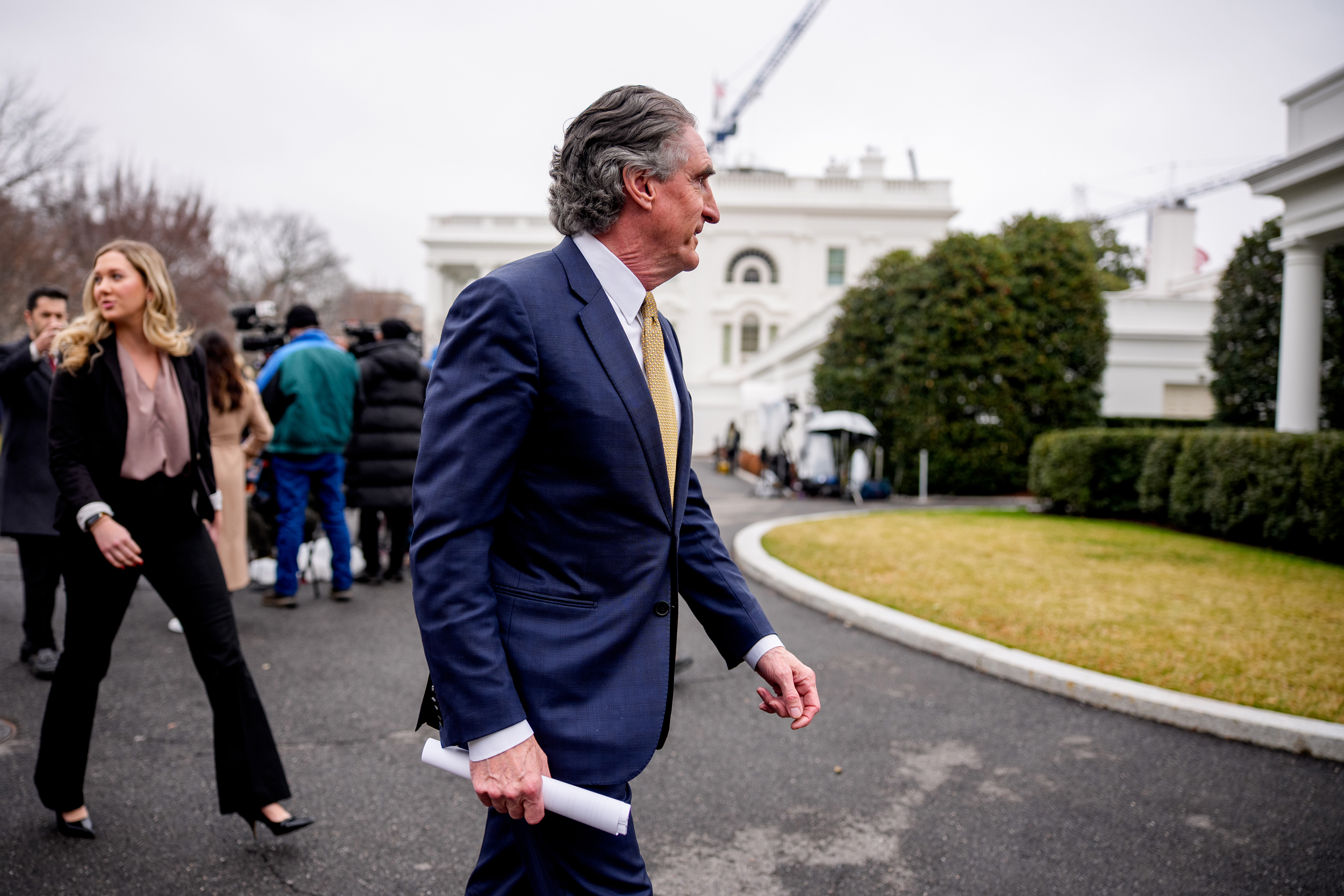


One year into President Donald Trump’s second term, the Department of the Interior is in turmoil, hobbling many of the agencies overseeing the country’s public lands and waters.
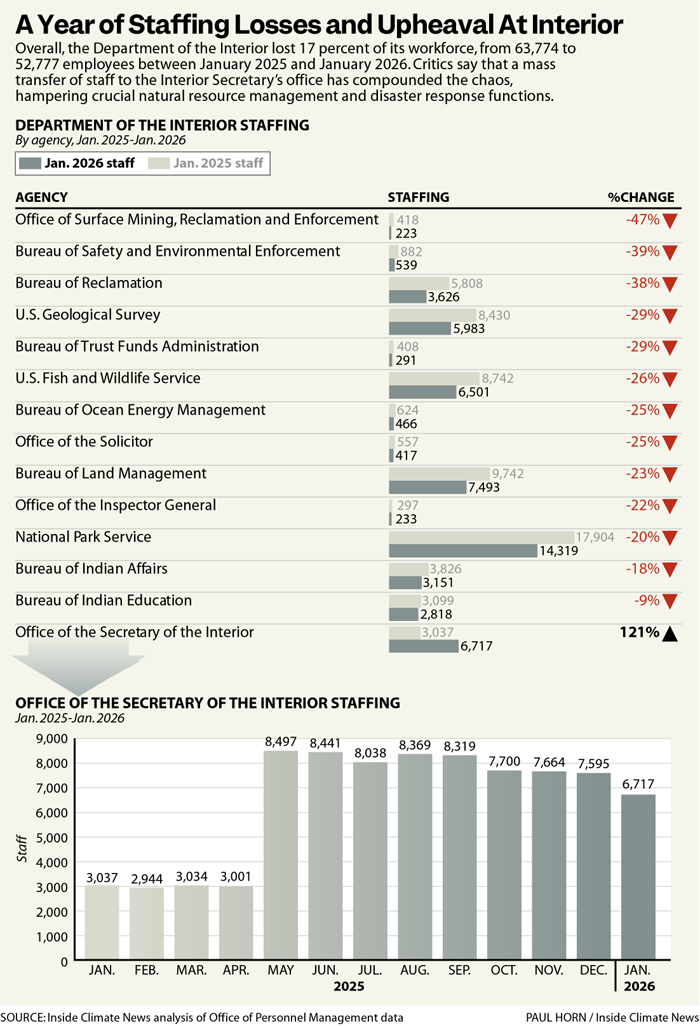
Not only has Interior lost some 11,000 employees, or more than 17 percent of its workforce, it is also reeling from a drastic centralization of personnel: Last May, almost 5,500 staff from the department’s component agencies were moved into the office of the Interior secretary, Doug Burgum.
That shift has created a hostile work culture, made staff less efficient and broken important lines of communication, former Interior employees say. According to an Inside Climate News analysis of federal workforce data released by the Office of Personnel Management, almost 1,800 workers have left Burgum’s office since the reorganization—the vast majority opting to retire or quit.
As a whole, the federal workforce shrank by about 12 percent in the first year of the second Trump administration. Some parts of the government, such as the Environmental Protection Agency, which shed 24 percent of its employees, have suffered bigger losses. But Burgum’s reorganization is unique, with wide ripple effects.
Under an order signed on April 17, Burgum confirmed plans to absorb administrative staff from Interior’s component agencies, including workers responsible for human resources, training, information technology, contracting and communications. The Inside Climate News analysis shows sudden staff losses in the next month at agencies including the Bureau of Reclamation; the U.S. Geological Survey; the Bureau of Land Management; the Office of Surface Mining Reclamation and Enforcement; and the Fish and Wildlife Service that correspond to the swelling of Burgum’s own staff.
The stated goal was efficiency. “This unification effort will accelerate technology advancements and enhance the Department’s ability to deliver on our core mission,” Burgum’s order said.
But Interior staff reorganized into Burgum’s office who later left say they encountered a hostile, inefficient work culture designed to push people out. Russell Vought, the powerful director of the federal Office of Management and Budget, said in a private speech between Trump’s two terms that “we want the bureaucrats to be traumatically affected” by going to work, ProPublica reported in 2024.
“They’re sucking the soul out of the agencies and they’re doing it on purpose,” said Tim Whitehouse, executive director of Public Employees for Environmental Responsibility, a nonprofit that provides legal services to public employees. Administrative workers newly reorganized to Burgum’s office “have no clear management structure,” he said. “They often have no clear lines of authority. This is part of the effort by Secretary Burgum—the buck stops with him—to deconstruct his agency by creating trauma.”
“Their goal was to make my life a living hell,” said Adam King, a former grant management specialist at the Office of Surface Mining Reclamation and Enforcement (OSMRE) who took a deferred resignation in part to avoid being reassigned to Burgum’s office. “I left because of this administration.”
“Once I was consolidated up to Interior, my supervisor wouldn’t meet with me,” said a former employee of one agency within Interior who requested anonymity for fear of retaliation. “I wasn’t given anything to do. … I was incredibly isolated.”
“I loved my job,” said Bill Betz, a former Interior email and software engineer who took early retirement last April after a 30-year career in the federal government. He had hoped to retire at 65, “but the stress level went from like three to a 100 with the new administration,” he said. He left at age 60.
The cuts mean agencies are shorthanded as the U.S. grapples with a broad range of environmental and climate threats to the lands and waters within its borders, critics and former Interior employees say.
“You’re losing a huge amount of institutional knowledge,” said Jacob Malcom, the former acting deputy assistant secretary for policy and environmental management at Interior. “People can’t do their jobs.” Malcom left Interior in February 2025 after being directed to fire newer employees—orders he said were illegal.
“No staff, no service,” he said.
Interior did not respond to requests for comment on this story.
Several people familiar with the intricacies of Interior said that Burgum’s approach to consolidating jobs, which was carried out by Tyler Hassen, a former oil executive who worked at the Trump-created Department of Government Efficiency until July, paid little attention to the nuances of seemingly similar roles across different agencies. Hassen did not respond to requests for comment.
Grasping those nuances ended Interior administrative staff reorganization attempts under a previous administration.
Bernhard Kluger, who worked in the Office of Personnel Management under President Barack Obama, was part of a team charged in 2011 with consolidating information technology staff across Interior’s agencies. But the team “failed miserably,” he said, because “you’ve got all of these people on paper that look like they kind of belong in headquarters, but when you actually look at them, they’re driving a 4×4 and they’re making sure that you know the roof doesn’t fall down in an emergency shelter. They’re doing very hands-on work.”
Kluger, who left the agency in 2017 and is now a founding partner of the consulting firm Prospect Partners, said as an example that an information technology staffer with the National Park Service stationed in Denali may also be responsible for monitoring radio communication for scientists working on glaciers in the area. “The person who’s maintaining my laptop, that’s not a cuttable position,” he said.
“Burgum’s got himself in a lot of trouble.”
Other consequences may be more subtle. Without administrative staff, grant recipients could struggle to properly spend tens of millions of dollars overseen by Interior component agencies.
This story is funded by readers like you.
Our nonprofit newsroom provides award-winning climate coverage free of charge and advertising. We rely on donations from readers like you to keep going. Please donate now to support our work.
Donate NowKing worries that with all the grant management specialists from every agency in one office, they could be assigned a case outside their area of expertise. Though many talented, hardworking people remain at Interior, King said, he wasn’t sure a grant manager from one agency could “come in and accurately advise people who have received federal funds [in another agency] on how it can be correctly expended without them getting an audit finding.” And, given the Trump administration’s clawback of federal grants, a grantee that’s had compliance issues could have the federal government take its funding away, King added.
At OSMRE, most grants go to states reclaiming mine lands, King said. The agency did not respond to requests for comment.
“How much money are they wasting by having these people running around chasing their tails trying to figure out a new way to do what we’ve known how to do?” he said. “What they’ve done to these agencies will take talented people decades to undo.”
Others noted that the field work carried out by federal land agencies requires administrative staff drafting documents hundreds of pages long, making sure invoices are filed correctly and ensuring communications happen as seamlessly as possible.
“It’s almost like, you know, [the Trump administration] thinks that invisible elves do it or something. But they don’t. It takes actually a huge administrative staff to accomplish those things,” the former Interior agency staffer said. “If it doesn’t get done, then the agency begins to break down.”
Federal responses to natural disasters like wildfires could also be affected by the centralization and subsequent departure of administrative employees under Burgum.
Fighting a wildfire requires “critical, behind-the-curtains folks that you rely on to make decisions,” said Andrea Delgado, a former chief of staff for Natural Resources and Environment at the U.S. Department of Agriculture, which, like Interior, is a cabinet-level department. There, Delgado oversaw wildland fire workforce policy and regularly coordinated with Interior.
Administrative staff secure contracts with ground or aviation equipment to support firefighting efforts, she said. They ensure workers are recruited for firefighting and mitigation, and some may possess the proper credentials to fight a blaze themselves, she added.
With so many administrative folks lost, “it raises questions about how that capacity hampers the ability to do general land management,” Delgado said.
All of the former Interior employees who spoke with Inside Climate News lamented the change in culture under Burgum. King said he would never work for another Republican president.
“I can’t even tell you how many times I worked over[time] and never said anything to anyone, but just to make sure I got something done on time for someone else to keep it moving, to pass the baton, because that’s important, and it matters,” he said. “And then to be told that, you know, we suck? … That’s frustrating, man. Nobody wants to work in a situation like that. And it just happens to be your own country that’s telling you that, too.”
Others are working to ensure Interior is effective under future presidential administrations. After leaving the agency, Malcom started Next Interior, an organization aiming to reconstruct the agency ahead of its 200th birthday in 2049. But after four more years of the Trump administration, “this is going to be a massive undertaking,” he said.
The former Interior agency staffer who spoke with Inside Climate News on the condition that her name not be included has not given up on a federal career. Though she took a job in the private sector, she said she would return to the federal workforce in the right circumstances.
“Interior is still a place that I believe in, and there are still really wonderful people who are there doing the best that they can,” she said. “I want to go back as soon as I can.”
About This Story
Perhaps you noticed: This story, like all the news we publish, is free to read. That’s because Inside Climate News is a 501c3 nonprofit organization. We do not charge a subscription fee, lock our news behind a paywall, or clutter our website with ads. We make our news on climate and the environment freely available to you and anyone who wants it.
That’s not all. We also share our news for free with scores of other media organizations around the country. Many of them can’t afford to do environmental journalism of their own. We’ve built bureaus from coast to coast to report local stories, collaborate with local newsrooms and co-publish articles so that this vital work is shared as widely as possible.
Two of us launched ICN in 2007. Six years later we earned a Pulitzer Prize for National Reporting, and now we run the oldest and largest dedicated climate newsroom in the nation. We tell the story in all its complexity. We hold polluters accountable. We expose environmental injustice. We debunk misinformation. We scrutinize solutions and inspire action.
Donations from readers like you fund every aspect of what we do. If you don’t already, will you support our ongoing work, our reporting on the biggest crisis facing our planet, and help us reach even more readers in more places?
Please take a moment to make a tax-deductible donation. Every one of them makes a difference.
Thank you,

Jake Bolster
Reporter, Wyoming and the West
Jake Bolster reports on Wyoming and the West for Inside Climate News. Previously, he worked as a freelancer, covering climate change, energy, and the environment across the United States. He holds a Masters in Journalism from Columbia University.

Peter Aldhous
Data Journalist
Peter Aldhous is a science and data reporter based in San Francisco. He got his break in journalism in 1989 as a reporter for Nature in London, fresh from a Ph.D. in animal behavior. Later he worked as European correspondent for Science, news editor for New Scientist and chief news & features editor with Nature, before moving to California in 2005 to become New Scientist’s San Francisco bureau chief. From 2015 to 2022 he worked on the science desk at BuzzFeed News. Peter also teaches investigative and policy reporting, data visualization, and news features writing in the Science Communication Program at the University of California, Santa Cruz. He is a two-time winner in the Global Editors Network Data Journalism Awards. His reporting has also been honored by the Association of British Science Writers, the Association of Health Care Journalists, the Society of Environmental Journalists, and the Royal Statistical Society.