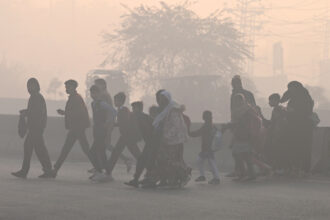


A new report on global air pollution shows that the majority of the world’s population breathes unhealthy air, and climate change is making the problem worse.
The report was published Tuesday by IQAir, a Swiss air monitor and purifier company that posts real-time air quality data aggregated from sensors around the world. It shows that in 2025, most of the world’s cities were plagued with unhealthy levels of air pollution, and that climate-driven wildfires and dust storms as well as the continued burning of fossil fuels are driving toxic air across borders and worsening the problem.
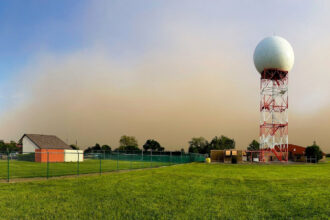
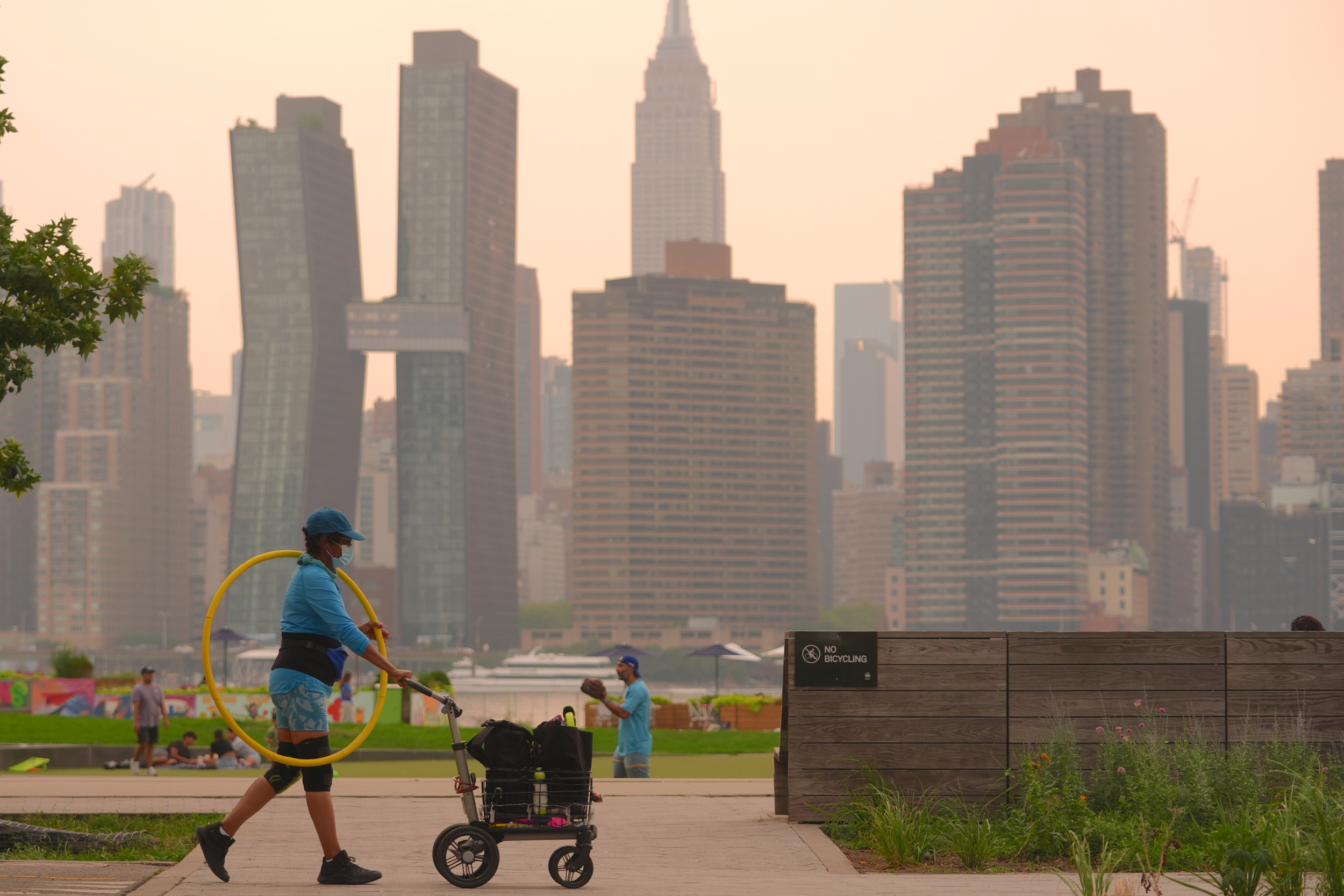
Supercharged wildfires in California, Canada and South Korea and dust storms from China to Texas last year made it harder for millions to breathe. In an era of larger and more severe weather events, living far from the pollution’s origin is no protection.
Only 14 percent of the more than 9,000 cities included in the report met the World Health Organization’s target level for toxic particulate matter pollution. Canadian wildfires, intensified by climate change, led to deteriorating air quality in regions previously seeing improvements.
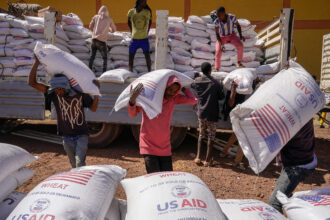
The report also found that global disparities in access to pollution data are a persistent problem, particularly in Africa, Latin America and West Asia, which have less robust networks for air quality monitoring. The problem was exacerbated last year by the U.S. Department of State’s decision to stop monitoring global air quality data from embassies and diplomatic posts.
The report’s results have broad implications for global health. Fine particulate matter, or PM2.5, is a mix of tiny particles of soot, smoke and other substances. Smaller than 2.5 micrometers, they can infiltrate the lungs and bloodstream, causing widespread health harms—from cardiovascular damage and respiratory distress to premature death.
PM2.5, the report’s focus, is only one kind of harmful air pollution. The WHO estimates that 4.2 million deaths annually worldwide are caused by fossil-fuel-driven ambient air pollution, including ozone and nitrogen dioxide.
“Air quality is a fragile asset,” said Christi Chester-Schroeder, senior air quality science manager at IQAir and the report’s primary author. “Even places that typically experience good quality air, it’s not guaranteed.”
Pollution Crossing Borders
The report includes 2025 particulate matter pollution data from 9,446 cities across 143 countries, using a combination of regulatory grade and low-cost sensors hosted by governments, nongovernmental organizations and communities. While some regions saw gains in air monitoring and decreased pollution, the majority of the world is still experiencing bad, sometimes worsening air quality and insufficient data.
Of the 1,264 cities included across East Asia, the 406 cities in Southeast Asia and the 103 in West Asia, which includes parts of the Middle East, not one city met the WHO recommended target for safe air.
In China, the country with the highest national average for particulate matter in East Asia, pollution was driven primarily by coal combustion and power plants, industrial emissions, transportation, rural biomass and dust storms intensified by climate change, the report found. Intense dust storms also led to significant spikes in air pollution in West Asia.
In Southeast Asia, Laos, Cambodia and Indonesia saw the most substantial improvements in air quality, while residents of Vietnam, Singapore and the Philippines experienced worsening air. Transboundary haze remained prevalent across the region, reinforcing the importance of cooperative international efforts to reduce pollution.
“Air pollution doesn’t respect borders,” Chester-Schroeder said. “We’ve always seen this sort of transboundary pollution, but in a lot of places it’s getting more intense, and more people are paying attention to it.”
Seventeen of the world’s 20 most polluted cities in 2025 were in Central and South Asia, and Pakistan topped the list as the world’s most polluted country, in a population-weighted ranking. A combination of industrial and transportation emissions, brick kilns, construction dust and seasonal crop burning drove the region’s pollution, the report found.
In Canada and the United States combined, 23 percent of cities met WHO standards—down from 29 percent in 2024. The climate-change-fueled Canadian wildfires last year drove much of the pollution increase.
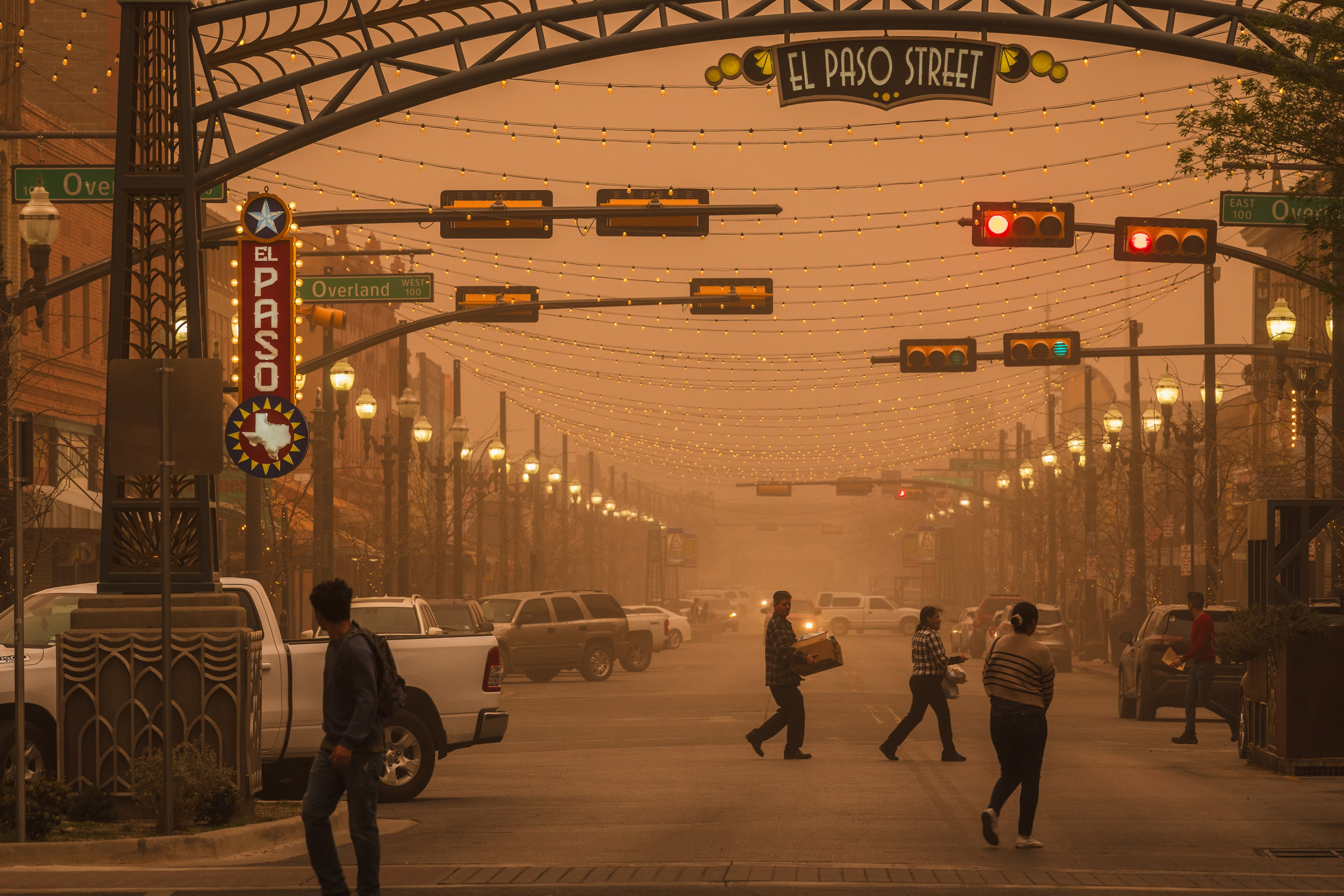
The report ranked El Paso, Texas, the most polluted major city in the U.S., ahead of Los Angeles and Chicago. In 2025, El Paso saw a 46 percent increase in PM2.5 levels, driven largely by dust storms worsened by drought and climate change. Last year was “exceptionally dusty” in El Paso, wrote Tom Gill, professor of environmental science and engineering at the University of Texas at El Paso, in an email.
“In terms of dust, 2025 was off the charts high in El Paso—the worst in decades, in some ways the worst since the Dust Bowl 90 years ago,” he said.
The report also highlighted significant global disparities in access to air quality data. Canada and the U.S. made up 54 percent of global air monitoring stations included in the report, far outstripping their share of the population. Meanwhile, the monitoring stations the report tracked in Africa, which has nearly 20 percent of the world’s population, make up just 1 percent of global monitoring capacity.
Insufficient, unequal air quality data can both hinder long-term policy solutions and prevent people from getting crucial information about the risks in their daily lives, said Laura Kate Bender, vice president of nationwide advocacy and public policy for the American Lung Association.
“It’s hard to clean up what you can’t measure,” Bender said. “But even before that … people have a right to know what’s in the air that they’re breathing, and any step back from that can result in harm to people’s health.”
Pallavi Pant, an environmental health scientist and head of global initiatives at the Health Effects Institute, a nonprofit research organization that studies global air quality data, warned against making comparisons across countries and regions with the report’s data, given that some countries had no data. She added that the accuracy of low-cost sensors can vary.
“Despite significant progress in the last decade, there are several regions and countries where there is limited ground monitoring data,” Pant wrote in an email. “Many of the data scarce regions are also in areas with relatively high air pollution levels and in some cases, high population density.”
This story is funded by readers like you.
Our nonprofit newsroom provides award-winning climate coverage free of charge and advertising. We rely on donations from readers like you to keep going. Please donate now to support our work.
Donate NowChester-Schroeder said IQAir aims to track as many cities as possible while maintaining quality standards.
“The objective is for information,” she said. “We want to provide as much high quality and as accurate as possible air quality data for as many people in the world as we can.”
“Regulatory Backsliding” in the U.S.
Since President Donald Trump was inaugurated in January 2025, the federal government has rolled back air pollution standards, prioritized coal-fired power generation, cut funding for clean energy projects and pulled the U.S. out of the global climate treaty, the Paris Agreement.
Chester-Schroeder said it was too soon to see how U.S. federal policy changes would be reflected in the data. “These things move slowly,” she said. “But we’re seeing the steps that are regulatory backsliding.”
Under Trump, the U.S. Environmental Protection Agency has sought to rescind a stronger annual standard for PM2.5 pollution set by the Biden administration in 2024 at 9 micrograms of the pollutant per cubic meter of air, still well above the WHO’s annual guideline of 5 micrograms per cubic meter.
Annual PM2.5 averages for the U.S. rose 3 percent in 2025, to 7.3 micrograms per cubic meter. Some cities in California recorded levels nearly double that figure.
Even low levels of exposure to air pollution can have a big impact, said New York University professor George Thurston, an expert on air pollution and health. “Any amount of air pollution is detrimental to your health. We haven’t been able to find a threshold below which there are no adverse effects.”
“Most people think, ‘Oh, well, the big problem with air pollution is your lungs,’ and it is a problem, but actually, most of the deaths from air pollution are cardiovascular, and it’s because of this long-term, accumulated exposure that you get throughout your life,” he said.
The type of pollution matters, too, he said. Pollution created by burning fossil fuels is particularly harmful.
Thurston was concerned about IQAir’s choice to display countries and cities with PM2.5 levels from 5.1 to 10 micrograms per cubic meter with the color green. Countries and cities with PM2.5 levels up to 5 micrograms per cubic meter were colored blue. “When you look at the visuals, it’s almost like dismissing the problem,” he said.
People have positive associations with the color green, he noted. But some of the places labeled green in this report recorded PM2.5 levels at double the WHO standard.
Thurston sees this problem with many air quality indexes. This year, the WHO published a report on best practices for these indexes.
Chester-Schroeder said IQAir used those colors because they are similar to the scale used by the U.S. Air Quality Index, the tool most Americans are familiar with. She acknowledged that it’s an ongoing debate in the field.
“There’s a huge discussion in the community right now of, ‘How do you actually do this? How do you communicate air quality to a global audience?’” she said. Countries use different standards, and research on the health risks is constantly evolving. “Communicating air quality is not a trivial task, because it can be very abstract. It’s always a work in progress.”
Inside Climate News reporter Martha Pskowski contributed reporting to this story.
About This Story
Perhaps you noticed: This story, like all the news we publish, is free to read. That’s because Inside Climate News is a 501c3 nonprofit organization. We do not charge a subscription fee, lock our news behind a paywall, or clutter our website with ads. We make our news on climate and the environment freely available to you and anyone who wants it.
That’s not all. We also share our news for free with scores of other media organizations around the country. Many of them can’t afford to do environmental journalism of their own. We’ve built bureaus from coast to coast to report local stories, collaborate with local newsrooms and co-publish articles so that this vital work is shared as widely as possible.
Two of us launched ICN in 2007. Six years later we earned a Pulitzer Prize for National Reporting, and now we run the oldest and largest dedicated climate newsroom in the nation. We tell the story in all its complexity. We hold polluters accountable. We expose environmental injustice. We debunk misinformation. We scrutinize solutions and inspire action.
Donations from readers like you fund every aspect of what we do. If you don’t already, will you support our ongoing work, our reporting on the biggest crisis facing our planet, and help us reach even more readers in more places?
Please take a moment to make a tax-deductible donation. Every one of them makes a difference.
Thank you,

Kiley Bense
Senior Editor
Kiley Bense is a senior editor at Inside Climate News. She was previously the Pennsylvania reporter, covering climate change and the environment with a focus on politics, energy, pollution and public health, and reporting on everything from fracking and steel to plastics, wildlife and extreme weather. Her past work has appeared in the New York Times, the Atlantic, Smithsonian Magazine, the Believer, and Sierra Magazine, and she holds master’s degrees in journalism and creative writing from Columbia University. She is based in Pennsylvania.

Keerti Gopal
Reporter, Health and Justice
Keerti Gopal covers intersections between climate change, public health and environmental justice at Inside Climate News. Previously, she covered climate activism and movement repression. She is a National Geographic Explorer and has received fellowships from Fulbright, the Solutions Journalism Network, The Lever, and the National Press Foundation.