


The Trump administration is turning to the nuclear option on endangered-species protections in the name of national security.
A rarely tapped panel nicknamed the “God Squad” will meet Tuesday to discuss whether overriding Endangered Species Act regulations for all federally regulated fossil fuel operations in the Gulf of Mexico is more important than preventing the extinction of several imperiled species. That includes sea turtles and a whale species down to its last 51 individuals.
Interior Secretary Doug Burgum announced the upcoming Endangered Species Committee meeting last week, with no details on specific projects in the Gulf or the basis for what would constitute an extraordinary action. Only twice in the panel’s nearly half-century has it ever lifted restrictions.
But after the nonprofit Center for Biological Diversity filed a lawsuit in an attempt to block the meeting, the Trump administration told the court that Defense Secretary Pete Hegseth wanted all federal oil and gas activities in the Gulf exempted “for reasons of national security.”
A federal judge declined Friday to block the meeting.

“It’s disappointing that the court didn’t immediately stop Hegseth’s reckless power grab, but this is just the first battle in a longer fight to protect the Gulf’s endangered whales and turtles,” Brett Hartl, government affairs director at the Center for Biological Diversity, said in a statement.
The situation puts the country in uncharted waters. No administration has ever before requested a national security exemption from endangered-species protections.
It’s a challenging case to make. U.S. oil production is hovering around record highs. Companies working offshore in the Gulf’s federal waters produced 1.9 million barrels of oil per day last year, and that’s with endangered-species protections in place, which require companies to minimize their impact on animals rather than limiting or prohibiting oil and gas operations altogether.
Experts also say it’s doubtful that increasing oil production there would have any immediate benefits to national security.
But it does align with President Donald Trump’s “drill, baby, drill” platform. His administration has called for much more production—especially after gas prices soared since he authorized strikes on Iran in February. The federal Bureau of Ocean Energy Management approved a $5 billion deepwater oil drilling project in the Gulf this month.
Though the committee meeting is moving forward, the Trump administration skipped several usual steps in the process, experts say.
“It was written to be a rare but necessary emergency escape clause when there was no alternative and human welfare was desperately at issue,” said Zygmunt Plater, a professor at Boston College Law School. “This is not carefully done. This is the antithesis of the way the God committee has worked in the past.”
How the “God Squad” Works
Plater was lead counsel in a high-profile 1970s lawsuit that gave rise to the creation of the Endangered Species Committee. A dam under construction in Tennessee, his legal team and environmentalists in the area argued, would threaten a tiny endangered fish called the snail darter.
Many saw this “Tellico Dam vs. the Snail Darter” case as the first real test of the Endangered Species Act’s powers. It eventually reached the Supreme Court, where the justices ruled in favor of the snail darter. Based on the law’s wording, they said, the government must protect an endangered species “whatever the cost.”
This powerful language prompted Congress to pass an amendment in 1978 creating the committee as an extreme measure to override endangered species protections in specific cases with major implications for the U.S. economy and welfare.
The committee is composed of several top officials, including the heads of the Interior Department, the U.S. Department of Agriculture, the Army, the Council of Economic Advisers, the Environmental Protection Agency and the National Oceanic and Atmospheric Administration.
Ironically, even this new entity sided with the fish—or, at the very least, against the dam.
“They had just figured out … that the cost of the dam was actually greater than the benefits, even putting aside the fish,” said Daniel Farber, a law professor at the University of California, Berkeley. (Construction was eventually completed anyway after Congress tucked an exemption for it in a budget bill.)
Since then, the God Squad has only been convened a handful of times. Just two exemptions have ever been granted, once for a dam in endangered whooping cranes’ habitat in the Great Plains region and another for proposed federal timber sales in Oregon, which would have affected threatened northern spotted owls. The God Squad voted to permit some of the timber sales, but the agency involved later withdrew its exemption request.
It’s been decades since the committee was last brought together.
The only parties that can request an exemption are federal agencies proposing an action, the governor of the state in which the action is proposed or the entity seeking a permit related to an agency action.
Before that point, as part of the normal endangered-species process for a federal action, government researchers perform rigorous analyses to forecast project impacts, creating what’s called a “biological opinion.” In it, they typically outline mandatory measures that could mitigate threats to endangered species.
In very rare cases, agencies conclude a federal action cannot be conducted without jeopardizing an endangered animal or plant. That’s when the God Squad comes into play.
Similar to a trial, the officials call in a range of experts—from economists to biologists—to testify on the project impacts. By the end, the committee must be able to answer two major questions: Is there a “reasonable and prudent” alternative? If not, do the pros outweigh the cons for the public?
That’s why it’s called the God Squad. There is a very real possibility a species could go extinct if the project moves forward, even if the committee still requires some level of mitigation measures.
The Trump administration said in a court filing this week that it would bypass the evidentiary hearing meant to inform the committee’s decision.

“It’s almost impossible to believe that there would be a project that couldn’t be altered in a way that would allow for the promotion of an endangered or threatened species,” said Rob Verchick, an environmental law expert at Loyola University New Orleans. “One thing I think we do know is that when Congress created this committee, it was seen as being an alternative of very last resort.”
Recent actions suggest the Trump administration doesn’t see it that way.
Energy vs. Extinction?
On Trump’s first day back in office last year, he declared a “National Energy Emergency” and directed the Interior secretary to convene the committee “not less than quarterly” to review applications or “identify obstacles to domestic energy infrastructure specifically deriving from implementation of the [Endangered Species Act] or the Marine Mammal Protection Act.”
While that hasn’t occurred—publicly, at least—the administration is now moving forward with its first God Squad meeting on March 31, which will be livestreamed at 9:30 a.m. Eastern.
This story is funded by readers like you.
Our nonprofit newsroom provides award-winning climate coverage free of charge and advertising. We rely on donations from readers like you to keep going. Please donate now to support our work.
Donate NowThe initial announcement of the meeting “seemed a little ridiculous, frankly, because there hadn’t been the proper procedural requirements to allow for a convening,” said Verchick, who served in the EPA during the Obama administration. In an interview before the administration’s court filing raised the specter of national security, he added: “It’s so unusual that they’re not even talking about what the individual project is that they’re concerned about. And then they’re not even talking about the individual animals that are, in theory, posing a barrier to whatever the project is.”
Christopher Danley, senior counselor to the Secretary of the Interior, argued in that court filing Wednesday that no exemption application or applicant is necessary due to the national security determination.
Verchick said over email the next day that the section of the law cited in the legal filing “does not relieve Secretary Hegseth from having to issue a valid exemption application.” Instead, it “directs how the Committee must respond upon receiving a valid exemption application that asserts an exemption is necessary for national security.”
He added that the Department of Defense “does not appear to have submitted a valid exemption application or report. There’s no evidence of an application or report at all. If the application exists, it was submitted too late.”
Asked about that, the Defense Department did not respond. The Interior Department also did not answer questions from Inside Climate News.
The sprawling nature of the exemption the agency seems to be seeking for all federal oil and gas activities in the Gulf could make it more difficult to secure, said Farber, the UC Berkeley professor.
“That’s sort of characteristic of the administration, you know, go big,” he said. “But on the other hand, it may make it more vulnerable than a more targeted exemption request.”
Even amid the conflict in Iran, it might also be challenging for the federal government to justify why overruling endangered species regulations in the Gulf will support national security, according to Charles McConnell, the executive director for the Center for Carbon Management in Energy at the University of Houston.
“If this is simply being looked at as a visceral reaction to the prices at the pump, and people want to see this announcement as something that’s going to make gasoline prices less next week, that’s absurd,” he said. “Last time I looked, we weren’t actually running short [on oil] at all.”
Instead, McConnell thinks this move could be the Trump administration’s way of showing it is “100 percent behind the oil and gas community.”
“It’s about power and control,” he said. “It’s more political than it is energy security.”
The Gulf of Mexico hosts one of the highest concentrations of offshore fossil fuel infrastructure in the world, with about 3,500 oil and gas structures and tens of thousands of inactive wells. Trump is looking to open up oil and gas operations by around 1.27 billion acres of federal waters in the Gulf, off California and along Alaska’s coast.
However, NOAA issued a biological opinion 10 months ago, finding that collisions with oil industry boats in the Gulf of Mexico could jeopardize the continued survival of the endangered Rice’s whale. At night, the whales spend most of their time within 50 feet of the water’s surface.
Some 51 remain, so even the loss of a single whale could have outsized effects on the population.
The analysis also found that noises from oil and gas construction or other activities are “likely to result in chronic stress” for the Rice’s whales and many other species in the area, including endangered sperm whales and five imperiled species of sea turtles.
Another profound—and potentially extinction-level—risk? Oil spills, as evidenced by the 2010 BP Deepwater Horizon catastrophe. The largest marine oil spill in U.S. history, the offshore drilling rig explosion killed 11 people directly and dumped more than 210 million gallons into the Gulf.
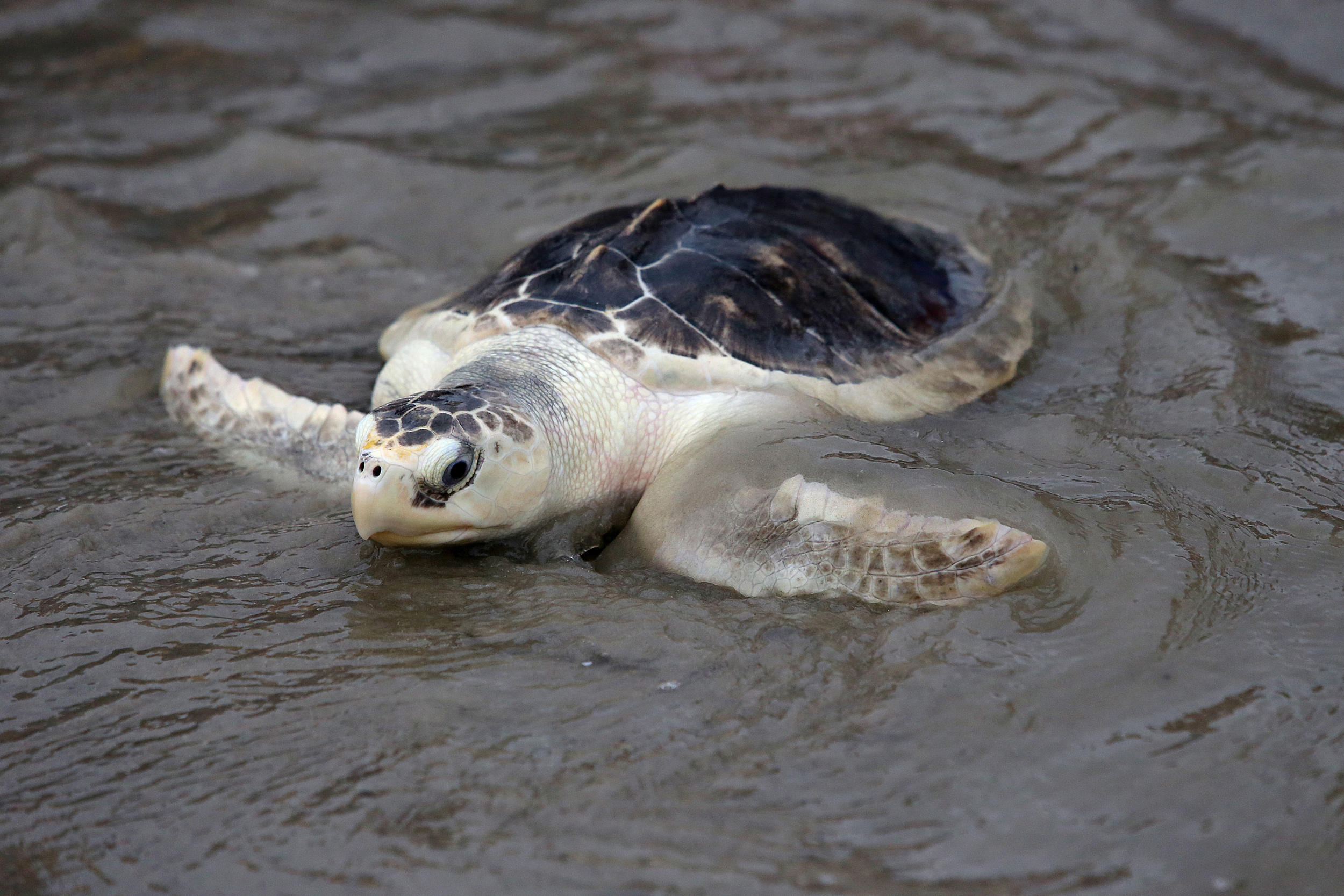
Sea turtles suffocated under sludge. Poisoned seabirds washed up by the hundreds on Louisiana shores. The spill killed an estimated 20 percent of the Rice’s whale population. Researchers, nonprofits and local volunteers are still cleaning up the aftermath of the spill in Gulf coastal ecosystems 16 years later.
Now, oil rigs in the region face stricter regulations to ensure their systems are up to date. They are also required to comply with Endangered Species Act requirements to minimize their impacts on vulnerable animals. The latest jeopardy finding for the Rice’s whale says boats should immediately begin using technology to avoid vessel strikes and monitor for the presence of the animal.
But Trump has rolled back many environmental protections he thinks stand in the way of oil. He scrapped drilling prohibitions in ecologically sensitive areas. His offshore fossil fuel expansion plan, the Center for Biological Diversity estimated, could trigger thousands of oil spills across the country, based on average spill rates in recent decades. And his administration rescinded guidance in February for oil and gas vessels to slow down in the western Gulf to avoid hitting whales.
The God Squad could remove other regulations on industry activities. Given that this national security exemption is unprecedented, only time will tell how it plays out, Farber said. But he expects further litigation.
The Trump administration has “a real advantage going in, because it’s [claiming] national security, but they’re really pressing that to kind of its far limits,” he said.
Plater said the Endangered Species Act is one of the few laws that allows citizens to increase enforcement through substantive actions. He’s seen this firsthand: The snail darter case that threw the law into the public spotlight decades ago was spurred by an idea from one of his law students for a paper.
In his view, the committee that grew out of that case is for the most part “a very fair, careful bypass” for extreme scenarios.
Now, however, Plater fears it will be “weaponized to roll back citizen enforceable protections for all the endangered and threatened species in the Gulf.”
“This is not just talking about a whale and the need for fossil fuels. It is just one more act in a political quashing of citizen involvement in statutory enforcement and protection of public values,” he said. “Scratch away at almost any environmental controversy, and pretty soon you’re looking at big questions of democratic governance.”
About This Story
Perhaps you noticed: This story, like all the news we publish, is free to read. That’s because Inside Climate News is a 501c3 nonprofit organization. We do not charge a subscription fee, lock our news behind a paywall, or clutter our website with ads. We make our news on climate and the environment freely available to you and anyone who wants it.
That’s not all. We also share our news for free with scores of other media organizations around the country. Many of them can’t afford to do environmental journalism of their own. We’ve built bureaus from coast to coast to report local stories, collaborate with local newsrooms and co-publish articles so that this vital work is shared as widely as possible.
Two of us launched ICN in 2007. Six years later we earned a Pulitzer Prize for National Reporting, and now we run the oldest and largest dedicated climate newsroom in the nation. We tell the story in all its complexity. We hold polluters accountable. We expose environmental injustice. We debunk misinformation. We scrutinize solutions and inspire action.
Donations from readers like you fund every aspect of what we do. If you don’t already, will you support our ongoing work, our reporting on the biggest crisis facing our planet, and help us reach even more readers in more places?
Please take a moment to make a tax-deductible donation. Every one of them makes a difference.
Thank you,

Kiley Price
Reporter
Kiley Price is a reporter at Inside Climate News, with a particular interest in wildlife, ocean health, food systems and climate change. She writes ICN’s “Today’s Climate” newsletter, which covers the most pressing environmental news each week.
She earned her master’s degree in science journalism at New York University, and her bachelor’s degree in biology at Wake Forest University. Her work has appeared in National Geographic, Time, Scientific American and more. She is a former Pulitzer Reporting Fellow, during which she spent a month in Thailand covering the intersection between Buddhism and the country’s environmental movement.