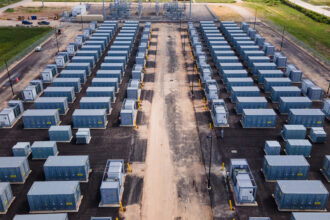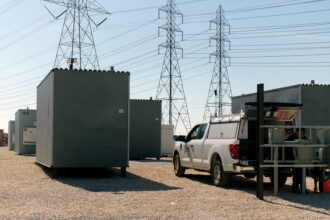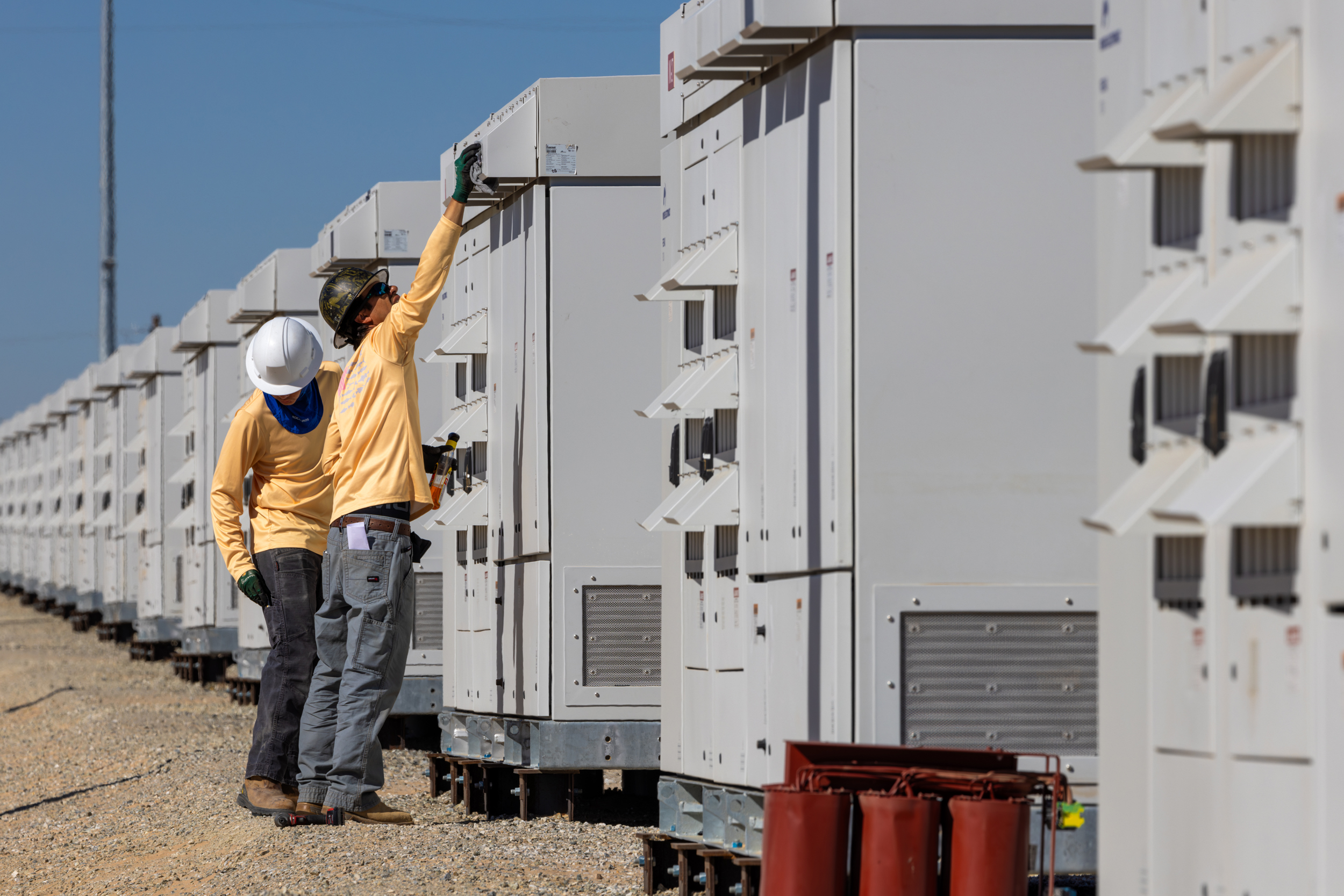


On a recent evening, batteries were the broad shoulders propping up California’s electricity grid.
The state got 43 percent of its power from batteries as of 7 p.m. on Sunday, more than double the next power source, natural gas. It was record-setting output for batteries in the California grid, said Nicolas Fulghum, senior data analyst for Ember, an energy think tank, in a Bluesky post.
Despite this strong showing in California, Texas has raced ahead to become the country’s leader in battery capacity, passing California by a nose as of February. I’ll get into the numbers in a moment.
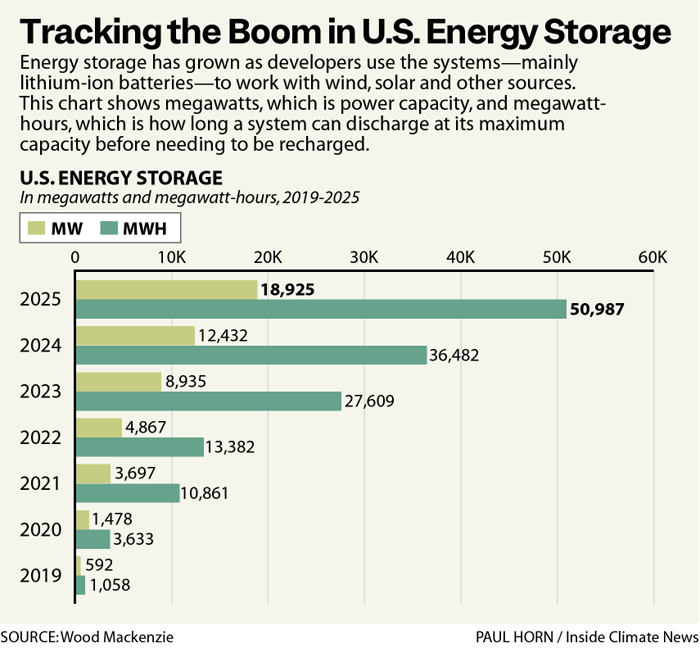
I remember when utility-scale batteries seemed to always be a few years away from viability. By about 2020, though, it was clear that a market had emerged as batteries reached 1,000 megawatts of utility-scale capacity.
The growth has accelerated ever since. The country added 18,925 megawatts of battery storage last year, a 52 percent increase from the prior year, according to a report issued last week by Wood Mackenzie and the American Clean Power Association. The total includes utility-scale systems and those in homes and businesses.
This boom follows a decrease in lithium-ion battery prices and rising demand for energy storage, as grid operators look for resources that can work with wind and solar.
Batteries also have a policy advantage under the Trump administration. The One Big Beautiful Bill Act, signed last year, included a phaseout of tax credits for investment in wind and solar projects and for consumer purchases of EVs, but it left the tax credit for energy storage intact.
“The White House does not have any problem with batteries,” said Pavel Molchanov, a power and renewables analyst for Raymond James, a financial services firm.
It’s unclear how the battery market will be affected by a provision in the new law that limits the use of parts sourced from China and other “prohibited foreign entities.” China is the world’s leading battery manufacturer. Molchanov said he expects that retaining the tax credit will help counteract other factors, such as the “foreign entities” rules and tariffs, but, he added, it will take time to assess the full effects.
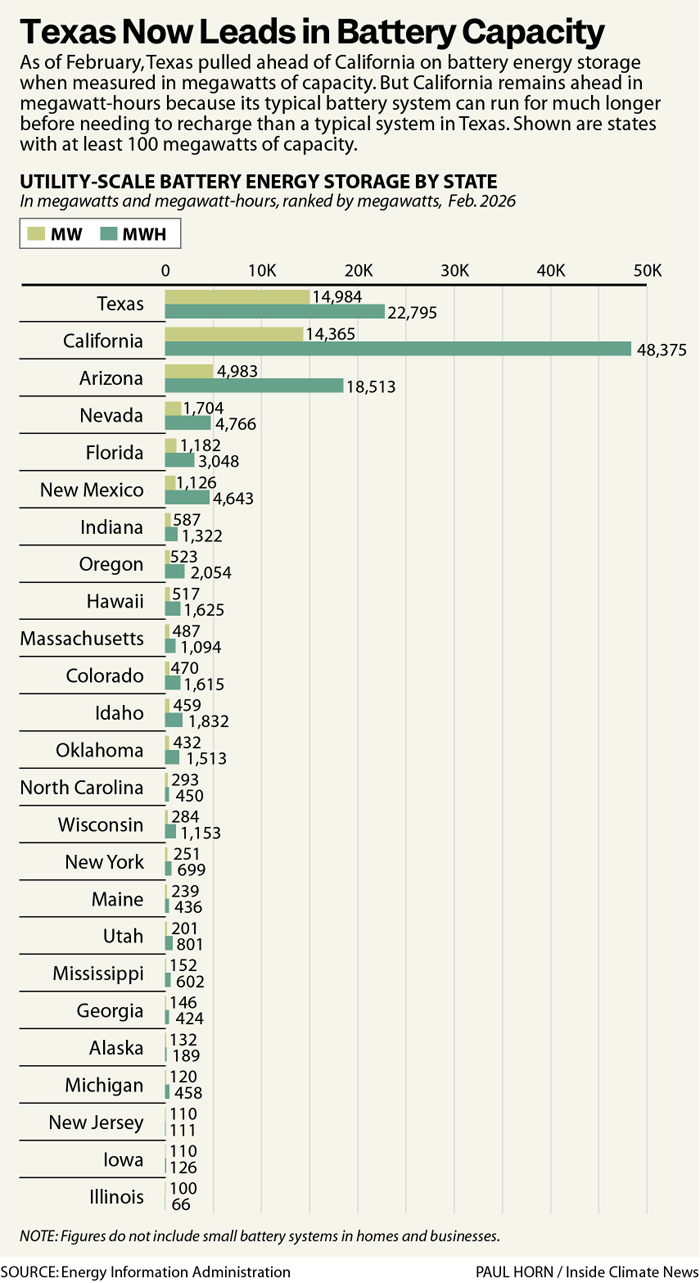
Texas stands out as a focal point for recent battery development. In February, the state passed California to become the country’s leader in battery storage capacity, with 14,984 megawatts in Texas and 14,365 megawatts in California, based on an analysis of U.S. Energy Information Administration data.
If this sounds familiar, it’s probably because Texas just passed California in 2025 to become the country’s leader in utility-scale solar.
Now’s a good time to explain the two main ways of showing the size of a battery storage system. First is megawatts of capacity, which is the maximum power output at any given moment. Second is megawatt-hours, the amount of electricity a system can discharge before it needs to be recharged. If a project has 10 megawatts and 40 megawatt-hours, it can run for four hours at full power.
While California no longer leads in megawatts, it still leads in megawatt-hours. That’s because the average utility-scale system in California runs for about three hours, which is about twice as long as the average in Texas.
Why the big difference? I asked Allison Feeney, an energy storage analyst at Wood Mackenzie, a research firm covering energy markets.
California’s batteries tend to run longer on a charge because of policies that encourage construction of four-hour systems, she said. In contrast, Texas’ market has favored systems with shorter bursts of power.
Geography plays a role. Texas is wide and it has substantial wind and solar resources in the central and western parts of the state that can produce power during peak early-evening hours for use by population centers in the east, Feeney said. California, with most of its population near the West Coast, can’t do this.
As energy storage grows, it likely will take market share away from natural gas peaker plants, which are among the most expensive and polluting plants, designed to fire up for a few hours at a time.
“It’s cheaper because you’re not spinning up those expensive peakers,” Feeney said.
This story is funded by readers like you.
Our nonprofit newsroom provides award-winning climate coverage free of charge and advertising. We rely on donations from readers like you to keep going. Please donate now to support our work.
Donate NowSo far, I’ve focused on battery storage, since that is nearly all of what’s been built in the United States in recent years. But before the rise of batteries, the energy storage leader was pumped hydropower, which has 22,224 megawatts of capacity, with the most recent project coming online in 2002.
Utility-scale batteries now have about double the capacity of pumped hydropower. Batteries will continue to dominate the energy storage market, but pumped hydropower is not finished growing. I wrote recently about how several pumped hydro projects are in development.
Many other energy storage technologies are in various stages of research and development but haven’t yet reached the market at scale. This is part of a race to develop systems that can run at the lowest cost and for a variety of durations.
Looking ahead, Wood Mackenzie projects continued growth in 2026 compared to 2025, with a 4 percent increase in megawatts and a 27 percent increase in megawatt-hours.
The factors driving the increase include rising electricity demand from data centers and other large users, availability of tax credits and a robust supply of batteries, Feeney said.
“All those factors combined are making a very, very strong case for storage over the next five years,” she said.
Other stories about the energy transition to take note of this week:
Onshore Wind Projects Wait as Pentagon Reviews Stall: At least 30 onshore wind farms are being forced to wait for approvals from the Pentagon that used to be routine, as Amy Harder reports for Axios. The reviews are supposed to make sure that wind projects don’t interfere with military radar or aviation systems, but it looks like they’ve turned into a stonewalling tactic for an administration that doesn’t like wind power.
China’s EV Companies Are Making a Profit in Addition to Making Cars: Leapmotor, Nio and Xpeng are three EV manufacturers based in China that have recently released financial results showing a profit after prior losses, as Suvrat Kothari reports for InsideEVs. They join fellow Chinese automakers, such as BYD, that were already profitable, showing that it’s possible to make money selling electric cars even as automakers in other countries struggle to do so.
States Lift Their Bans on Nuclear Power: Five states (Wisconsin, Kentucky, Montana, West Virginia and Illinois) have lifted moratoria on building new nuclear power plants in the last five years, and another five (California, Massachusetts, Minnesota, New Jersey and Vermont) have pending legislation that would do the same, as Alexander C. Kaufman reports for Canary Media. The current legislation may indicate that blue states, which once opposed the expansion of nuclear energy, are now open to the power source amid surging electricity demand.
A Court Allows Alabama Power to Keep Its Unusually High Solar Fee: A federal judge has ruled that the utility Alabama Power can continue to charge rooftop solar owners one of the highest fees in the country, as my colleague Dennis Pillion reports for ICN. The fee, which averages about $40 per month, may be one reason that Alabama ranks near the bottom of the country in rooftop solar ownership. Utilities say solar fees are necessary so that solar customers pay an appropriate share of the cost of grid infrastructure. Solar advocates disagree and say these policies are an attempt to discourage a competing energy source.
Inside Clean Energy is ICN’s weekly bulletin of news and analysis about the energy transition. Send news tips and questions to [email protected].
About This Story
Perhaps you noticed: This story, like all the news we publish, is free to read. That’s because Inside Climate News is a 501c3 nonprofit organization. We do not charge a subscription fee, lock our news behind a paywall, or clutter our website with ads. We make our news on climate and the environment freely available to you and anyone who wants it.
That’s not all. We also share our news for free with scores of other media organizations around the country. Many of them can’t afford to do environmental journalism of their own. We’ve built bureaus from coast to coast to report local stories, collaborate with local newsrooms and co-publish articles so that this vital work is shared as widely as possible.
Two of us launched ICN in 2007. Six years later we earned a Pulitzer Prize for National Reporting, and now we run the oldest and largest dedicated climate newsroom in the nation. We tell the story in all its complexity. We hold polluters accountable. We expose environmental injustice. We debunk misinformation. We scrutinize solutions and inspire action.
Donations from readers like you fund every aspect of what we do. If you don’t already, will you support our ongoing work, our reporting on the biggest crisis facing our planet, and help us reach even more readers in more places?
Please take a moment to make a tax-deductible donation. Every one of them makes a difference.
Thank you,

Dan Gearino
Reporter, Clean Energy
Dan Gearino covers the business and policy of renewable energy and utilities, often with an emphasis on the midwestern United States. He is the main author of ICN’s Inside Clean Energy newsletter. He came to ICN in 2018 after a nine-year tenure at The Columbus Dispatch, where he covered the business of energy. Before that, he covered politics and business in Iowa and in New Hampshire. He grew up in Warren County, Iowa, just south of Des Moines, and lives in Columbus, Ohio.