

The world’s forests are simultaneously climate powerhouses and victims, sucking carbon from the air while facing myriad global warming impacts—from wildfires to pest outbreaks.
Recent research found that climate change is already driving widespread disturbances in European forests and, by the end of the century, will likely transform the landscapes that communities depend on.
My colleague Bob Berwyn has been covering climate science and forests for decades, and recently wrote a story about this unsettling forest forecast. I asked Bob to tell me more about how he first got started reporting on forests—which are much more diverse than people may realize—and explain what this research could mean for the future of these critical ecosystems.
When did you first become interested in forests?
I’ve been interested in forests since I was very young and wanted to know where they came from and why they grew in some places and not others, so I started learning about the geological history of Earth, and how forests grew after big glaciers and ice sheets retreated from North America and Europe.
And for me, growing up in a part-European culture, forests were also places that held mysterious and powerful life forces, manifesting in stories about fairies and druids.
Have there been any moments that really struck you while reporting on climate change’s impact on forests?
In the early 2000s, my 11-year-old son asked why all the huge pine forests around our Colorado neighborhood were turning brown and red. I was reporting on a destructive epidemic of pine beetles that was causing the die-off, but it was still hard to describe to Dylan how climate change had tipped the balance against trees that had stood for a century or more, and were part of his outdoor playground growing up.
The overwhelming outbreak killed about 90 percent of mature lodgepole pines growing across millions of acres in less than a decade. All the scientists studying the event pointed at a warming climate and more severe droughts as the trigger, stressing trees and promoting beetle reproduction, a double whammy.
A few days after my son’s question, I took him along to an interview with a U.S. Forest Service scientist in an area where the bugs were spreading, along Swan Mountain Road, near a favorite patch of edible mushrooms scattered through thin tufts of grass and pine needles on the forest floor. About half the trees were already marked as dead by their rust-colored needles, and the rest were doomed.
It was hot and windless. At one point, the scientist asked us to stop talking and listen. After a few seconds, we heard and felt a faint, pulsing vibration—the sound, she said, of millions of beetles chewing through the nutrient-carrying phloem layer just beneath the bark.
The damage was mostly invisible, but it was happening everywhere at once. The researcher explained that spring had come so early and summer lasted so long that the insects were breeding an entire second generation within the seasonal cycle, something that had never been recorded before the 1980s. That all but guaranteed that the remaining trees would be overwhelmed, and soon after, the mushroom patch would disappear.
Our sadness mirrored the collective shock of communities around the West mourning the loss of forests and landscapes that had seemed timeless, with a huge death toll of billions of long-revered trees—piñon pines, ponderosa, high elevation spruce and fir trees and even adaptable aspens all succumbing to climate-related disturbances.
How do changes in forests affect the broader landscape?
One good example is a beetle-caused die-off of piñon pines in the Southwest, also in the early 2000s. The pine nuts of the piñon were an important food source for Native American tribes in the region for thousands of years, and are still culturally important and have spiritual value. But so many of the mature seed-carrying trees died that it became nearly impossible for some people to find them.
Major changes in forests also affect the land and how water moves across it. When trees die or burn, rain falls on bare soil instead of leaves and needles, running off more quickly and carrying sediment downhill. Slopes once held together by roots can loosen. In mountain headwaters, those changes can ripple into rivers that supply farms, towns and hydropower plants far from forests.
Can you tell me about the recent study you covered on European forests?
Forest disturbance across Europe could more than double by the end of the century with continued global warming, according to the research, which published in March. The study showed how different types of climate impacts intensify each other. It focused on European forests, but there are similar processes happening everywhere around the world.
It’s a warning sign, along with a lot of other recent research, that forests and trees, in general, are struggling in a climate that’s already 2.5 degrees Fahrenheit warmer than the average climate in which these forests first started growing.
The study was interesting because it used artificial intelligence to analyze forest landscapes at a very detailed scale, down to plots the size of a couple of football fields. That level of detail helped researchers show in a spatially realistic way how the disturbances can spread.
And the conclusions are that, if warming keeps up at the current rate, there will be widespread changes, with more patchy forests, more stands of younger trees, some areas where trees will be lost for the foreseeable future, or where new types of trees move in.
Is there any way to prevent this?
If we stop burning fossil fuels and heating the planet, we can perhaps avoid some of the worst-case endings of massive, permanent forest loss, or the loss of iconic species like redwoods and giant sequoias or Joshua trees. And also, we should stop cutting down older, naturally growing forests and try to protect the forests that are left.
The good news is that forests have existed on Earth for much, much longer than humans, which means they’ve survived some pretty extreme climate cycles of warm and cold. That means they will most likely persist through the human-caused warming era. But exactly what kind of trees will grow where, and for how long, is uncertain.
Postcard From … Colorado
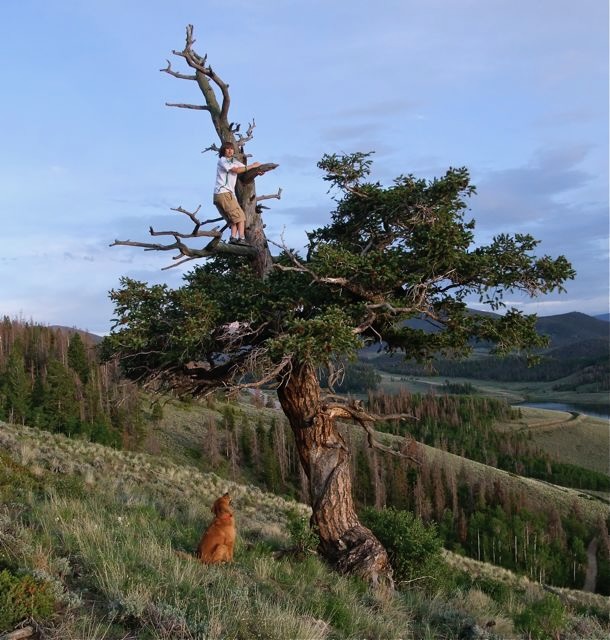
For this week’s “Postcards From,” Bob shared a photo with his son from one of their forest adventures in Colorado.
“Trees that my son climbed in the early 2000s have since succumbed to beetles, drought and extreme heat, like this centuries-old Douglas fir. In the background are stands of lodgepole pines turning brownish-orange after being killed by mountain pine beetles,” Bob said.
“This is part of a group of Douglas firs that have had core samples taken to show climate records going back a few centuries.”
About This Story
Perhaps you noticed: This story, like all the news we publish, is free to read. That’s because Inside Climate News is a 501c3 nonprofit organization. We do not charge a subscription fee, lock our news behind a paywall, or clutter our website with ads. We make our news on climate and the environment freely available to you and anyone who wants it.
That’s not all. We also share our news for free with scores of other media organizations around the country. Many of them can’t afford to do environmental journalism of their own. We’ve built bureaus from coast to coast to report local stories, collaborate with local newsrooms and co-publish articles so that this vital work is shared as widely as possible.
Two of us launched ICN in 2007. Six years later we earned a Pulitzer Prize for National Reporting, and now we run the oldest and largest dedicated climate newsroom in the nation. We tell the story in all its complexity. We hold polluters accountable. We expose environmental injustice. We debunk misinformation. We scrutinize solutions and inspire action.
Donations from readers like you fund every aspect of what we do. If you don’t already, will you support our ongoing work, our reporting on the biggest crisis facing our planet, and help us reach even more readers in more places?
Please take a moment to make a tax-deductible donation. Every one of them makes a difference.
Thank you,

Kiley Price
Reporter
Kiley Price is a reporter at Inside Climate News, with a particular interest in wildlife, ocean health, food systems and climate change. She writes ICN’s “Today’s Climate” newsletter, which covers the most pressing environmental news each week.
She earned her master’s degree in science journalism at New York University, and her bachelor’s degree in biology at Wake Forest University. Her work has appeared in National Geographic, Time, Scientific American and more. She is a former Pulitzer Reporting Fellow, during which she spent a month in Thailand covering the intersection between Buddhism and the country’s environmental movement.