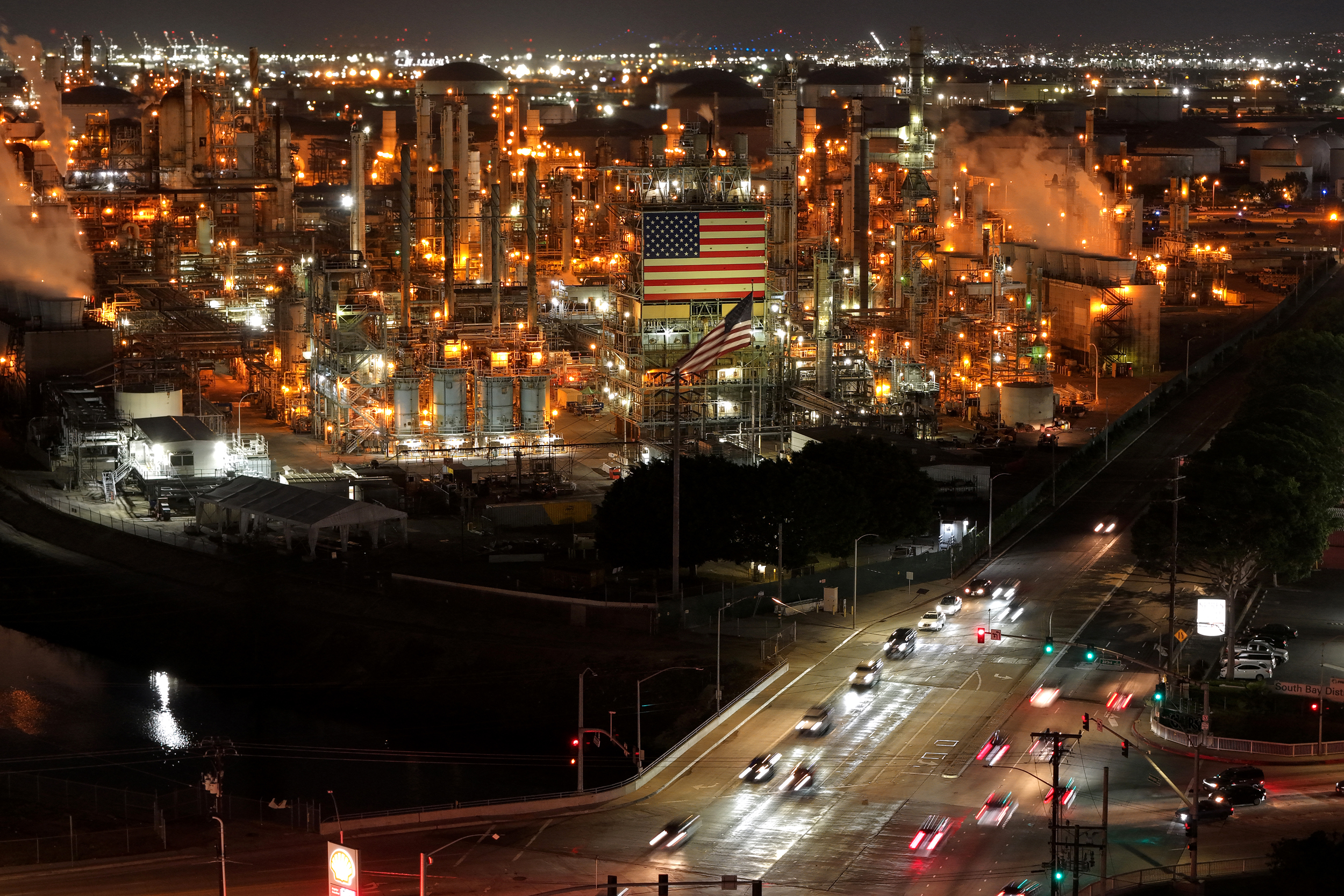


In President Donald Trump’s telling, the United States has fuel enough to hover above the chaos that his attack on Iran has triggered in global energy markets.
“We’re in great shape for the future,” Trump said in a speech last week, asserting that this nation, as the world’s biggest oil and gas producer, doesn’t rely on the tankers Iran blocked from passage through the Strait of Hormuz for the past month. “We don’t need anything they have.”
But the view is much different beneath the service station signs across the country that have flipped to more than $4 per gallon for the first time in four years. Over the past month, U.S. households paid $8.4 billion more for gasoline compared to prices before the war on Iran began, according to a report by Democrats on Congress’ Joint Economic Committee.
Under the two-week ceasefire agreement that headed off—for now—Trump’s threat to destroy “a whole civilization,” Iran was to re-open the Strait of Hormuz. But most tankers remained blocked while the sides sparred over details of the deal. Iran has made clear it intends to maintain control over the passageway for 20 percent of the world’s oil and liquefied natural gas (LNG). The oil industry reportedly was lobbying the White House to reject Iran’s bid to levy multimillion-dollar tolls on tankers to pay for post-war rebuilding, but crossing fees reportedly already were being charged.
Oil prices will remain elevated at least through the end of the year even if the conflict is fully resolved by the end of April, the U.S. Energy Information Administration said in a short-term outlook Tuesday. And key energy infrastructure—like the world’s largest LNG export terminal at Ras Laffan Industrial City in Qatar—could be hobbled for years by severe damage sustained in missile strikes.
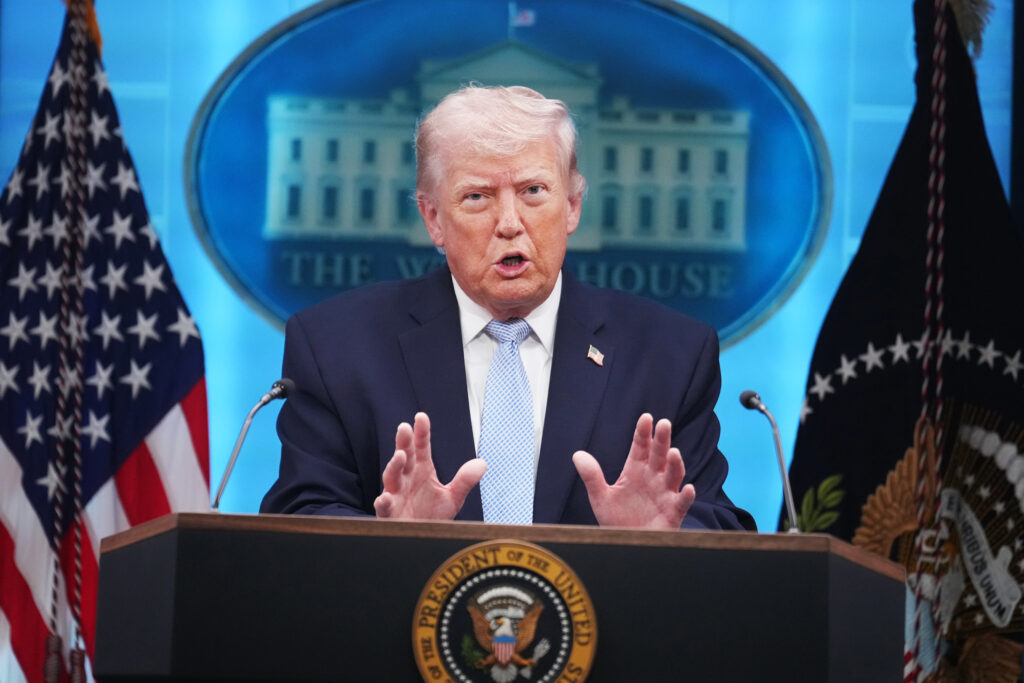
In parts of Asia, the energy shock has forced gas rationing. Across Europe, flights have been cancelled and filling stations have faced shortages. And at gasoline pumps across the United States, Americans have confronted a reality about international markets that is missing from Trump’s portrait of an energy dominant—and impervious—nation. The United States is the world’s biggest oil consumer as well as its biggest producer. And our heavy reliance on this globally traded commodity, set to grow deeper as Trump strips away policies to address climate change and suppresses clean energy, leaves us vulnerable to global disruption.
“The only way to do what the president said in his speech, which is to be completely independent and have this not matter to us at all, is to just dramatically reduce demand for oil,” said Kate Gordon, CEO of the sustainability advocacy group California Forward, who served as a senior advisor in the Department of Energy under President Joe Biden. “There’s no other policy mechanism that actually makes us independent of this system.”
But such an energy transformation couldn’t be achieved overnight, even under an administration that made it a goal. And some supporters of climate action are warning that transitioning away from fossil fuels won’t buy independence when the geopolitical order is fraying. China, for example, weaponized clean energy when it imposed restrictions on rare-earth element exports in response to U.S. tariffs under both Biden and Trump. “The clean energy transition has not eliminated geopolitical risk,” wrote Jason Bordoff of Columbia University and Meghan L. O’Sullivan of Harvard University in Foreign Affairs this week. “It has layered new vulnerabilities atop old ones.” They argue that international cooperation is crucial, in addition to simply lowering demand for energy overall.
In the meantime, the Iran war has laid bare how global energy shocks will play out in the United States despite its role as the world’s top oil and gas producer. The impacts are different for oil, natural gas and the clean energy transition.
Oil Dependence: A Tie That Binds
Although U.S. crude oil production is at record highs—currently about 13 million barrels per day—the nation still imports crude oil to meet its 20 million-barrel-per-day appetite for petroleum products (gasoline, diesel and other fuels refined from crude). Last year, crude imports totaled 6.1 million barrels per day, with about 8 percent of that coming from the Persian Gulf—mostly from Saudi Arabia and Iraq, both caught up in Iran’s chokehold on the Hormuz passageway.
The United States can call itself energy independent because its exports (10.8 million barrels per day of crude oil and petroleum products) exceed its imports. But the imports—the oil that Trump says the country doesn’t “need”—are crucially important for meeting the particular requirements of U.S. refineries—especially those on the Gulf Coast and in California.
Samantha Gross, director of the energy security and climate initiative at the Brookings Institution, explains that in the 1980s and 1990s, refineries invested in configuring their operations to process cheaper, lower-quality “heavy, sour crude”—which seemed like a good business decision at the time, since there was so much available in the market. But then, beginning in the 2010s, the fracking boom delivered a virtual gusher of “light, sweet crude” into the U.S. market. Much of U.S. international trade in oil is aimed at correcting the imbalance.
“An important part of our exports and imports are sort of swaps of higher-quality crude to buy lower-quality crude,” Gross said. That means the United States, despite its high production, is fully integrated into a global market in upheaval.
“The way that supply and demand are going to balance themselves in this post-disruption world is price,” Gross said. “And so we’re going to pay the same high oil prices everybody else is paying because we’re competing for the same oil.”
In an April 7 forecast published hours before the ceasefire deal between the U.S. and Iran, U.S. government energy experts projected that the global crude oil price, known as “Brent,” which was around $60 at the start of the year and averaged $103 per barrel in March, would rise to $115 in the coming months before falling below $90 by the end of the year. But after news of the two-week truce broke, oil marked its biggest daily decline since the COVID-19 pandemic, falling below $95 a barrel, at least temporarily. The U.S. oil price benchmark, known as West Texas Intermediate, saw the same steep rise in the past month and precipitous fall Wednesday, even while trading at a discount to Brent, as is often the case in times of global disruption.
Analysts stressed that the situation remained volatile, with questions remaining about the durability of the peace, the tolls that Iran wants to levy for tanker passage through the Strait, the lingering damage to infrastructure and other uncertainties. “The transition period itself could present the next challenge,” wrote Janiv Shah, a commodity markets vice president at Rystad Energy.
Drivers on the West Coast have seen the worst price jumps in the United States, with the average price of a gallon of regular gasoline reaching $5.40 per gallon at the start of this week, about 30 percent higher than the U.S. average. That is largely because the most-populous state is not connected to other U.S. supply centers by pipelines and its refineries rely heavily on imports. It’s one of the details that Trump overlooked when he said the U.S. doesn’t need oil from the Strait of Hormuz, Gordon said. “A lot of this depends on infrastructure and geography.”
Gasoline prices were up about 40 percent since the start of the war, but other petroleum fuels saw more dramatic run-ups, according to EIA data. Diesel fuel was up close to 50 percent—adding to trucking costs, which get passed along to consumers in higher prices for food and goods. Jet fuel was up 65 percent, according to EIA. United Airlines CEO Scott Kirby told his employees in an open memo that if prices stayed at this level, the company would face $11 billion in additional jet fuel costs this year—or more than triple the company’s 2025 profit of $3.35 billion. United is cutting unprofitable flights, expecting to reduce passenger capacity by 5 percent through summer.
Natural Gas: Insulation That Is Hard to Notice
Because the U.S. natural gas market is not as closely integrated into the global market as its oil market, the United States has seen no shortages and little change in prices while Asia has been in a full-blown crisis since the war began. India has restricted natural gas supply to the industrial sector to prioritize deliveries to households, who rely on gas for cooking. In the Philippines, the work week has been cut back to four days, while in Bangladesh, universities have been closed in order to conserve natural gas.
The closing of the Strait of Hormuz stranded tankers from Qatar and the United Arab Emirates, which together provide 20 percent of global LNG. Asia has been especially hard hit because it imports 80 percent to 90 percent of the supply from the Persian Gulf. The reopening of the strait will not restore all of the lost supply. In mid-March, Iranian missiles knocked out 17 percent of capacity at Qatar’s Ras Laffan refinery, and QatarEnergy’s CEO said repairs could take five years.
The United States has made an aggressive push to be a bigger part of the global LNG market, with Trump seeking to secure major purchase agreements from trade partners like Japan, the EU and South Korea. But the eight existing U.S. LNG export terminals are already running at full capacity. Although Trump has vowed to bring more capacity online, construction and permitting of the complex multibillion-dollar facilities take years.
As a result, U.S. exports of LNG, about 15 billion cubic feet of gas per day, are currently limited to only 11 percent to 13 percent of total U.S. natural gas production. The situation leaves the United States with an abundance of its top fuel for electricity even while other countries are scrambling to stretch their supplies.
This story is funded by readers like you.
Our nonprofit newsroom provides award-winning climate coverage free of charge and advertising. We rely on donations from readers like you to keep going. Please donate now to support our work.
Donate NowBut American consumers have been coping with sharply rising electricity prices for a host of reasons unrelated to the war—mostly due to the capital build-out by utility companies, in part to accommodate the data center explosion but also to build resilience against wildfire, storms and other climate change impacts and to replace aging infrastructure.
In their bi-monthly video series, energy analysts at the Center for Strategic and International Studies contemplated how the best example of U.S. energy independence is almost wholly unnoticed by American consumers because of these other factors.
“So while we’re staring at the precipice of a global energy crisis, or might already be in one, the United States is going to feel that in oil markets, but we are, for the time being, by the nature of the gas system and the bountiful supply here in the United States, insulated against the gas price shocks?” asked Joseph Majkut, director of the CSIS’ Energy Security and Climate Change program.
“Well, nobody paying their utility bills right now is probably feeling like this is a good news story here in the United States,” said Kevin Book, head of research at ClearView Energy Partners, a CSIS senior advisor. “But they should talk to their friends across the oceans.”
Clean Energy: A Security Incentive, but No Policy
Stories coming out of China since the start of the Iran conflict show that it has the policy and corporate infrastructure to ride out oil and gas shortages better than other countries, in part by leveraging its undisputed position as world leader in clean energy technology.
With more than half of new car sales in China now electric, analysts estimate EVs have displaced about 1.7 million barrels of oil per day, or about 10 percent of the nation’s petroleum consumption. Chinese battery makers have seen their stock prices climb, and China’s BYD, which overtook Tesla three years ago to become the world’s top-selling EV company, saw its exports and overseas vehicle sales soar 65 percent in March compared to March 2025, according to the company’s chief executive.
China still is burning a great deal of coal for electricity, and that could increase due to the energy crisis—a seeming contradiction with China’s clean energy policies if looked at from a climate perspective. But Gross said when considered through an energy-security lens, it makes sense that China would lean on use of its most abundant fossil fuel, coal, while investing in alternatives to oil, since it doesn’t have enough reserves to meet domestic demand.
“They’re doing better than they otherwise would be” amid the Iran crisis because of these seemingly contradictory energy policies of ramping up coal and renewables, Gross said. “This is the energy security crisis they’ve been thinking of.”
But Gross is not betting that high prices at U.S. gas pumps will be sufficient to spur a significant short-term increase in EV sales in the United States, especially since Trump and the Republican Congress last year repealed the tax incentives that would have made the initial purchase easier.
“They’re still expensive and the subsidy has gone away, so people are going to have to really believe that oil prices are going to be high for a while for them to sort of see their value in it, which is unfortunate,” Gross said. “This could be a real opportunity to get more electrification into the vehicle fleet.”
In a research note this week, Michael Cembalest, chairman of market and investment strategy for J.P. Morgan Asset & Wealth Management, was even more pessimistic that an energy shock like the Iran disruption could motivate the United States to reduce its fossil fuel dependence enough to enhance its energy security. “For a country without a national carbon tax or a gasoline tax and declining renewable subsidies, this seems like a fever dream,” he wrote.
But David Victor, professor in the school of global policy at University of California, San Diego, who co-directs the school’s Deep Decarbonization Initiative, said he saw the possibility that the crisis could revive enthusiasm for investment in alternatives, which have been scaled back under Trump.
“Unless the war really drags on for a long, long time, and we see sustained extremely high oil prices, I don’t think it’s going to change the fundamentals,” he said in a discussion with EconoFact, a publication of the Fletcher School at Tufts University. “But there’s no question that a lot of clean energy projects look a whole lot more attractive in a world where oil is dancing around $100 than when it’s dancing around $50.”
Inside Climate News’ Peter Aldhous contributed to this report.
About This Story
Perhaps you noticed: This story, like all the news we publish, is free to read. That’s because Inside Climate News is a 501c3 nonprofit organization. We do not charge a subscription fee, lock our news behind a paywall, or clutter our website with ads. We make our news on climate and the environment freely available to you and anyone who wants it.
That’s not all. We also share our news for free with scores of other media organizations around the country. Many of them can’t afford to do environmental journalism of their own. We’ve built bureaus from coast to coast to report local stories, collaborate with local newsrooms and co-publish articles so that this vital work is shared as widely as possible.
Two of us launched ICN in 2007. Six years later we earned a Pulitzer Prize for National Reporting, and now we run the oldest and largest dedicated climate newsroom in the nation. We tell the story in all its complexity. We hold polluters accountable. We expose environmental injustice. We debunk misinformation. We scrutinize solutions and inspire action.
Donations from readers like you fund every aspect of what we do. If you don’t already, will you support our ongoing work, our reporting on the biggest crisis facing our planet, and help us reach even more readers in more places?
Please take a moment to make a tax-deductible donation. Every one of them makes a difference.
Thank you,

Marianne Lavelle
Bureau Chief, Washington, D.C.
Marianne Lavelle is the Washington, D.C. bureau chief for Inside Climate News. She has covered environment, science, law, and business in Washington, D.C. for more than two decades. She has won the Polk Award, the Investigative Editors and Reporters Award, and numerous other honors. Lavelle spent four years as online energy news editor and writer at National Geographic. She spearheaded a project on climate lobbying for the nonprofit journalism organization, the Center for Public Integrity. She also has worked at U.S. News and World Report magazine and The National Law Journal. While there, she led the award-winning 1992 investigation, “Unequal Protection,” on the disparity in environmental law enforcement against polluters in minority and white communities. Lavelle received her master’s degree from Columbia University Graduate School of Journalism, and is a graduate of Villanova University.