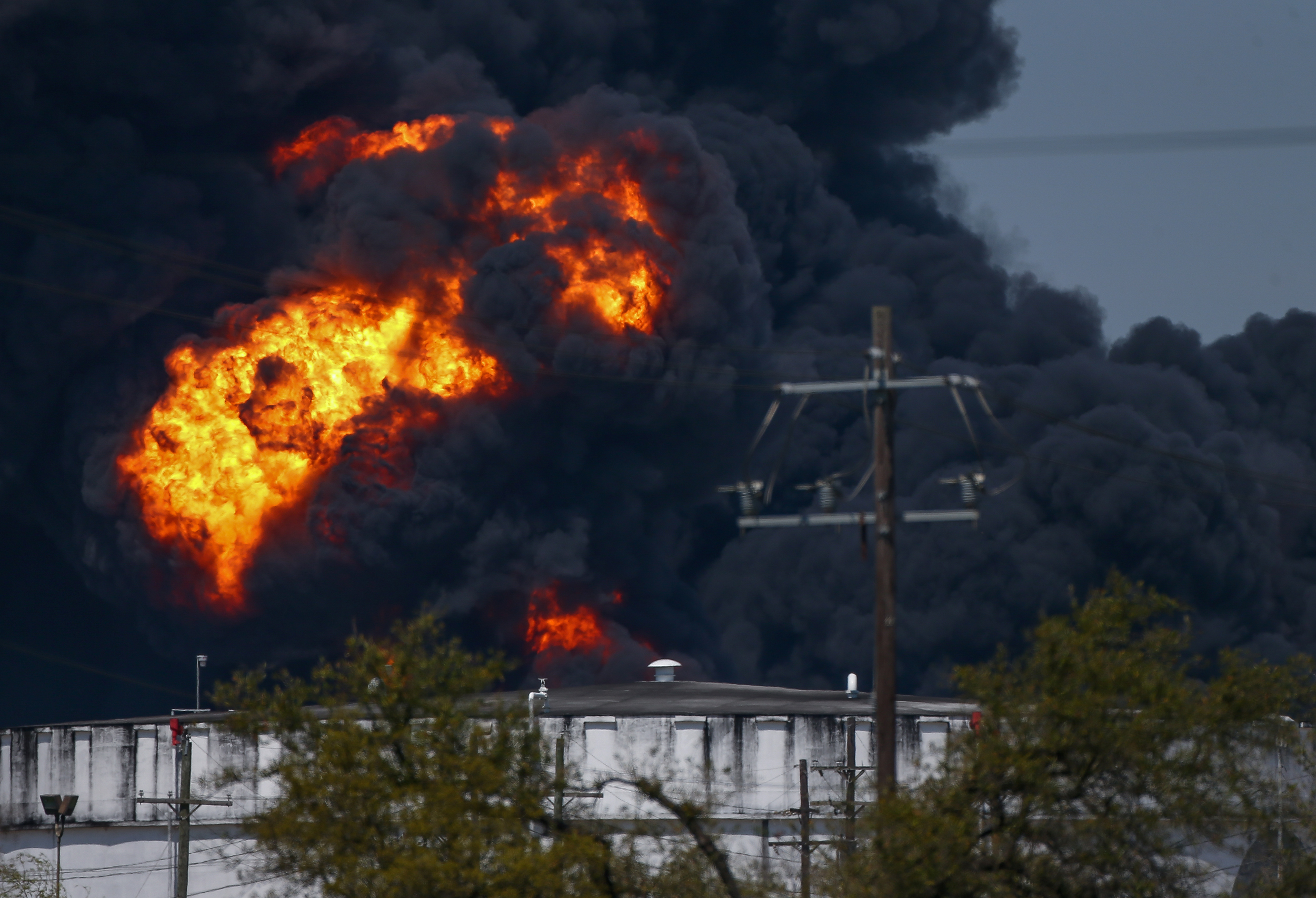


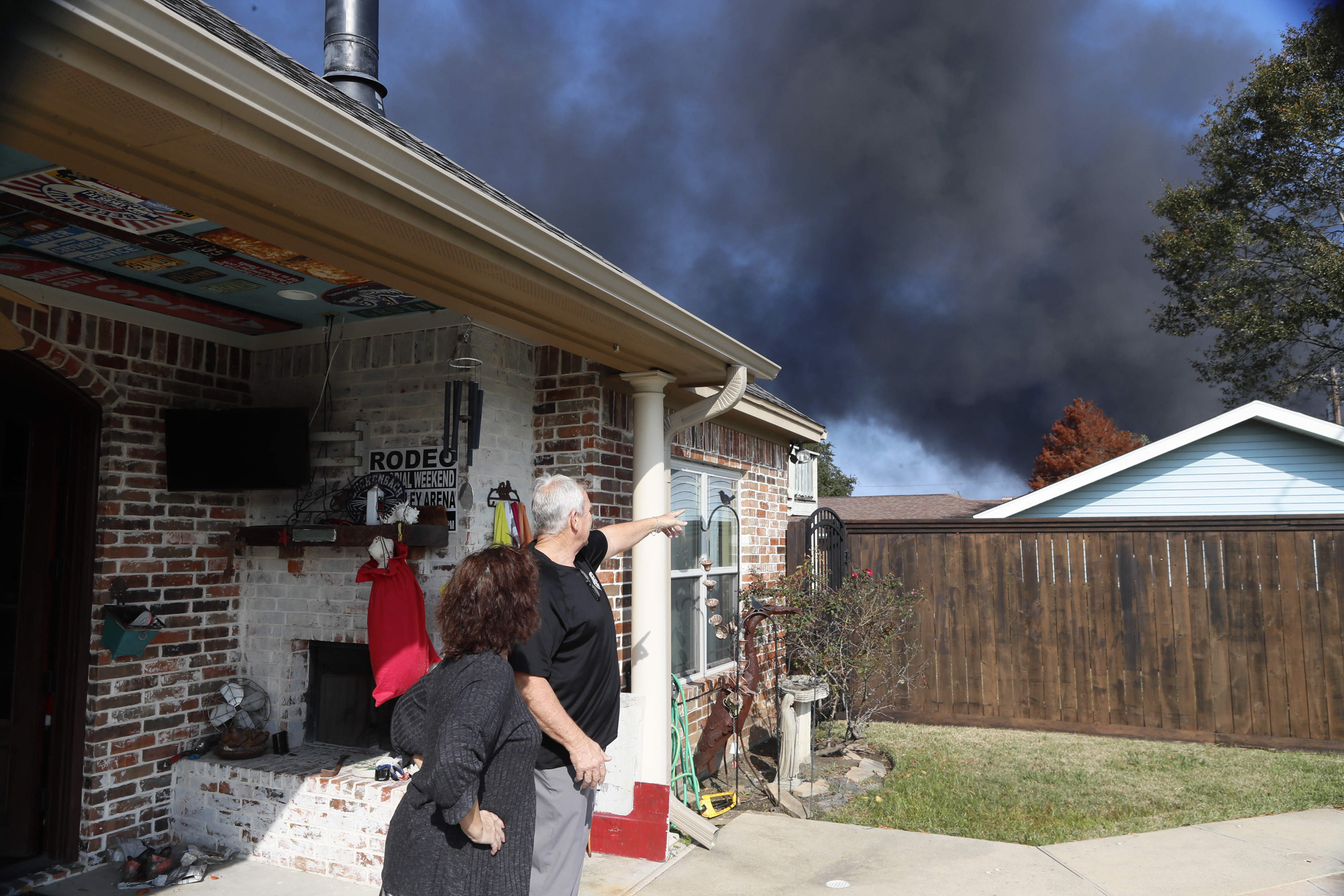
Raschelle Grandison had just walked out her front door to grab something from her car on a chilly March morning in 2019 when she stopped dead in her tracks.
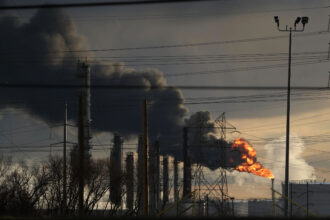
Grandison stared in disbelief at what looked like a nuclear mushroom cloud approaching the Houston home she shared with her mother, who ran outside to see what was wrong. They were still watching the giant black cloud hurtling toward their neighborhood from the Houston Ship Channel when the shelter-in-place alerts started blaring.
“It was just terrifying because when you shelter in place, you’ve got a cloud over you, you can’t leave, you can’t go anywhere and nobody can come in,” Grandison said. “It’s just you and God at that point.”
A massive fire had started at a bulk-liquid storage facility run by the Intercontinental Terminals Co. about 5 miles away after a faulty pump released naphtha, a highly flammable hydrocarbon used to make gasoline and plastic, from an 80,000-barrel tank.
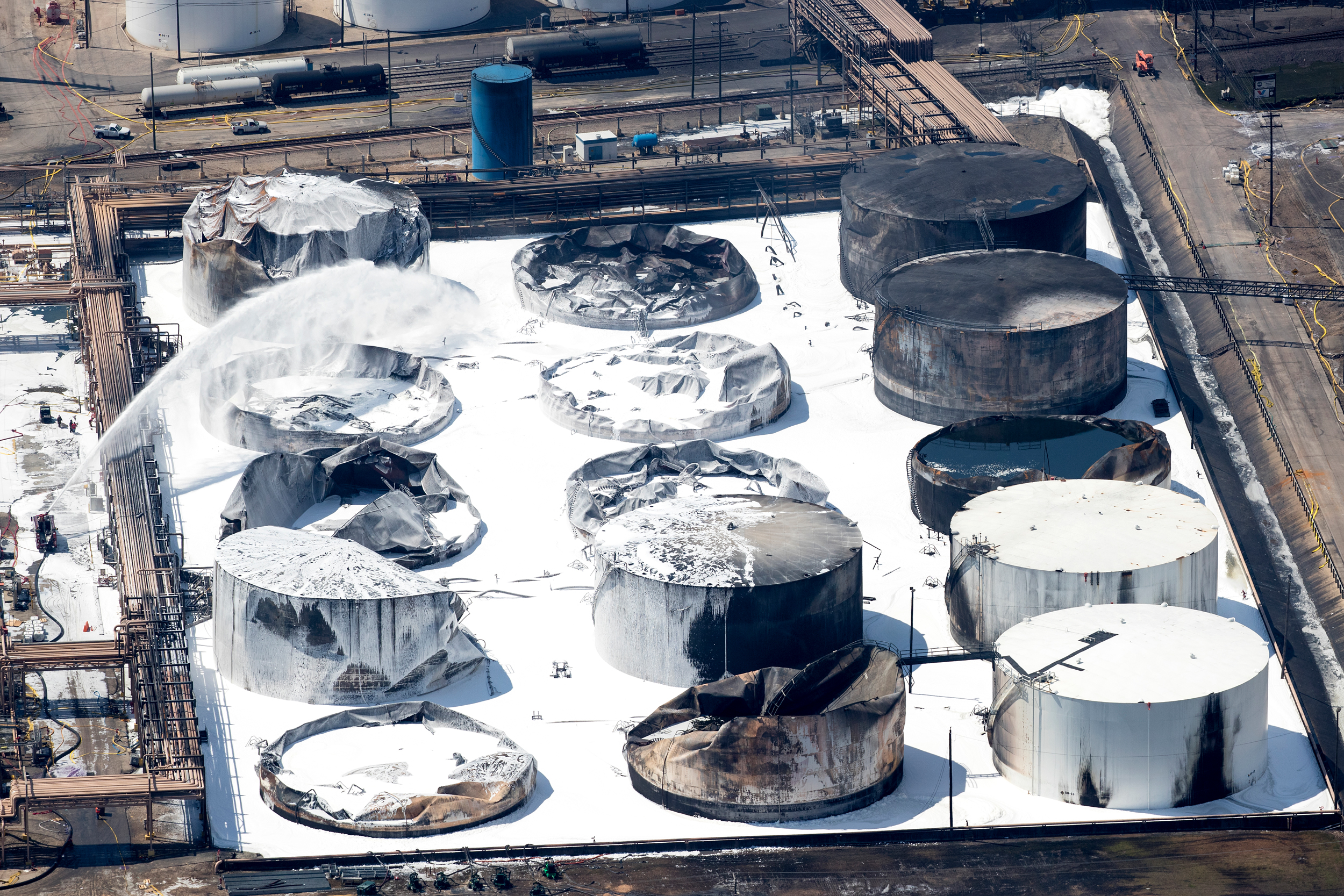
The flames spread to 14 surrounding tanks, and the apocalyptic cloud menaced the Houston skyline for three days before emergency crews put the fire out. By then, a containment wall had failed and released hundreds of thousands of barrels of toxic compounds into nearby waterways, harming birds and their habitat.
Close to 180 million Americans live near one of the country’s 12,000 facilities capable of producing a “worst-case scenario” chemical disaster. A third of these facilities operate in areas where natural hazards like wildfires, hurricanes and sea level rise could disrupt power supplies or damage infrastructure to trigger a catastrophic accident. These risks grow as the planet warms, the Government Accountability Office reported in 2022, when it advised the Environmental Protection Agency to require plants to plan for climate-supercharged natural hazards.
But President Donald Trump, whose 2024 campaign received more than $25 million in donations from the oil and gas industry, is trying to keep fenceline communities in the dark about these risks.
His administration is doubling down on efforts started during his first term to weaken rules designed to prevent chemical accidents, which are regulated by the EPA’s Risk Management Program (RMP) under the Clean Air Act. The right of neighborhood residents to know what dangerous chemicals nearby facilities handle is one of several enhanced chemical-accident prevention requirements finalized and strengthened during the Obama and Biden administrations that are now under attack.
A disproportionate number of the millions in greatest danger from a chemical accident are Black, Latino or low income. Some 12,000 schools sit within a mile of one of these facilities.
Six school districts cancelled classes and activities after the Houston accident, citing “concern for the safety of our students and employees.”
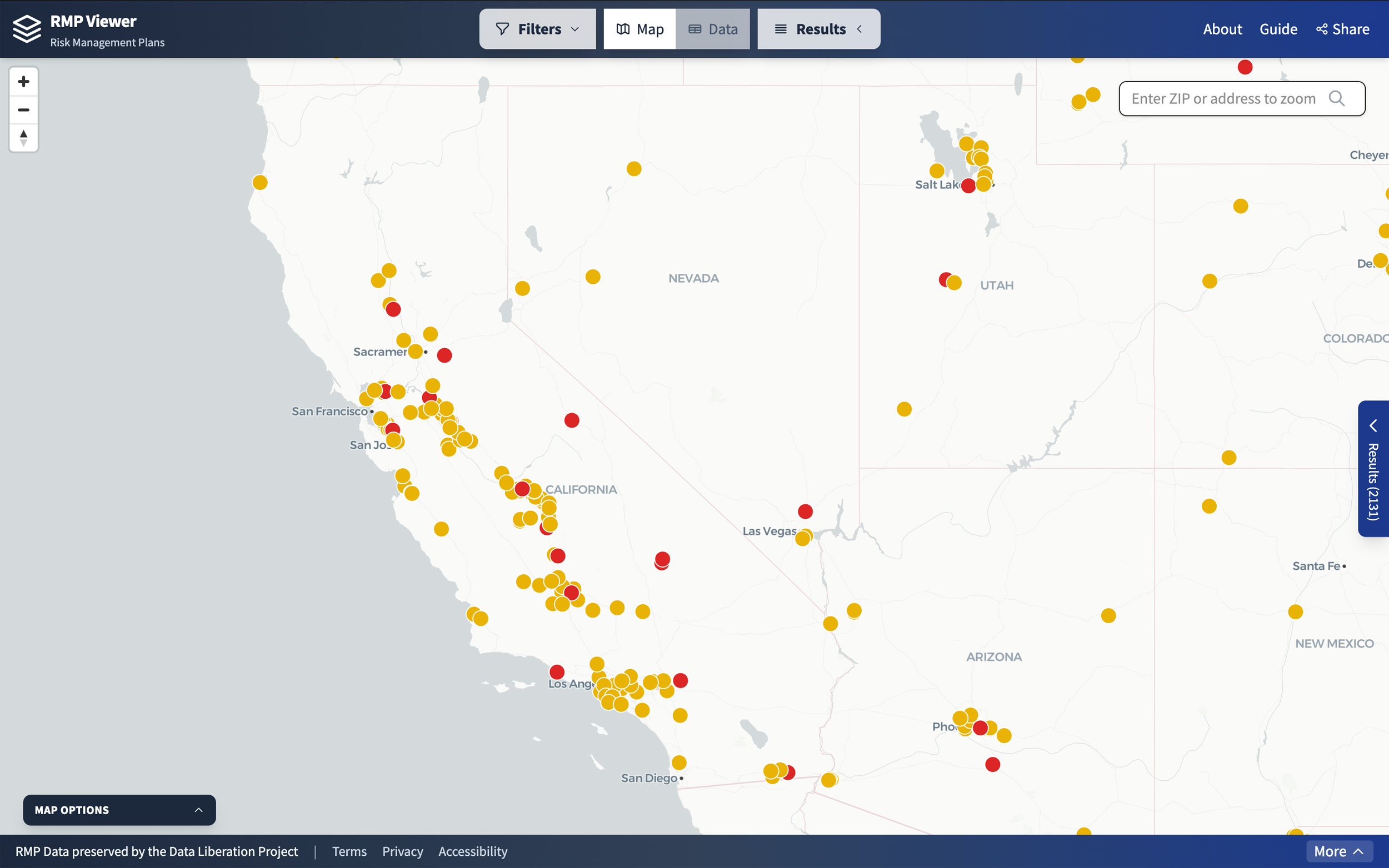
To make it easier for vulnerable communities to access information about nearby chemical risks and prepare for potential disasters, Biden’s EPA released a public data tool alongside the stronger protections.
Industry groups quickly made it clear they didn’t want that information available.
“To Correct” Stronger Safeguards
The day after Lee Zeldin was sworn in as EPA administrator in January 2025, more than a dozen top RMP-regulated trade groups urged him to “immediately” remove the public data tool from its website. They also requested a meeting with Zeldin “to initiate rulemaking to correct” multiple provisions of the “Biden EPA rule.”
Several representatives of the regulated industries visited EPA headquarters in early February 2025, and the following month, Zeldin announced that the agency was reconsidering the 2024 RMP rule. Biden’s rule, the announcement claimed, makes America’s oil and natural gas refineries and chemical facilities more vulnerable to a terrorist attack and less competitive.
By mid-April last year, the EPA had erased the public tool from its website.
In February, the EPA proposed revisions to the RMP regulations that would rescind or modify requirements targeted by the industry groups, including analyses of safer alternatives, third-party audits of facilities that have accidents and worker participation in plans to prevent chemical releases.
The Chemical Safety Board, an independent agency that investigates what causes accidents and recommends safety precautions, has flagged many of these contested provisions as critical to preventing disasters. The CSB cited the lack of a formal safety management plan as among the factors contributing to the Houston conflagration.
The CSB has only about 40 experts qualified to investigate chemical incidents with a modest $14 million budget. Yet Trump’s last two budget requests proposed eliminating the board’s funding and dismissed its investigations as “unprompted studies of the chemical industry.” Congress salvaged the board’s budget last year.
If the Trump administration’s goal was really prevention, officials would propose a series of other safeguards, said Rick Engler, a chemical safety expert who served on the CSB board under the Obama administration. “Their objective is deregulation and increasing corporate profits.”
Asked why the EPA is letting industries that handle hazardous materials rewrite rules that regulate them, a spokesperson said only that the agency published its “common sense” proposal in February and that Zeldin would be reconsidering the 2024 rule due to concerns relating to national security and “prescriptive requirements.”
If officials wanted to reduce risks to national security, they’d ask basic questions like, “Does this hazard need to exist?” and replace those that terrorists could target with safer alternatives, said Paul Orum, an expert on chemical safety policy and public access to information.
Restricting public access to basic hazard information will ultimately impede emergency planning and prevention efforts while allowing hazards that could be mitigated to persist in a “a know-nothing, do-nothing environment,” Orum said.
Ignoring Disaster-Prevention Lessons
Grandison can walk to two RMP-regulated plants from the house her family has lived in since the 1800s.
“We have blood in the soil here,” she said. “People literally walked off a plantation and bought this land.”

Her mother, Theresa Williams, farmed their land long before any of the facilities that now threaten their health and safety were built. She worked for decades to improve conditions for her community as president of a local civic club, and it pains her daughter to see the EPA remove a tool that finally informed her neighbors about risks posed by nearby chemical plants.
“When you live so close to the plants and what’s going on is so important to you,” Grandison said, “to the air you breathe, to the soil you walk on every day, isn’t it terrifying?”
ITC did not respond to a request for comment on steps they’re taking to ensure the community’s safety. But a spokesperson for the company told The Texas Tribune in 2023 that the company was working with regulatory agencies in connection with their review of the incident.
Twenty years before the catastrophic fire in Houston, independent auditors drew several accident-prevention lessons from a tragedy in California.
On Feb. 10, 1999, a worker in a Martinez refinery’s crude unit discovered a pinhole leak in a pipe containing naphtha, the same culprit in the Houston disaster. For weeks, workers on a tower more than 100 feet above the ground tried to drain and replace the pipe. But on the morning of Feb. 23, naphtha gushed from it onto hot processing equipment and ignited, killing four workers and seriously injuring another.
Safety at the refinery was compromised by an “adversarial relationship” between managers and workers, mixed messages about prioritizing safety over production and unreliable radios that “significantly interfered” with communications when problems arose, a third-party audit commissioned by county-run Contra Costa Health and obtained through a public records request found.
The refinery has gone through several ownership changes since the accident and now produces renewable fuels.
The Martinez refinery tragedy haunts Democratic Rep. Mark DeSaulnier, who was a county supervisor at the time. DeSaulnier has attended many funerals of workers who died on the job in his district.
Lack of employee input or pressure to avoid stopping dangerous work are common contributors to major chemical incidents. Audits and CSB investigations also show that insufficient worker training, lack of hazard communication and failure to adopt safer processes are recurring factors in refinery explosions and toxic releases, DeSaulnier told Inside Climate News.
Provisions in the Biden rule that addressed these gaps and ensured public access to safety information and workers’ ability to raise concerns without fear of retaliation are on the chopping block, DeSaulnier said.
“The proposed rollbacks of the RMP would increase risks to workers and nearby communities by weakening and in some cases removing safeguards that were specifically designed to prevent catastrophic chemical incidents,” he said.
The 2024 rule also recognized the EPA RMP office’s woefully insufficient enforcement resources, citing a government watchdog report that found barely three dozen credentialed experts had inspected just 2 percent of regulated facilities in 2019.
“When disaster strikes and people are wondering why EPA wasn’t ready, this reckless agenda will be the reason.”
— Peter Murchie, Environmental Protection Network
The loss of expertise at the agency hit a 40-year low this year, an Inside Climate News investigation found.
The EPA has lost thousands of staff that deploy first responders, inspectors who help prevent accidents, scientists who identify the biggest threats, all to serve a political agenda, said Peter Murchie, senior director of policy at the nonprofit Environmental Protection Network, which works with hundreds of former EPA staff to keep the agency accountable.
“When disaster strikes and people are wondering why EPA wasn’t ready,” Murchie said, “this reckless agenda will be the reason.”
In reconsidering the Biden-era rule, the EPA said it intends to remove duplicative requirements among agencies, referring to the Occupational Safety and Health Administration’s chemical safety management standard, which hasn’t been updated for decades. The agency also said it was eliminating “unnecessary burdens” on facilities where there is not specific data available to show that current RMP requirements, such as third-party audits, would reduce or have reduced the number of accidental releases.
Tracking Chemical Accidents
An accidental chemical release happens every two days, on average, according to an analysis of EPA data by the environmental law nonprofit Earthjustice. More than 3,900 industrial chemical releases were reported between 2004 and 2025, the analysis found, including at least 2,814 chemical incidents that resulted in injuries, loss of life, property or environmental damage, or shelter-in-place or evacuation orders.
Earthjustice is part of the Coalition to Prevent Chemical Disasters, a network of environmental justice groups, unions, public health organizations, environmental groups and national security experts, which has urged the EPA to strengthen chemical accident prevention rules for decades. The EPA will accept written comments on its proposed rule to roll back Obama- and Biden-era requirements until May 11 online at the Federal Register.
The EPA still has tools like third-party audits available in certain circumstances, said the EPA spokesperson, who did not acknowledge that the agency has proposed to rescind or sunset audit requirements after several years. The spokesperson also did not address a question about how it could require evidence for the effectiveness of provisions that haven’t been implemented yet.
Instead, the spokesperson wrote in an email, “Over the last decade, the application of RMP and similar proactive requirements and actions has driven a nearly 45 percent reduction in reportable incidents.”
Claims about reduced accident rates don’t hold up under rigorous analysis, Darius Sivin, legislative representative for the union UAW, argued in a hearing about the proposed rule earlier this year. Facilities are required to report accidents every five years but they start at different years, and many submit late. So estimates using the most recent five years always yield an undercount, he explained at the hearing.
Then there are all the accidents that never made it into EPA’s incident database. Some don’t show up because of regulatory gaps, like the accident that threatened Grandison’s neighborhood. Others aren’t counted because the accidental release was so catastrophic the company shut down and no longer had to report.
Right to Know
Grandison is a self-proclaimed news junkie. But she heard nothing about the Trump EPA’s plans to rescind stronger rules that require facilities to have backup power for chemical-release monitors until Nalleli Hidalgo, an organizer with Texas Environmental Justice Advocacy Services, told her.
“Without Nalleli, the community wouldn’t even know,” Grandison said.
Being in a hurricane-prone region, “we lose power here all the time,” Grandison said. If a chemical plant loses power, it goes completely black at night and nobody can see anything, she said. “That’s as terrifying as that cloud was over our head.”
Texas has more registered RMP facilities and more chemical disasters each year than any other state, Hidalgo said at a briefing in March, just a few days after a fiery refinery explosion in Port Arthur, Texas, rattled homes miles away.
It was a 2013 massive explosion at a fertilizer storage facility in West, Texas, that inspired the effort to strengthen rules to prevent chemical accidents.
Ammonium nitrate at West Fertilizer Co. exploded with the equivalent force of 12.5 tons of TNT, leaving 15 people dead, including a dozen first responders, and more than 250 injured. The blast created a 10-foot-crater that completely destroyed the facility and damaged more than 150 buildings, including nearby schools, an apartment complex and a nursing home.
“The WFC incident serves as yet another unnecessary and deadly reminder that little has been done to address the risks of locating communities near facilities handling hazardous chemicals,” the CSB warned.
A few months after President Barack Obama spoke at a memorial service for the victims, he issued an executive order creating a working group tasked with identifying ways to prevent and respond to chemical accidents. By the end of his second term, the EPA had finalized a rule with requirements for accident prevention, information disclosure, emergency responses, third-party audits and safer alternatives analyses.
Provisions of the more protective RMP rule have been under attack by industry groups and their Republican allies ever since.
Political Football
Soon after Trump’s first inauguration, industry groups petitioned the EPA to rescind the Obama administration’s rules. By June 2017, the agency had put the new RMP rule on hold to consider those arguments.
On Aug. 31, 2017, highly volatile organic peroxides spontaneously combusted at the Arkema chemical plant in Crosby, Texas, after unprecedented rainfall and flooding from Hurricane Harvey disabled cooling systems that stabilized the raw materials for polymers like plastics. The power failure caused roughly 350,000 pounds of the volatile chemicals to burn and release toxic fumes, forcing more than 200 people living within a mile and a half of the plant out of their homes for a week.
CSB investigators found “a significant lack of guidance” in the Harris County plant’s planning for flooding and other severe weather events exacerbated by climate change.
This story is funded by readers like you.
Our nonprofit newsroom provides award-winning climate coverage free of charge and advertising. We rely on donations from readers like you to keep going. Please donate now to support our work.
Donate NowArkema did not respond to a request to explain what steps it’s taking to protect the community from similar disasters, which a company representative called an “act of God” at the time.
In 2024, after Arkema agreed to pay $1 million to Harris County to settle a lawsuit over the incident, the company told ABC13 that the storm “overwhelmed virtually every organization across Harris County,” adding, “We are pleased to put this action behind us.”
The Biden rule cited the Arkema disaster when it required facilities to evaluate their vulnerability to extreme weather events—a risk a 2021 report called “double disasters.”
But the Arkema accident wasn’t counted in the EPA’s incident database because “reactive” chemicals like peroxides aren’t regulated under the RMP.
At 4 a.m. on a Friday in June 2019, as the Trump administration worked to overturn the Obama-era rules, a corroded pipe at the Philadelphia Energy Solutions refinery ruptured and released vapors that quickly ignited. A massive fire and series of explosions emitted more than 5,000 pounds of highly toxic hydrofluoric acid, used to make gasoline, into the surrounding neighborhoods of mostly Black and low-income residents and catapulted a 19-ton chunk of equipment across the Schuylkill River.
“I was finishing the last couple of hours of a 12-hour night shift, looking forward to having the coming weekend off,” United Steelworkers legislative representative Jim Savage testified in 2024 before a congressional hearing led by Republicans, who called the strengthened RMP rule “the latest example of President Biden bending to radical environmentalists at the expense of America’s economic prosperity.”
Savage doubted his co-workers would survive the massive explosions, “because you can’t outrun a vapor cloud,” he testified, imploring the committee members to support the stronger regulations as “a lifeline for workers, families and their communities.”
The incident caused $750 million in property damages and ranked as one of the world’s costliest refinery disasters. Preventing future disasters, CSB investigators advised, rested with developing safer technologies to produce gasoline.
But the incident is not captured in the EPA RMP database because the company closed the facility days after the catastrophic accident.
The first Trump administration did not heed Savage’s pleas or the CSB’s recommendations. Instead, on Nov. 20, 2019 the agency deleted most of the Obama-era amendments, including the safer alternatives analysis, “to better address potential security risks, reduce unnecessary and ineffective regulatory burdens on facilities and emergency responders … address the concerns of stakeholders, and save Americans roughly $88 million a year.”
A week later, a series of explosions at the TPC Group’s chemical plant in Port Neches, Texas, forced more than 50,000 people living within 4 miles of the plant to evacuate the night before Thanksgiving.
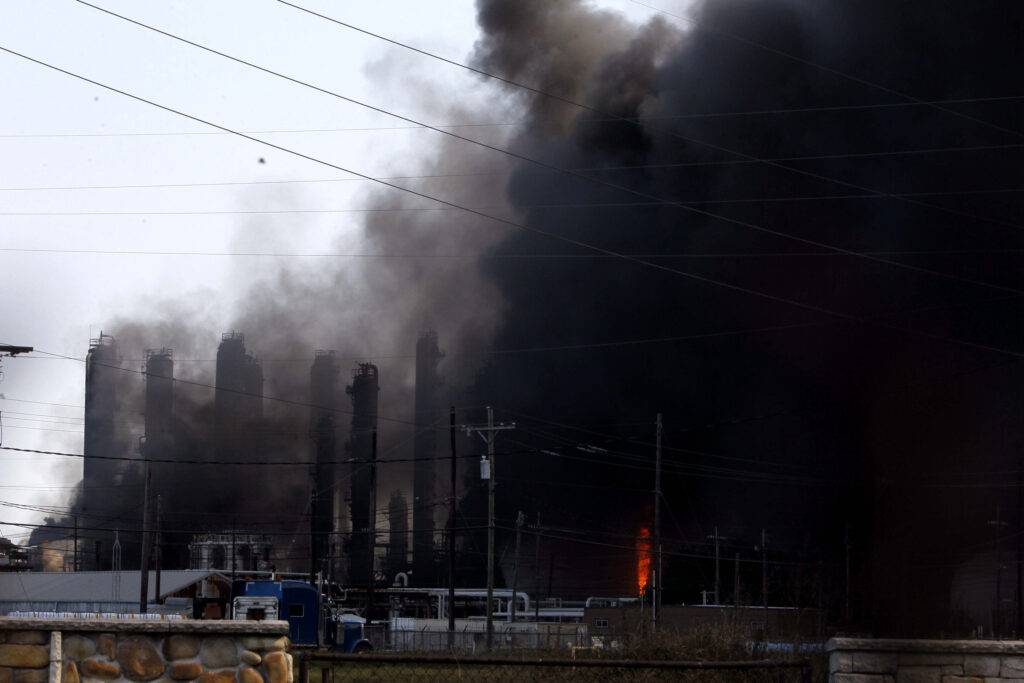
Employees had warned of a “potential runaway” reaction that could rupture pipes and release a volatile chemical used to make rubber, but the unit continued operating, the CSB reported.
TPC Group did not respond to a request for comment about how it has enhanced safeguards since the accident. A TPC spokesperson told the Houston Chronicle in 2024 that the company “sincerely regrets the damage and disruption caused by the November 2019 incident” and that it remains focused on “ensuring the safe and reliable performance and operations of our facilities.”
Had the stronger Biden administration RMP rules been in effect prior to the Port Neches accident, the EPA noted in announcing those provisions, “the facility would have been required to perform a safer technologies and alternatives analysis and implement at least one safeguard measure, which may have mitigated or prevented the accident.”
And had those protections been in place, a black cloud may not have rained toxic ash down on Grandison’s neighborhood eight months before the Port Neches accident.
Nobody in her community has been the same since that day, Grandison said. “My mom never had respiratory issues. She was 92 when that cloud came, and then she had respiratory problems until the day she died. Whatever was in the air, we never got it back out of us,” she said.
Without the opportunity to speak out about the generations of harms these plants are causing, Grandison said, “they will erase us.”
About This Story
Perhaps you noticed: This story, like all the news we publish, is free to read. That’s because Inside Climate News is a 501c3 nonprofit organization. We do not charge a subscription fee, lock our news behind a paywall, or clutter our website with ads. We make our news on climate and the environment freely available to you and anyone who wants it.
That’s not all. We also share our news for free with scores of other media organizations around the country. Many of them can’t afford to do environmental journalism of their own. We’ve built bureaus from coast to coast to report local stories, collaborate with local newsrooms and co-publish articles so that this vital work is shared as widely as possible.
Two of us launched ICN in 2007. Six years later we earned a Pulitzer Prize for National Reporting, and now we run the oldest and largest dedicated climate newsroom in the nation. We tell the story in all its complexity. We hold polluters accountable. We expose environmental injustice. We debunk misinformation. We scrutinize solutions and inspire action.
Donations from readers like you fund every aspect of what we do. If you don’t already, will you support our ongoing work, our reporting on the biggest crisis facing our planet, and help us reach even more readers in more places?
Please take a moment to make a tax-deductible donation. Every one of them makes a difference.
Thank you,

Liza Gross
Reporter, California
Liza Gross is a reporter for Inside Climate News based in Northern California. She is the author of The Science Writers’ Investigative Reporting Handbook and a contributor to The Science Writers’ Handbook, both funded by National Association of Science Writers’ Peggy Girshman Idea Grants. She has long covered science, conservation, agriculture, public and environmental health and justice with a focus on the misuse of science for private gain. Prior to joining ICN, she worked as a part-time magazine editor for the open-access journal PLOS Biology, a reporter for the Food & Environment Reporting Network and produced freelance stories for numerous national outlets, including The New York Times, The Washington Post, Discover and Mother Jones. Her work has won awards from the Association of Health Care Journalists, American Society of Journalists and Authors, Society of Professional Journalists NorCal and Association of Food Journalists.